

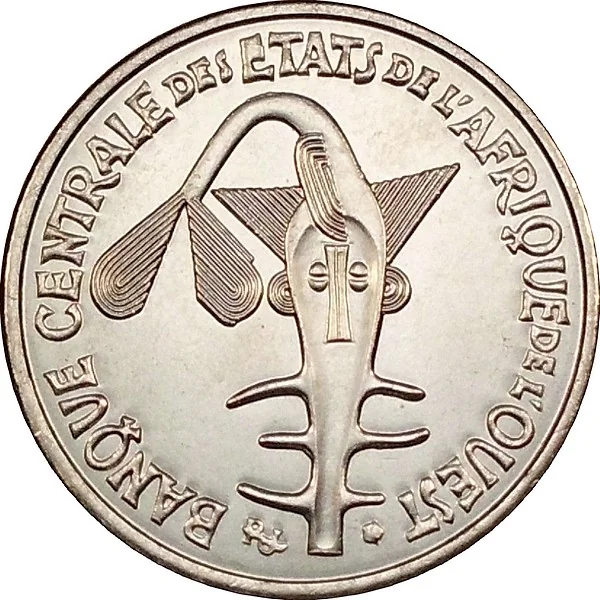
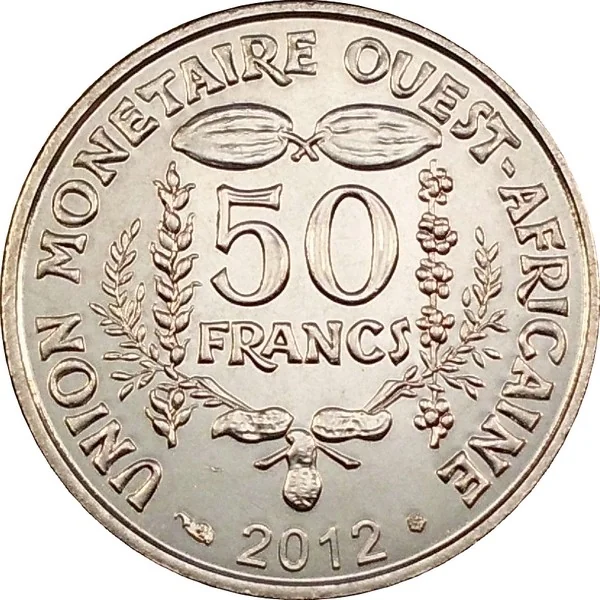
50 francs cfa – Western African States
Add to wishlist
Context
Years: 2012–2024
Issuer: Western African States
Issuing organization: Central Bank of Western African States
Currency:
(since 1958)
Material
References
KM: #
Numista: #53891
Value
Exchange value: 50 XOF
Obverse
Description:
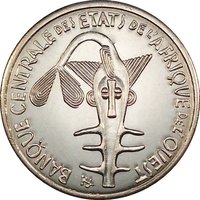
Central Bank of West African States emblem
Inscription:
BANQUE CENTRALE DES ETATS DE L'AFRIQUE DE L'OUEST
Translation:
CENTRAL BANK OF THE WEST AFRICAN STATES
Script: Latin
Language: French
Engraver: Raymond Joly
Reverse
Edge
Reeded
Mints
| Name | Mark |
|---|---|
| Monnaie de Paris | — |
Mintings
| Year | Mint Mark | Mintage | Quality | Collection |
|---|---|---|---|---|
| 2012 | — | — | ||
| 2013 | — | — | ||
| 2014 | — | — | ||
| 2015 | — | — | ||
| 2016 | — | — | ||
| 2017 | — | — | ||
| 2018 | — | — | ||
| 2019 | — | — | ||
| 2020 | — | — | ||
| 2021 | — | — | ||
| 2022 | — | — | ||
| 2023 | — | — | ||
| 2024 | — | — |
Historical background
In 2012, the currency situation in West Africa was defined by the stability and regional integration of the CFA franc zones, contrasted with the volatility and challenges faced by the region's other currencies. The core of monetary stability was the two CFA franc currencies—the West African CFA franc (XOF) and the Central African CFA franc (XAF)—which were used by 14 countries across two monetary unions. These currencies were pegged to the euro (and formerly the French franc) with a fixed exchange rate and guaranteed convertibility by the French Treasury, providing notable macroeconomic stability and lower inflation compared to their neighbours. This system, however, was frequently critiqued for its neo-colonial overtones and constraints on independent monetary policy.
Outside the CFA zones, major economies like Nigeria, Ghana, and Sierra Leone operated independent floating or managed currencies. These nations faced significant pressures in 2012, including inflationary trends, fiscal deficits, and the impacts of fluctuating global commodity prices. The Nigerian naira, in particular, came under sustained pressure, leading the Central Bank of Nigeria to intervene heavily to defend its peg within a target band, depleting foreign reserves. Ghana's cedi also experienced a sharp depreciation, losing over 17% of its value against the dollar that year, driven by high import demand, election-related spending, and declining confidence.
The broader regional context was shaped by the ongoing vision for a single currency for the Economic Community of West African States (ECOWAS), a long-standing but elusive goal. While the West African Monetary Zone (WAMZ), comprising Ghana, Nigeria, and other non-CFA states, had aimed to launch the "Eco" by 2015, 2012 highlighted the significant convergence criteria challenges these countries faced, particularly regarding inflation and fiscal deficits. Consequently, the year underscored a two-speed monetary reality: entrenched stability in the CFA franc unions and persistent volatility elsewhere, with a unified regional currency remaining a distant prospect.
Outside the CFA zones, major economies like Nigeria, Ghana, and Sierra Leone operated independent floating or managed currencies. These nations faced significant pressures in 2012, including inflationary trends, fiscal deficits, and the impacts of fluctuating global commodity prices. The Nigerian naira, in particular, came under sustained pressure, leading the Central Bank of Nigeria to intervene heavily to defend its peg within a target band, depleting foreign reserves. Ghana's cedi also experienced a sharp depreciation, losing over 17% of its value against the dollar that year, driven by high import demand, election-related spending, and declining confidence.
The broader regional context was shaped by the ongoing vision for a single currency for the Economic Community of West African States (ECOWAS), a long-standing but elusive goal. While the West African Monetary Zone (WAMZ), comprising Ghana, Nigeria, and other non-CFA states, had aimed to launch the "Eco" by 2015, 2012 highlighted the significant convergence criteria challenges these countries faced, particularly regarding inflation and fiscal deficits. Consequently, the year underscored a two-speed monetary reality: entrenched stability in the CFA franc unions and persistent volatility elsewhere, with a unified regional currency remaining a distant prospect.
🌱 Common