


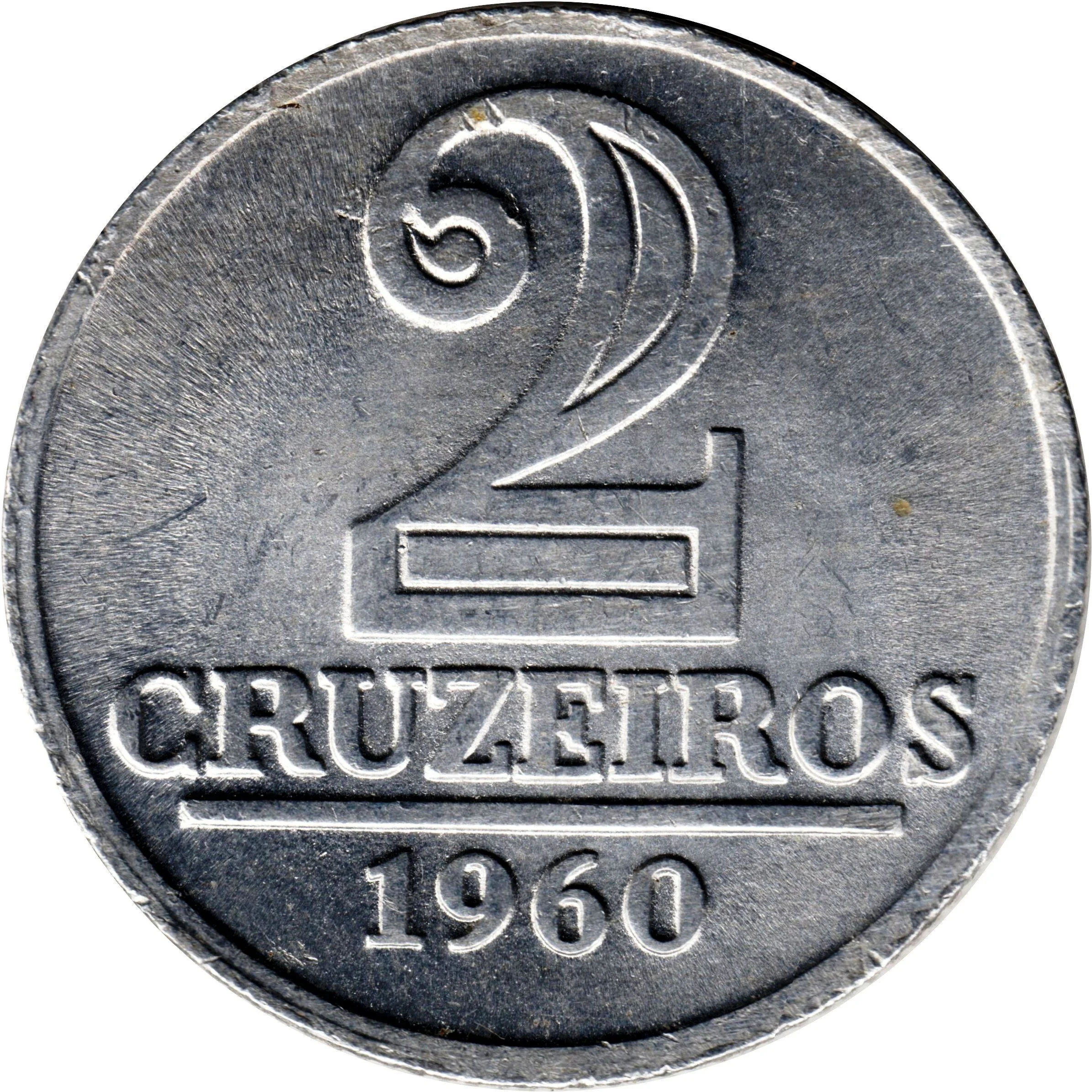
2 cruzeiros – Brazil
Add to wishlist
Brazil

Obverse
Description:
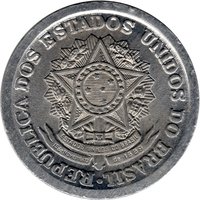
Brazil's emblem: a central star encircled by 20 smaller stars, featuring the Southern Cross, flanked by tobacco and coffee plants.
Inscription:
REPUBLICA DOS ESTADOS UNIDOS DO BRASIL
ESTADOS UNIDOS DO BRASIL
15 de Novembro de 1889
ESTADOS UNIDOS DO BRASIL
15 de Novembro de 1889
Translation:
REPUBLIC OF THE UNITED STATES OF BRAZIL
UNITED STATES OF BRAZIL
15 November 1889
UNITED STATES OF BRAZIL
15 November 1889
Script: Latin
Language: Portuguese
Reverse
Edge
Reeded
Mints
| Name | Mark |
|---|---|
| Casa da Moeda do Brasil | — |
Mintings
| Year | Mint Mark | Mintage | Quality | Collection |
|---|---|---|---|---|
| 1957 | — | 194,000 | ||
| 1958 | — | 13,687,000 | ||
| 1959 | — | 20,894,000 | ||
| 1960 | — | 19,624,000 | ||
| 1961 | — | 24,924,000 |
Historical background
In 1957, Brazil was in the midst of a prolonged period of economic instability characterized by high inflation and chronic balance of payments deficits, a condition often described as "stagflation." The core of the currency situation was the overvaluation of the cruzeiro, the national currency at the time. The government, operating under the Target Plan (Plano de Metas) of President Juscelino Kubitschek, maintained an official exchange rate that was artificially strong to facilitate the import of capital goods for ambitious industrialization projects, such as the construction of Brasília and the automotive industry. This policy, however, created a severe drain on foreign reserves.
The overvalued exchange rate discouraged exports (making Brazilian goods expensive abroad) while making imports artificially cheap, leading to a growing trade deficit. To bridge the gap between the strong official rate and market reality, a complex system of multiple exchange rates and currency auctions was employed. This created a lucrative parallel market for dollars and widespread currency speculation. Furthermore, the government's expansive fiscal and monetary policies to fund its development plans poured fuel on inflationary fires, which averaged around 20% annually in the late 1950s, further eroding the cruzeiro's domestic purchasing power.
Consequently, 1957 represented a tipping point where the contradictions of the development model became acute. The Central Bank of Brazil, established just two years prior in 1955, struggled to manage the crisis. International reserves dwindled, forcing the government to seek external financing and begin negotiations with the International Monetary Fund (IMF) by the end of the decade. The currency instability of 1957 thus set the stage for the more severe economic crises and successive currency reforms (including the introduction of the cruzeiro novo in 1967) that would mark the following decades in Brazil.
The overvalued exchange rate discouraged exports (making Brazilian goods expensive abroad) while making imports artificially cheap, leading to a growing trade deficit. To bridge the gap between the strong official rate and market reality, a complex system of multiple exchange rates and currency auctions was employed. This created a lucrative parallel market for dollars and widespread currency speculation. Furthermore, the government's expansive fiscal and monetary policies to fund its development plans poured fuel on inflationary fires, which averaged around 20% annually in the late 1950s, further eroding the cruzeiro's domestic purchasing power.
Consequently, 1957 represented a tipping point where the contradictions of the development model became acute. The Central Bank of Brazil, established just two years prior in 1955, struggled to manage the crisis. International reserves dwindled, forcing the government to seek external financing and begin negotiations with the International Monetary Fund (IMF) by the end of the decade. The currency instability of 1957 thus set the stage for the more severe economic crises and successive currency reforms (including the introduction of the cruzeiro novo in 1967) that would mark the following decades in Brazil.
Series: 1957 Brazil circulation coins

🌱 Very Common