

20 centavos – Brazil
Add to wishlist
Brazil
Context
Years: 1943–1948
Issuer: Brazil
Period:
(1889—1967)
Currency:
(1942—1967)
Demonetization: 1 December 1964
Total mintage: 195,315,500
Material
Diameter: 19 mm
Weight: 4 g
Thickness: 1.83 mm
Shape: Round
Composition: Aluminium bronze
Magnetic: No
Technique: Milled
Alignment: Coin alignment
flip
References
KM: #
Numista: #5378
Value
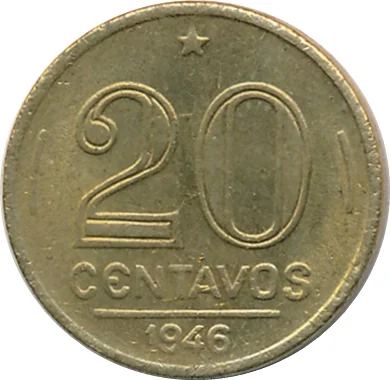
Exchange value: 0.20 BRZ
Obverse
Description:
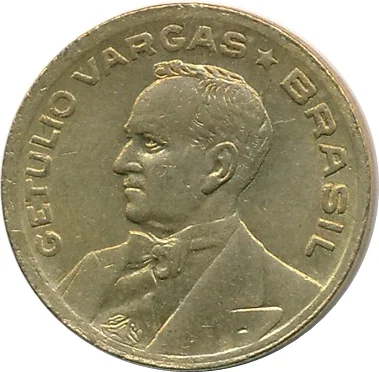
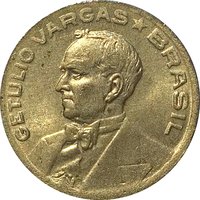
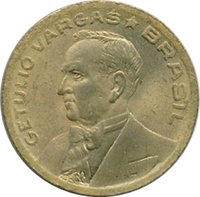
Portrait of Getúlio Vargas (1882-1954), facing left.
Inscription:
GETULIO VARGAS * BRASIL
Translation:
Getulio Vargas Brazil
Script: Latin
Languages: Portuguese, Latin
Reverse
Edge
Plain
Categories
| Person> Politician |
Mintings
| Year | Mint Mark | Mintage | Quality | Collection |
|---|---|---|---|---|
| 1943 | — | 13,391,500 | ||
| 1944 | — | 12,673,000 | ||
| 1945 | — | 61,632,000 | ||
| 1946 | — | 31,526,000 | ||
| 1947 | — | 36,422,000 | ||
| 1948 | — | 39,671,000 |
Historical background
In 1943, Brazil's currency situation was defined by its strategic alignment with the Allied powers during World War II and the economic policies of President Getúlio Vargas's Estado Novo regime. The country's primary currency was the Brazilian mil-réis, but its value and management were heavily influenced by external factors. A key development was the signing of the Washington Accords in 1942, which provided substantial U.S. financial and military aid in exchange for Brazilian raw materials (like rubber and iron ore) and the deployment of its Expeditionary Force. This influx of U.S. dollars helped stabilize Brazil's foreign exchange reserves and supported its industrial and infrastructure projects, albeit within a framework of centralized control.
Domestically, the currency system operated under strict government oversight. The Vargas administration utilized exchange controls, multiple exchange rates, and import licensing to manage the economy for the war effort and to protect nascent industries. Inflationary pressures were present but were partially contained by price controls and the rationing of essential goods. The Banco do Brasil, acting as the country's central monetary authority, played a crucial role in implementing these policies, directing credit to priority sectors and managing the relationship between the mil-réis and foreign currencies.
Overall, the 1943 currency environment was one of relative stability, but it was an administered stability dependent on wartime conditions and foreign aid. The mil-réis was not freely convertible, and its value was a tool of state policy rather than a market reflection. This period reinforced a pattern of state intervention in the financial system and set the stage for the post-war economic challenges Brazil would face, including persistent inflation and debates over industrialization and foreign dependence that would culminate in the creation of a new currency, the cruzeiro, in 1942, which was in the process of fully replacing the mil-réis during this time.
Domestically, the currency system operated under strict government oversight. The Vargas administration utilized exchange controls, multiple exchange rates, and import licensing to manage the economy for the war effort and to protect nascent industries. Inflationary pressures were present but were partially contained by price controls and the rationing of essential goods. The Banco do Brasil, acting as the country's central monetary authority, played a crucial role in implementing these policies, directing credit to priority sectors and managing the relationship between the mil-réis and foreign currencies.
Overall, the 1943 currency environment was one of relative stability, but it was an administered stability dependent on wartime conditions and foreign aid. The mil-réis was not freely convertible, and its value was a tool of state policy rather than a market reflection. This period reinforced a pattern of state intervention in the financial system and set the stage for the post-war economic challenges Brazil would face, including persistent inflation and debates over industrialization and foreign dependence that would culminate in the creation of a new currency, the cruzeiro, in 1942, which was in the process of fully replacing the mil-réis during this time.
Series: 1943 Brazil circulation coins
🌱 Very Common