

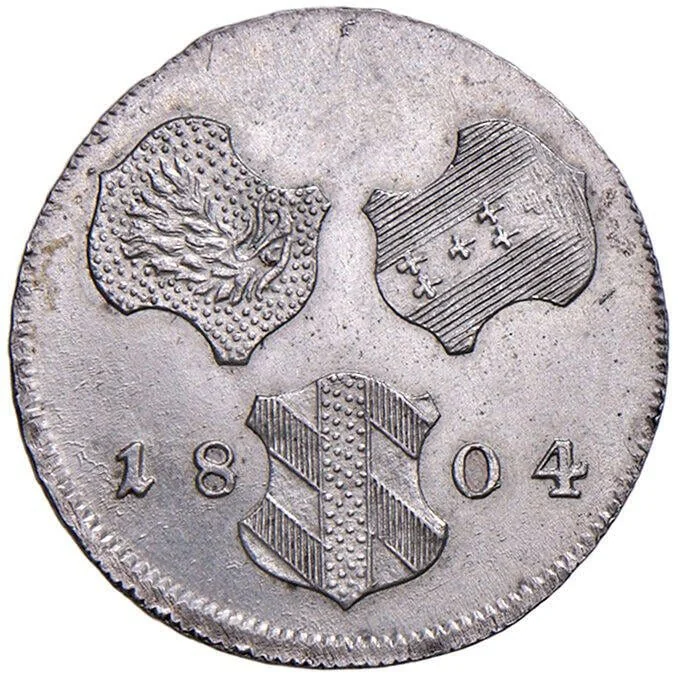
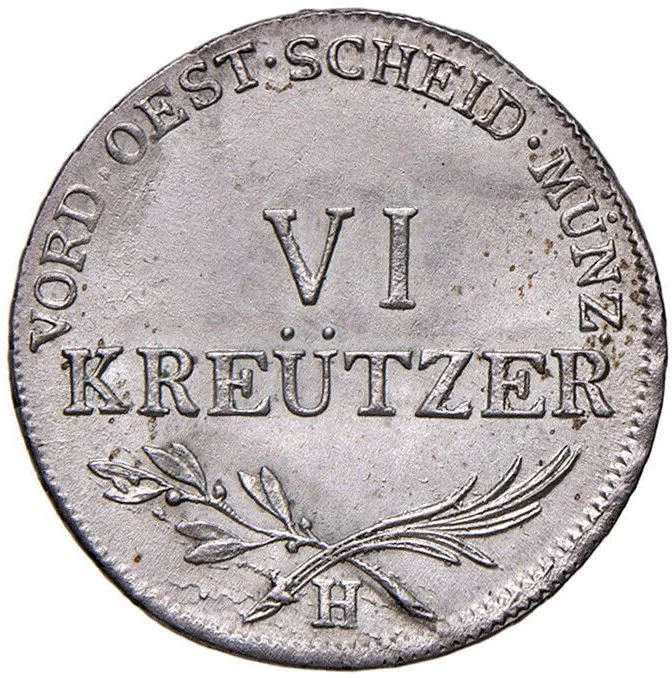
6 Kreuzers – Further Austria
Austria
Context
Years: 1802–1805
Country: Austria 
Issuer: Further Austria
Ruler: Francis II
Currency:
Demonetized: Yes
Material
References
KM: #Click to copy to clipboard29
Numista: #11030
Obverse
Reverse
Edge
Categories
| Symbols> Coat of Arms |
Mints
| Name | Mark |
|---|---|
| Münze Österreich | A |
| Baia Mare | G |
| Günzburg | H |
Historical background
In 1802, the currency situation in Further Austria (Vorderösterreich) was complex and fragmented, reflecting the territory's disparate geography and political dependencies. These Habsburg possessions, scattered across modern-day southwest Germany, Switzerland, and Alsace, did not operate under a single, unified monetary system. Instead, circulation was dominated by a multitude of coins from neighbouring German states, alongside the official Austrian Conventionsthaler and kreuzer. This created a challenging environment for trade and administration, as merchants and officials constantly dealt with fluctuating exchange rates between local, regional, and imperial currencies.
The root of this complexity lay in the monetary policies of the Holy Roman Empire. While the 1753 Imperial Coinage Act (Reichsmünzfuß) had aimed to standardize the thaler and gulden across the Empire, its authority had waned. By the turn of the 19th century, many member states, including powerful entities like Bavaria and Prussia, issued their own coins at varying standards. Consequently, the Austrian authorities in Further Austria had to publish frequent exchange rate tables (Kurszettel) to equate these circulating foreign coins with the official Viennese standard, a tedious process that was prone to confusion and exploitation.
This monetary disarray was symptomatic of the wider political twilight of Further Austria itself. By 1802, the territories were already being dismantled in the wake of the Napoleonic Wars and the Peace of Lunéville (1801). As the Habsburgs ceded these lands, the brief window for any potential currency reform closed. The final dissolution in 1805-06 would see these areas absorbed into newly organized German states like Baden, Württemberg, and Bavaria, which would subsequently impose their own monetary systems, bringing an end to the distinctive, if cumbersome, currency situation of Further Austria.
The root of this complexity lay in the monetary policies of the Holy Roman Empire. While the 1753 Imperial Coinage Act (Reichsmünzfuß) had aimed to standardize the thaler and gulden across the Empire, its authority had waned. By the turn of the 19th century, many member states, including powerful entities like Bavaria and Prussia, issued their own coins at varying standards. Consequently, the Austrian authorities in Further Austria had to publish frequent exchange rate tables (Kurszettel) to equate these circulating foreign coins with the official Viennese standard, a tedious process that was prone to confusion and exploitation.
This monetary disarray was symptomatic of the wider political twilight of Further Austria itself. By 1802, the territories were already being dismantled in the wake of the Napoleonic Wars and the Peace of Lunéville (1801). As the Habsburgs ceded these lands, the brief window for any potential currency reform closed. The final dissolution in 1805-06 would see these areas absorbed into newly organized German states like Baden, Württemberg, and Bavaria, which would subsequently impose their own monetary systems, bringing an end to the distinctive, if cumbersome, currency situation of Further Austria.
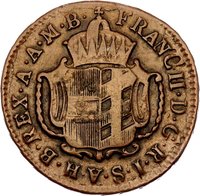
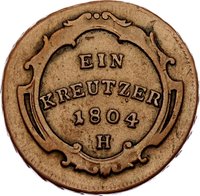
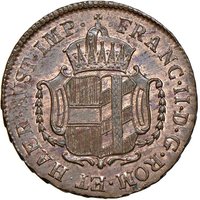
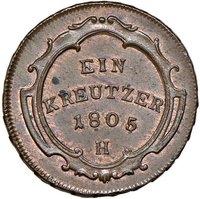
⭐ Somewhat Rare