

3 Cents – United States
United States
Context
Years: 1865–1889
Issuer: United States 
Period:
(since 1776)
Currency:
(since 1785)
Total mintage: 30,605,826
Material
References
KM: #Click to copy to clipboard95
Numista: #5336
Value
Exchange value: 0.03 USD = $0.03
Obverse
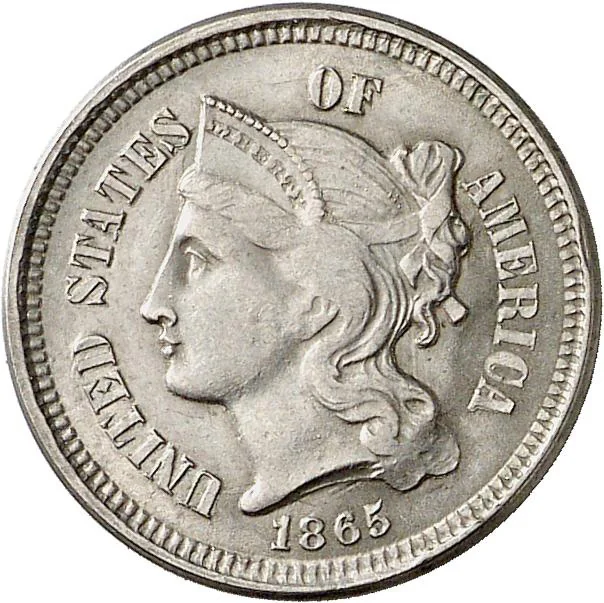
Description:
Female portrait left, date beneath.
Inscription:
UNITED STATES OF AMERICA
1885
1885
Script: Latin
Designer and engraver: James Barton Longacre
Reverse
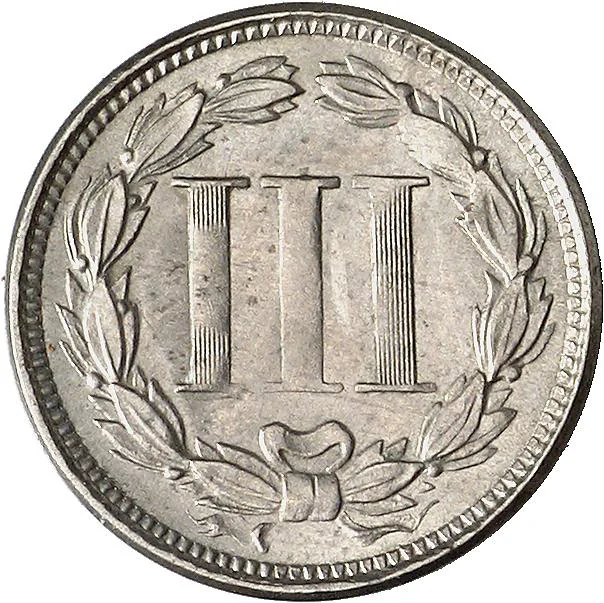
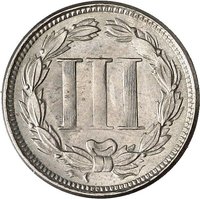
Description:
Roman wreath numerals
Inscription:
III
Translation:
Three
Script: Latin
Language: Latin
Designer and engraver: James Barton Longacre
Edge
Plain
Mints
| Name | Mark |
|---|---|
| United States Mint of Philadelphia | — |
Mintings
| Year | Mint Mark | Mintage | Quality | Collection |
|---|---|---|---|---|
| 1865 | — | 500 | Proof | |
| 1865 | — | 11,382,000 | ||
| 1866 | — | 4,801,000 | ||
| 1866 | — | 725 | Proof | |
| 1867 | — | 3,915,000 | ||
| 1867 | — | 625 | Proof | |
| 1868 | — | 3,252,000 | ||
| 1868 | — | 600 | Proof | |
| 1869 | — | 600 | Proof | |
| 1869 | — | 1,604,000 | ||
| 1870 | — | 1,335,000 | ||
| 1870 | — | 1,000 | Proof | |
| 1871 | — | 604,000 | ||
| 1871 | — | 960 | Proof | |
| 1872 | — | 862,000 | ||
| 1872 | — | 950 | Proof | |
| 1873 | — | 390,000 | ||
| 1873 | — | 1,100 | Proof | |
| 1874 | — | 700 | Proof | |
| 1874 | — | 790,000 | ||
| 1875 | — | 228,000 | ||
| 1875 | — | 700 | Proof | |
| 1876 | — | 162,000 | ||
| 1876 | — | 1,150 | Proof | |
| 1877 | — | 900 | Proof | |
| 1878 | — | 2,350 | Proof | |
| 1879 | — | 38,000 | ||
| 1879 | — | 3,200 | Proof | |
| 1880 | — | 21,000 | ||
| 1880 | — | 3,955 | Proof | |
| 1881 | — | 1,077,000 | ||
| 1881 | — | 3,575 | Proof | |
| 1882 | — | 22,200 | ||
| 1882 | — | 3,100 | Proof | |
| 1883 | — | 4,000 | ||
| 1883 | — | 6,609 | Proof | |
| 1884 | — | 1,700 | ||
| 1884 | — | 3,942 | Proof | |
| 1885 | — | 1,000 | ||
| 1885 | — | 3,790 | Proof | |
| 1886 | — | 4,290 | Proof | |
| 1887 | — | 5,001 | ||
| 1887 | — | 2,960 | Proof | |
| 1888 | — | 36,501 | ||
| 1888 | — | 4,582 | Proof | |
| 1889 | — | 18,125 | ||
| 1889 | — | 3,436 | Proof |
Historical background
In 1865, the United States currency system was in a state of profound transformation and crisis, directly shaped by the Civil War. Prior to the conflict, the nation operated on a patchwork of thousands of different state-chartered banknotes and a limited supply of gold and silver coin, lacking a uniform federal paper currency. The war's immense financial demands forced the federal government, through the Legal Tender Acts of 1862, to issue its own paper money—"greenbacks"—for the first time. These notes were not backed by gold but by the government's credit, making them a fiat currency necessary to fund the Union war effort. Consequently, the nation found itself with a dual monetary system: depreciating greenbacks circulating alongside gold-backed notes and coins, with their values fluctuating based on battlefield fortunes.
The financial landscape was further complicated by the National Banking Acts of 1863 and 1864, which created a new system of nationally chartered banks. These banks were required to purchase U.S. government bonds to back their own currency, National Bank Notes, which helped create a market for war debt and aimed to bring uniformity to the banknote system. However, this did not resolve the fundamental issue of the "greenback dollar," which traded at a significant discount to the gold dollar throughout the war. By 1865, with the war concluding, the pressing monetary question was whether the government would contract the money supply by retiring the greenbacks and returning to the pre-war gold standard ("hard money"), or maintain a larger, more flexible currency to aid reconstruction and debt management.
Thus, as the year ended, the United States stood at a monetary crossroads. The wartime measures had successfully financed victory but left a legacy of inflation, a massive public debt, and a fractured currency system. The political and economic battle between "hard money" advocates (creditors, financiers, and conservatives) and "soft money" proponents (debtors, farmers, and many in the war-ravaged South) over the future of the greenback would define the economic policy debates—known as the "Money Question"—for the next two decades, setting the stage for the financial tensions of the Gilded Age.
The financial landscape was further complicated by the National Banking Acts of 1863 and 1864, which created a new system of nationally chartered banks. These banks were required to purchase U.S. government bonds to back their own currency, National Bank Notes, which helped create a market for war debt and aimed to bring uniformity to the banknote system. However, this did not resolve the fundamental issue of the "greenback dollar," which traded at a significant discount to the gold dollar throughout the war. By 1865, with the war concluding, the pressing monetary question was whether the government would contract the money supply by retiring the greenbacks and returning to the pre-war gold standard ("hard money"), or maintain a larger, more flexible currency to aid reconstruction and debt management.
Thus, as the year ended, the United States stood at a monetary crossroads. The wartime measures had successfully financed victory but left a legacy of inflation, a massive public debt, and a fractured currency system. The political and economic battle between "hard money" advocates (creditors, financiers, and conservatives) and "soft money" proponents (debtors, farmers, and many in the war-ravaged South) over the future of the greenback would define the economic policy debates—known as the "Money Question"—for the next two decades, setting the stage for the financial tensions of the Gilded Age.
🌱 Very Common