

2 Cents – United States
United States
Context
Years: 1864–1873
Issuer: United States 
Period:
(since 1776)
Currency:
(since 1785)
Total mintage: 24,213,660
Material
References
KM: #Click to copy to clipboard94
Numista: #2296
Value
Exchange value: 0.02 USD = $0.02
Obverse
Description:
Shield in wreath with U.S. motto.
Inscription:
IN GOD WE TRUST
1871
1871
Script: Latin
Engraver: James Barton Longacre
Reverse
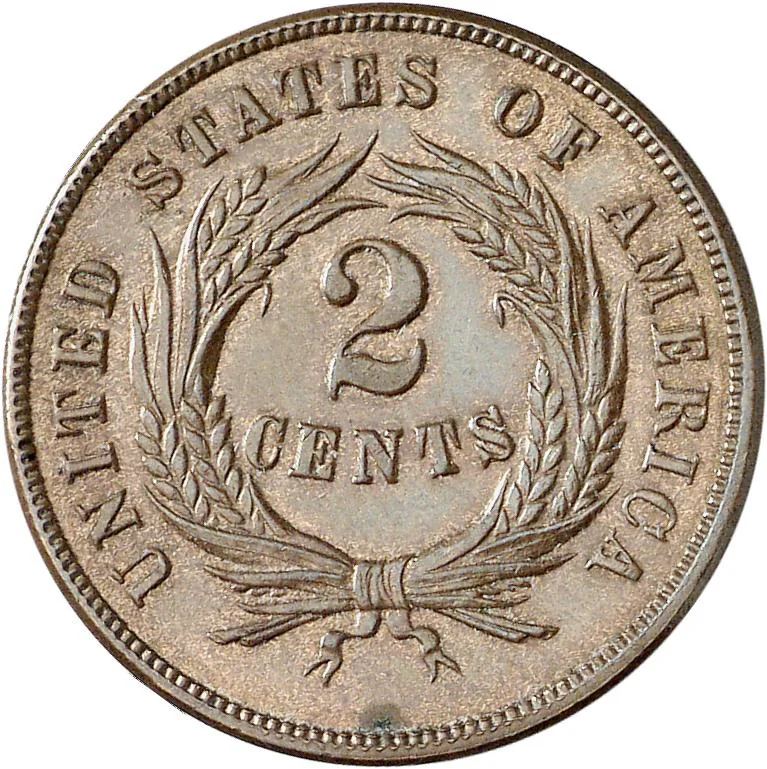
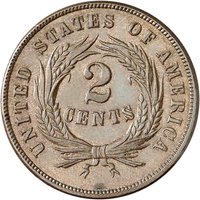
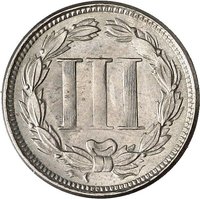
Description:
Wheat wreath encircling face value and country name.
Inscription:
UNITED STATES OF AMERICA
2
CENTS
2
CENTS
Script: Latin
Engraver: James Barton Longacre
Edge
Plain
Categories
| Symbols> Coat of Arms |
Mints
| Name | Mark |
|---|---|
| United States Mint of Philadelphia | — |
Mintings
| Year | Mint Mark | Mintage | Quality | Collection |
|---|---|---|---|---|
| 1864 | — | 100 | Proof | |
| 1864 | — | — | ||
| 1865 | — | 13,640,000 | ||
| 1865 | — | 500 | Proof | |
| 1866 | — | 3,177,000 | ||
| 1866 | — | 725 | Proof | |
| 1867 | — | 2,938,750 | ||
| 1867 | — | 625 | Proof | |
| 1868 | — | 600 | Proof | |
| 1868 | — | 2,803,750 | ||
| 1869 | — | — | ||
| 1869 | — | 600 | Proof | |
| 1870 | — | 861,250 | ||
| 1870 | — | 1,000 | Proof | |
| 1871 | — | 721,250 | ||
| 1871 | — | 960 | Proof | |
| 1872 | — | 65,000 | ||
| 1872 | — | 950 | Proof | |
| 1873 | — | 600 | Proof |
Historical background
In 1864, the United States was in the third year of the Civil War, and its currency system was in a state of profound and chaotic transformation. To finance the immense cost of the conflict, the federal government had abandoned the gold standard and issued paper money not backed by specie, known as "greenbacks" or United States Notes. This created a dual-currency system where gold coins and gold-backed banknotes traded at a premium compared to the fluctuating value of greenbacks, leading to widespread speculation and price inflation. Furthermore, the banking landscape was fractured, with hundreds of state-chartered banks still issuing their own often-unreliable notes, creating a bewildering array of thousands of different currencies in circulation.
Recognizing the urgent need for stability and a unified national currency, Congress passed the National Banking Acts of 1863 and 1864. These acts established a system of nationally chartered banks that were required to purchase U.S. government bonds and deposit them with the Treasury as security for new, uniform National Bank Notes. This served the dual purpose of creating a more stable, federally regulated currency and creating a guaranteed market for war bonds. However, the transition was not smooth, and the older systems of state bank notes and depreciating greenbacks continued to circulate alongside the new national notes throughout the year.
Thus, 1864 represents a pivotal moment of financial experimentation and consolidation. The year was marked by significant inflation—driven by greenback depreciation and wartime scarcity—which eroded purchasing power and caused social strain. Yet, amidst this turmoil, the foundational laws for a modern national banking system were being implemented. The chaotic multi-currency environment of the early war years began a forced march toward the more uniform, federally controlled monetary system that would characterize the post-war era, setting the stage for the financial expansions and panics of the later 19th century.
Recognizing the urgent need for stability and a unified national currency, Congress passed the National Banking Acts of 1863 and 1864. These acts established a system of nationally chartered banks that were required to purchase U.S. government bonds and deposit them with the Treasury as security for new, uniform National Bank Notes. This served the dual purpose of creating a more stable, federally regulated currency and creating a guaranteed market for war bonds. However, the transition was not smooth, and the older systems of state bank notes and depreciating greenbacks continued to circulate alongside the new national notes throughout the year.
Thus, 1864 represents a pivotal moment of financial experimentation and consolidation. The year was marked by significant inflation—driven by greenback depreciation and wartime scarcity—which eroded purchasing power and caused social strain. Yet, amidst this turmoil, the foundational laws for a modern national banking system were being implemented. The chaotic multi-currency environment of the early war years began a forced march toward the more uniform, federally controlled monetary system that would characterize the post-war era, setting the stage for the financial expansions and panics of the later 19th century.
🌱 Very Common