

20 Pesos – Mexico
Circulating commemorative coins
Commemoration: Constitution Centennial
Mexico
Context
Material
References
KM: #Click to copy to clipboard989
Numista: #103355
Value
Exchange value: 20 MXN = $1.16
Inflation-adjusted value: 29.88 MXN
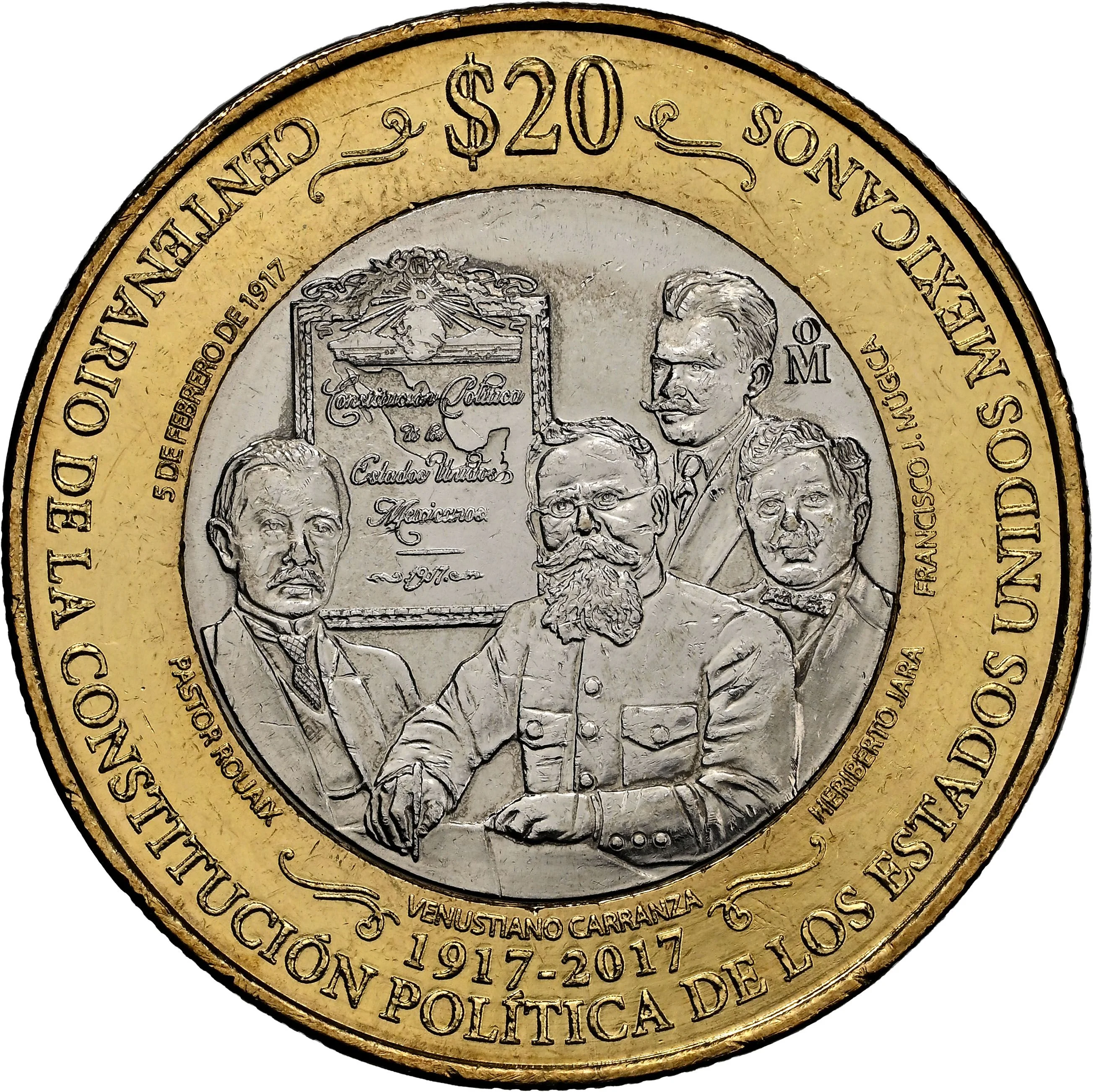
Obverse
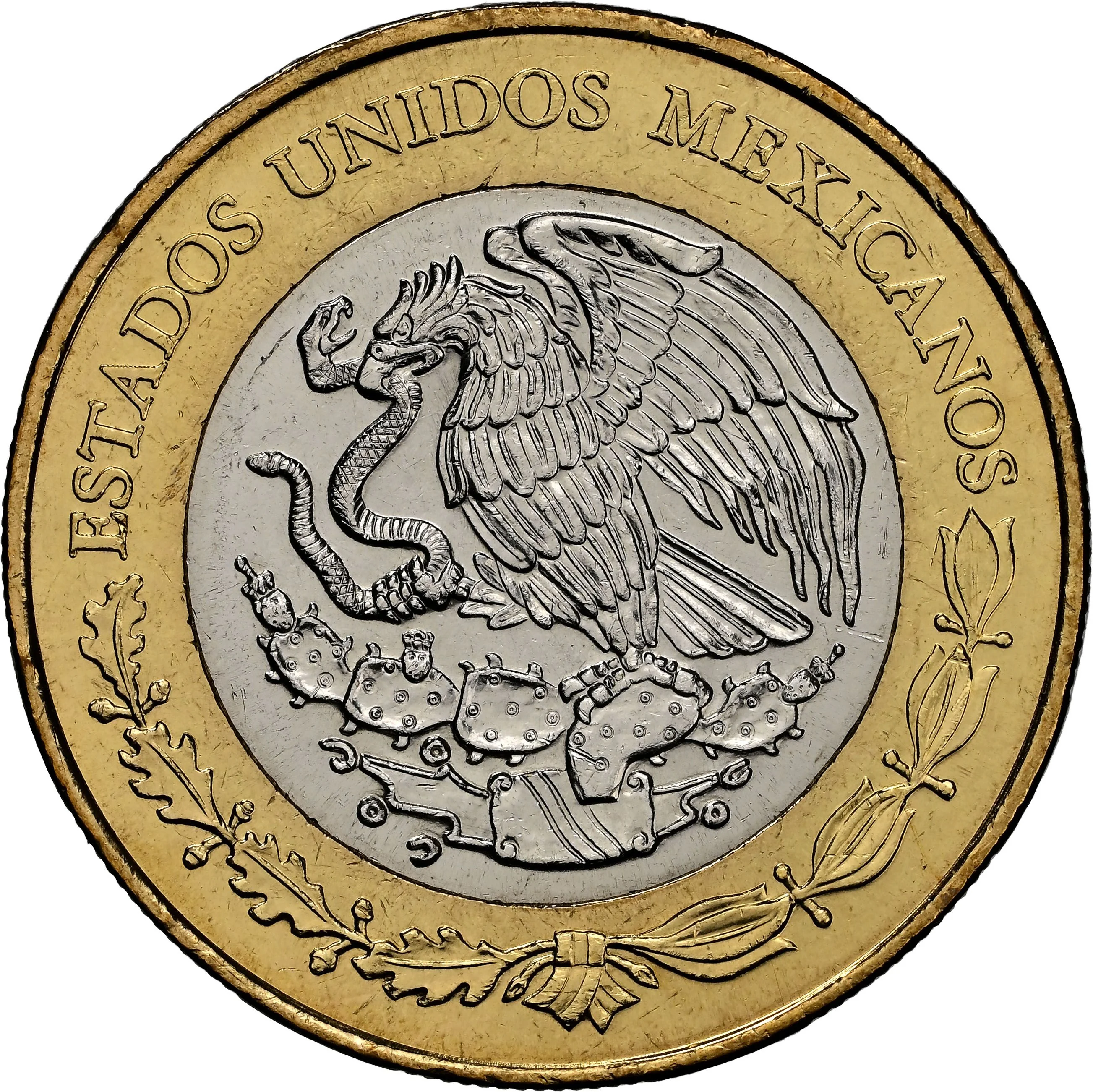
Reverse
Description:
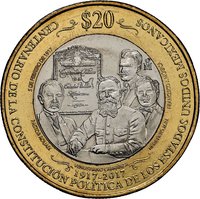
Center: Venustiano Carranza flanked by deputies Rouaix, Múgica, and Jara, before the 1917 Constitution. Outer ring: commemorative dates, legend, face value, and signing details.
Inscription:
$20
CENTENARIO DE LA CONSTITUCIÓN POLÍTICA DE LOS ESTADOS UNIDOS MEXICANOS
5 DE FEBRERO
Mo
PASTOR ROUAIX, VENUSTIANO CARRANZA, HERIBERTO JARA y FRANCISCO J. MÚGICA
1917-2017
CENTENARIO DE LA CONSTITUCIÓN POLÍTICA DE LOS ESTADOS UNIDOS MEXICANOS
5 DE FEBRERO
Mo
PASTOR ROUAIX, VENUSTIANO CARRANZA, HERIBERTO JARA y FRANCISCO J. MÚGICA
1917-2017
Translation:
$20
Centenary of the Political Constitution of the United Mexican States
February 5
Mo
Pastor Rouaix, Venustiano Carranza, Heriberto Jara y Francisco J. Múgica
1917-2017
Centenary of the Political Constitution of the United Mexican States
February 5
Mo
Pastor Rouaix, Venustiano Carranza, Heriberto Jara y Francisco J. Múgica
1917-2017
Script: Latin
Language: Spanish
Edge
Segmented reeding8 milled segments (consisting of 14 lines each) separated by 8 smooth segments.
Categories
| Animal> Bird> Eagle |
| Person> Politician |
| Symbols> Coat of Arms |
| Mustache/Beard |
| Symbol> Wreath |
Mints
| Name | Mark |
|---|---|
| Mexican Mint | Mo |
Mintings
| Year | Mint Mark | Mintage | Quality | Collection |
|---|---|---|---|---|
| 2017 | Mo | 7,000,000 |
Historical background
In 2017, the Mexican peso (MXN) navigated a year of significant volatility and political uncertainty, largely driven by the inauguration of U.S. President Donald Trump. The currency had ended 2016 at a historic low, breaching 21 pesos per U.S. dollar, as markets reacted to Trump's protectionist campaign promises, particularly the threat to dismantle the North American Free Trade Agreement (NAFTA). Given that over 80% of Mexico's exports are destined for the U.S., the peso functioned as a real-time barometer of U.S.-Mexico relations, with every tweet or statement from the new administration causing sharp fluctuations in its value.
Despite this tense backdrop, the peso staged a notable recovery throughout much of 2017, becoming one of the world's best-performing major currencies. This strength was supported by several factors: the Bank of Mexico (Banxico) aggressively raised interest rates to 7%—a nine-year high—to combat inflation and support the currency, attracting foreign capital. Simultaneously, the formal start of NAFTA renegotiations in August provided a more structured and less confrontational framework than markets had feared, easing investor anxiety. Furthermore, resilient economic fundamentals, including stable remittances and foreign direct investment, provided underlying support.
By the end of 2017, the peso had strengthened to approximately 19.70 per dollar, demonstrating remarkable resilience. However, the year concluded with ongoing challenges. Inflation peaked at a 16-year high of 6.77%, largely due to domestic gasoline price liberalization and the peso's prior weakness, squeezing household purchasing power. Thus, the currency's technical recovery existed alongside persistent economic pressures on the ground, setting the stage for continued focus on monetary policy and trade negotiations in the year ahead.
Despite this tense backdrop, the peso staged a notable recovery throughout much of 2017, becoming one of the world's best-performing major currencies. This strength was supported by several factors: the Bank of Mexico (Banxico) aggressively raised interest rates to 7%—a nine-year high—to combat inflation and support the currency, attracting foreign capital. Simultaneously, the formal start of NAFTA renegotiations in August provided a more structured and less confrontational framework than markets had feared, easing investor anxiety. Furthermore, resilient economic fundamentals, including stable remittances and foreign direct investment, provided underlying support.
By the end of 2017, the peso had strengthened to approximately 19.70 per dollar, demonstrating remarkable resilience. However, the year concluded with ongoing challenges. Inflation peaked at a 16-year high of 6.77%, largely due to domestic gasoline price liberalization and the peso's prior weakness, squeezing household purchasing power. Thus, the currency's technical recovery existed alongside persistent economic pressures on the ground, setting the stage for continued focus on monetary policy and trade negotiations in the year ahead.
🌱 Common