

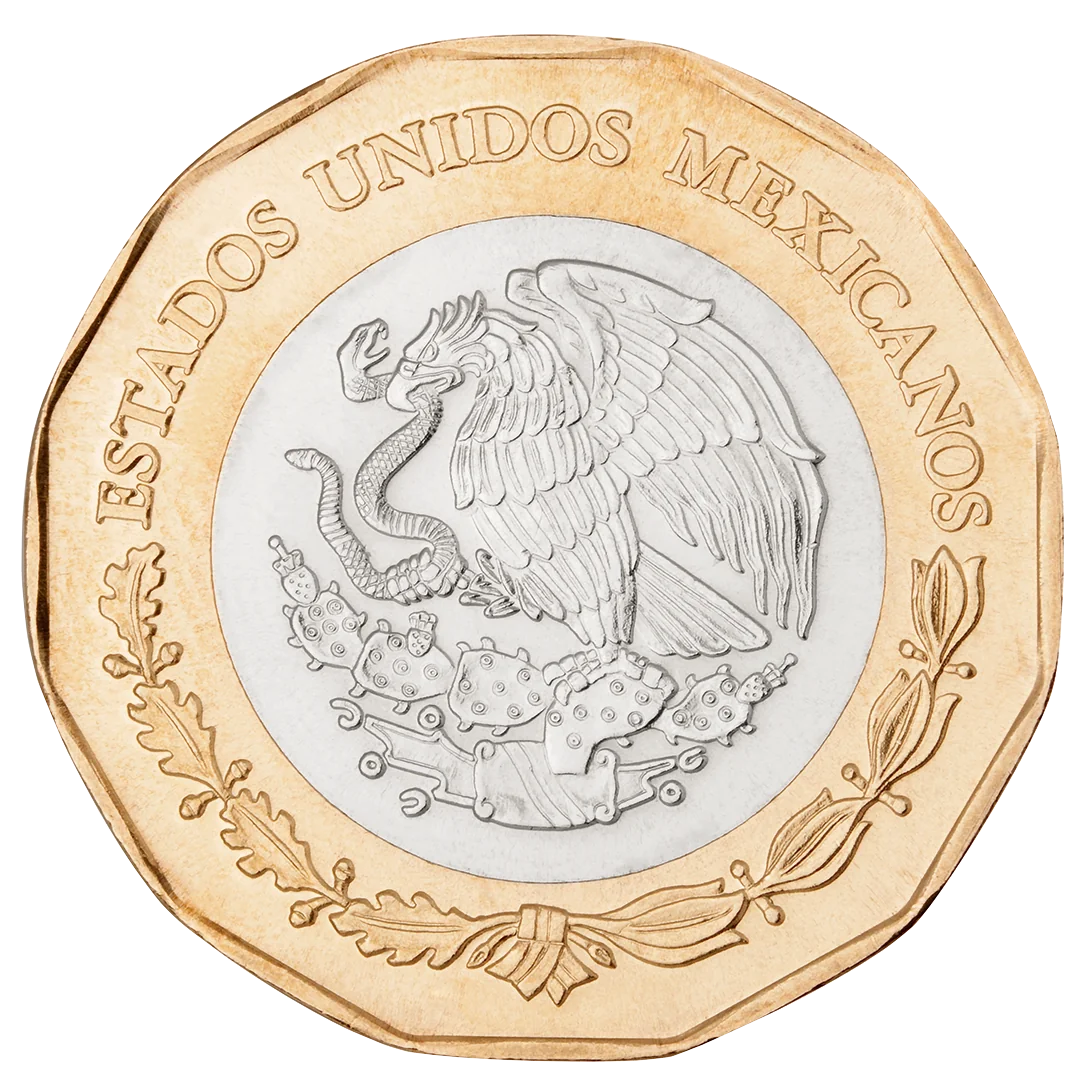
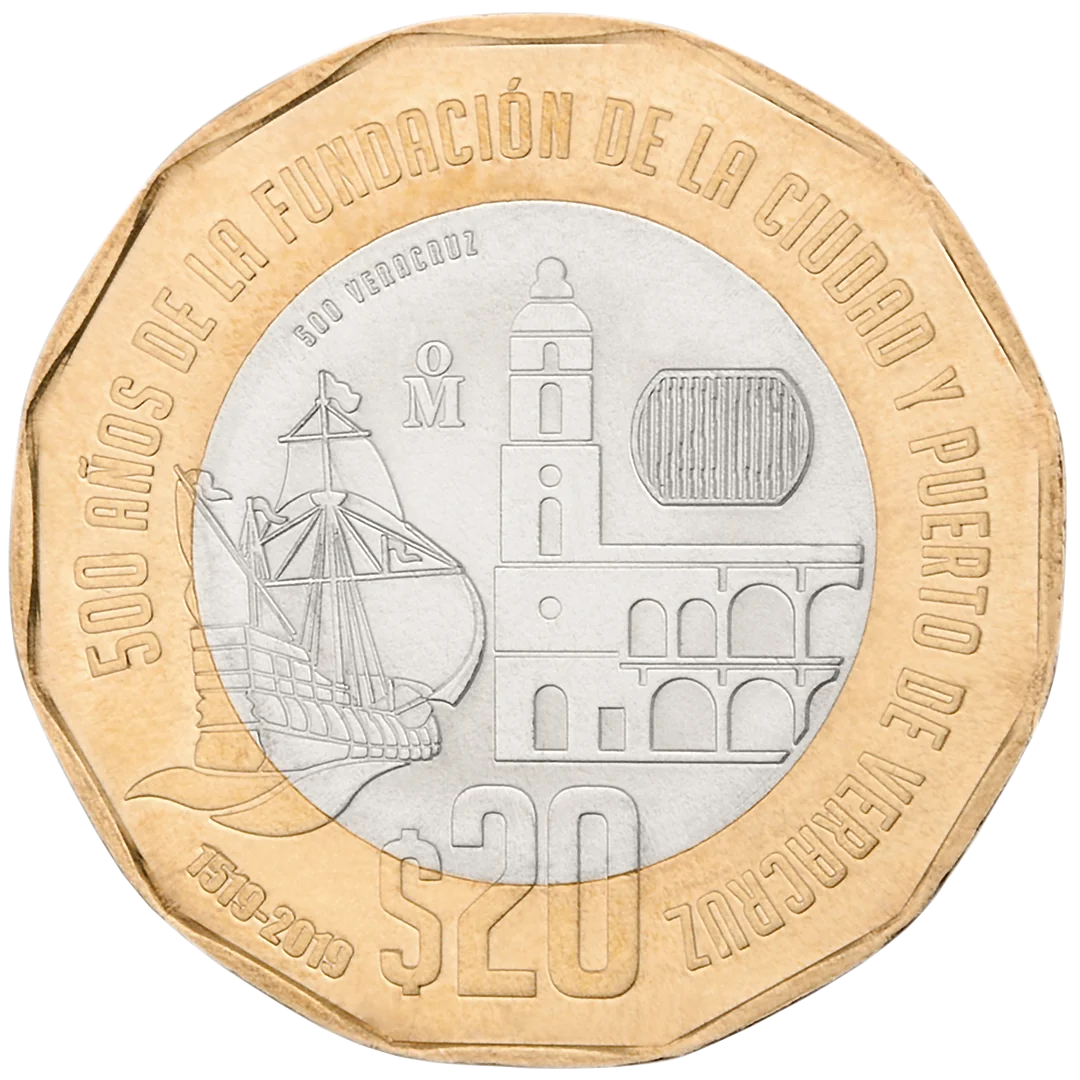
20 pesos (Founding of the City and Port of Veracruz) – Mexico
Add to wishlist
Circulating commemorative coins
Commemoration: 500th Anniversary of the Founding of the City and Port of Veracruz
Mexico
Context
Material
Diameter: 30 mm
Weight: 12.67 g
Thickness: 2.4 mm
Shape: Dodecagonal
Technique: Milled
Alignment: Coin alignment
flip
References
KM: #
Numista: #206424
Value
Exchange value: 20 MXN
Inflation-adjusted value: 26.86 MXN
Obverse
Reverse
Description:
16th-century ship left, Old City Hall right, latent "20" above building.
Inscription:
500 AÑOS DE LA FUNDACIÓN DE LA CIUDAD Y PUERTO DE VERACRUZ
500 VERACRUZ
Mo
20
$20
1519-2019
500 VERACRUZ
Mo
20
$20
1519-2019
Translation:
500 Years of the Foundation of the City and Port of Veracruz
500 Veracruz
Mo
20
$20
1519-2019
500 Veracruz
Mo
20
$20
1519-2019
Script: Latin
Language: Spanish
Edge
Segmented reeding
Categories
| Building |
| Transportation> Watercraft |
Mints
| Name | Mark |
|---|---|
| Mexican Mint | (Mo) |
Mintings
| Year | Mint Mark | Mintage | Quality | Collection |
|---|---|---|---|---|
| 2019 | Mo | 60,000,000 |
Historical background
In 2019, the Mexican peso (MXN) navigated a year of significant volatility, largely driven by external trade tensions and domestic policy uncertainty. The primary external pressure stemmed from the ongoing renegotiation and eventual ratification of the United States-Mexico-Canada Agreement (USMCA), which replaced NAFTA. While the eventual passage of the treaty in late 2019 provided a crucial anchor for investor confidence, fears of its collapse during the year, coupled with broader U.S.-China trade war anxieties, frequently triggered risk-off sentiment that weakened the peso. The currency often acted as a liquid proxy for emerging market risk, fluctuating with headlines from Washington.
Domestically, the economic policies of President Andrés Manuel López Obrador (AMLO), who took office in December 2018, introduced a layer of uncertainty that weighed on the currency throughout 2019. Investors were concerned by the cancellation of major infrastructure projects, most notably the new Mexico City airport, and the perceived erosion of institutional autonomy. These actions raised questions about the government's commitment to fiscal discipline and its approach to private investment. Consequently, credit rating agencies placed Mexico's sovereign rating under negative watch, further pressuring the peso.
Despite these headwinds, the peso demonstrated notable resilience by year's end. This strength was supported by the Bank of Mexico (Banxico), which maintained a high benchmark interest rate at 8.25% to combat inflation and attract capital inflows, creating a favorable interest rate differential. Furthermore, the decisive ratification of the USMCA in December removed a major overhang, while disciplined fiscal spending from the administration alleviated some early fears. Thus, the peso closed 2019 stronger than many analysts had predicted, having weathered a turbulent period defined by trade diplomacy and a testing of the new political landscape.
Domestically, the economic policies of President Andrés Manuel López Obrador (AMLO), who took office in December 2018, introduced a layer of uncertainty that weighed on the currency throughout 2019. Investors were concerned by the cancellation of major infrastructure projects, most notably the new Mexico City airport, and the perceived erosion of institutional autonomy. These actions raised questions about the government's commitment to fiscal discipline and its approach to private investment. Consequently, credit rating agencies placed Mexico's sovereign rating under negative watch, further pressuring the peso.
Despite these headwinds, the peso demonstrated notable resilience by year's end. This strength was supported by the Bank of Mexico (Banxico), which maintained a high benchmark interest rate at 8.25% to combat inflation and attract capital inflows, creating a favorable interest rate differential. Furthermore, the decisive ratification of the USMCA in December removed a major overhang, while disciplined fiscal spending from the administration alleviated some early fears. Thus, the peso closed 2019 stronger than many analysts had predicted, having weathered a turbulent period defined by trade diplomacy and a testing of the new political landscape.
🌱 Common