

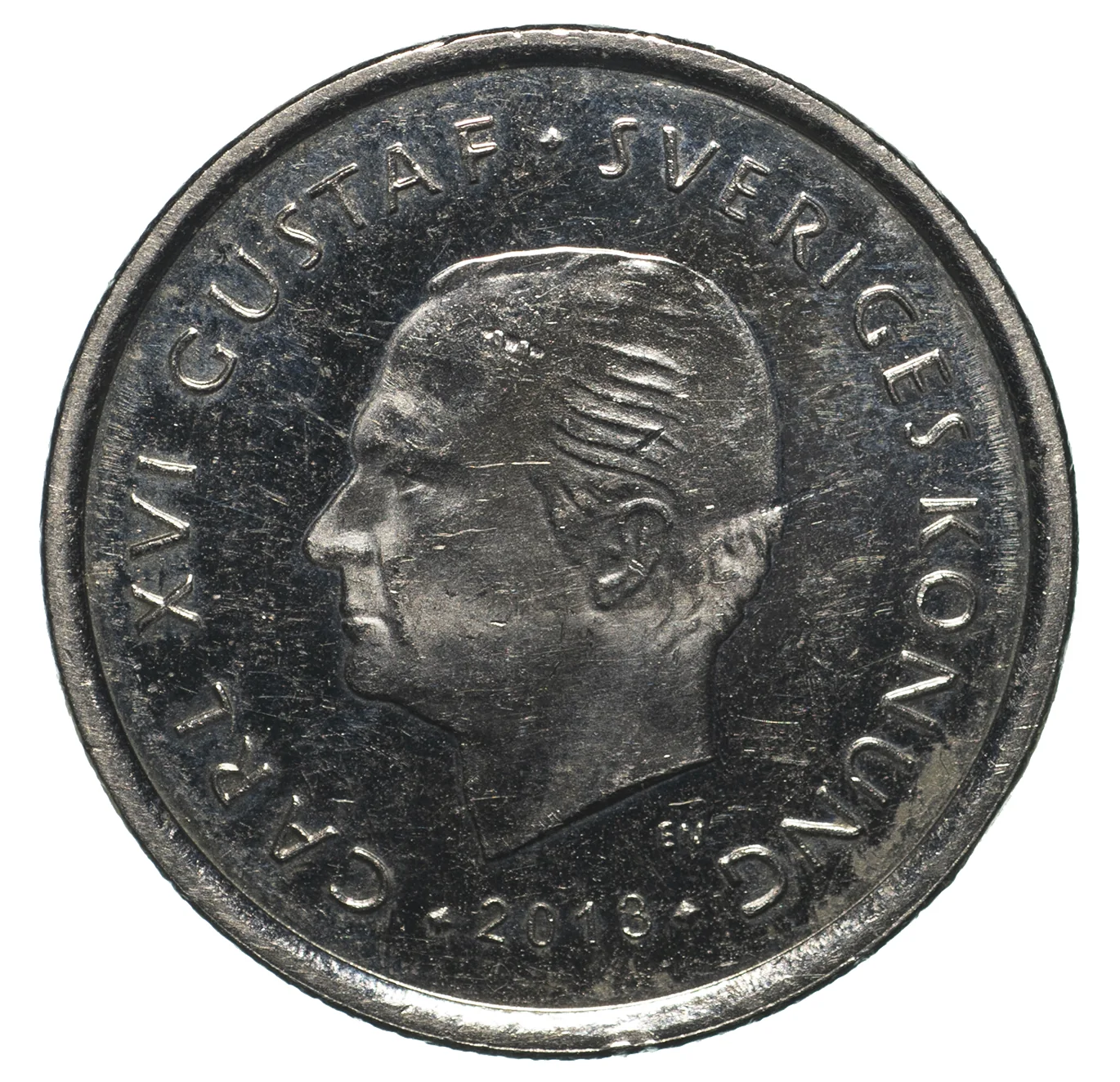
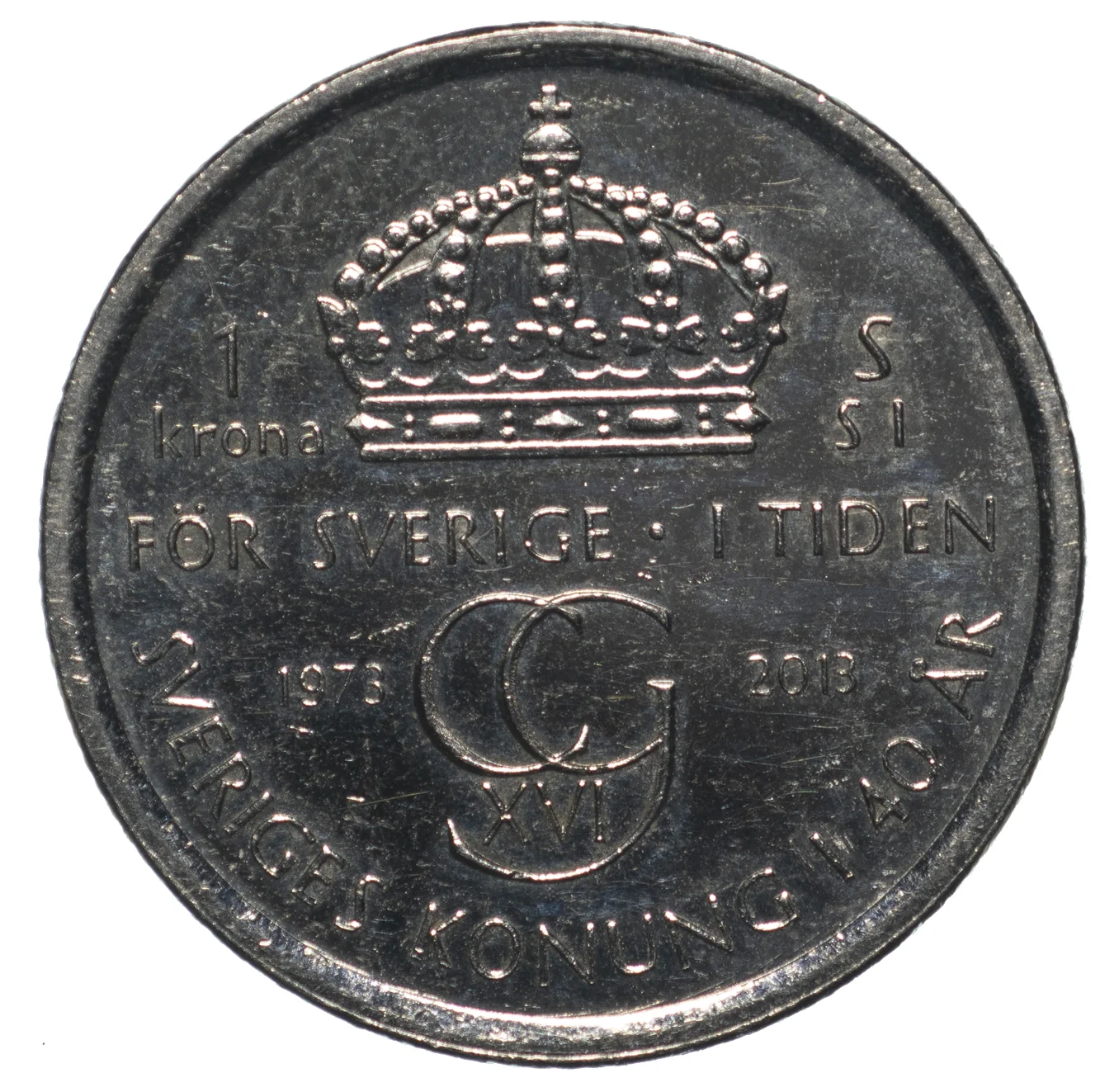
1 krona (King Carl XVI Gustaf) – Sweden
Add to wishlist
Circulating commemorative coins
Commemoration: 40th Anniversary of the Reign of King Carl XVI Gustaf
Sweden
Context
Year: 2013
Issuer: Sweden
Ruler: Carl XVI Gustaf
Currency:
(since 1873)
Demonetization: 1 July 2017
Total mintage: 5,000,000
Material
Diameter: 25 mm
Weight: 7 g
Thickness: 1.88 mm
Shape: Round
Composition: Copper-nickel
Technique: Milled
Alignment: Medal alignment
flip
References
KM: #
Numista: #53288
Value
Exchange value: 1 SEK
Inflation-adjusted value: 1.34 SEK
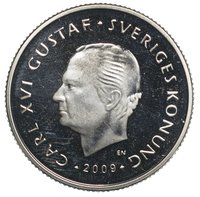
Obverse
Description:
King Carl XVI Gustaf in profile, with the artist's initials below.
Inscription:
CARL XVI GUSTAF + SVERIGES KONUNG
EN
+ 2013 +
EN
+ 2013 +
Translation:
Carl XVI Gustaf + King of Sweden
+ 2013 +
+ 2013 +
Script: Latin
Engraver: Ernst Nordin
Reverse
Description:
Above the crown, the value is left and "S SI" right (Stockholm and Governor Stefan Ingves). Below the king's monogram, the anniversary dates are split. The king's motto is between the monogram and crown.
Inscription:
1 S
KRONA SI
FÖR SVERIGE · I TIDEN
1973 2013
SVERIGES KONUNG I 40 ÅR
KRONA SI
FÖR SVERIGE · I TIDEN
1973 2013
SVERIGES KONUNG I 40 ÅR
Translation:
Crown for Sweden · In Time
1973 2013
Sweden's King for 40 Years
1973 2013
Sweden's King for 40 Years
Script: Latin
Language: Swedish
Engraver: Ernst Nordin
Edge
Reeded
Mints
| Name | Mark |
|---|---|
| Mint of Finland | S |
Mintings
| Year | Mint Mark | Mintage | Quality | Collection |
|---|---|---|---|---|
| 2013 | S | 5,000,000 |
Historical background
In 2013, Sweden's currency situation was characterized by a persistent and concerning trend of krona (SEK) weakness. The Swedish krona had been depreciating for several years, losing significant value against major currencies like the euro and the US dollar since the 2008 financial crisis. This weakness was primarily driven by the Riksbank's dovish monetary policy stance, which kept interest rates historically low to combat low inflation and support economic growth. As a result, the krona became a popular funding currency for carry trades, where investors borrowed in low-interest SEK to invest in higher-yielding assets abroad, further suppressing its value.
The weak krona presented a dual-edged economic impact. On one hand, it provided a substantial boost to Sweden's large export sector, making Swedish goods and services more competitive internationally. Major exporters like Volvo and Ericsson benefited, supporting economic growth and employment. On the other hand, it increased the cost of imports, contributing to higher consumer prices and squeezing household purchasing power. This dynamic created a complex challenge for the Riksbank, which was simultaneously grappling with inflation that remained stubbornly below its 2% target, despite the traditional inflationary pressure a weaker currency should provide.
By the end of 2013, the currency debate centered on future monetary policy and financial stability. While the weak krona supported exports, there were growing concerns about household indebtedness, fueled by low interest rates and rising housing prices. The Riksbank faced criticism for focusing too narrowly on inflation targeting while potentially ignoring financial risks. The stage was thus set for a pivotal shift in the coming years, as the Riksbank would eventually begin to prioritize financial stability and gradually signal an end to the era of ultra-low interest rates, which would later contribute to a strengthening of the krona.
The weak krona presented a dual-edged economic impact. On one hand, it provided a substantial boost to Sweden's large export sector, making Swedish goods and services more competitive internationally. Major exporters like Volvo and Ericsson benefited, supporting economic growth and employment. On the other hand, it increased the cost of imports, contributing to higher consumer prices and squeezing household purchasing power. This dynamic created a complex challenge for the Riksbank, which was simultaneously grappling with inflation that remained stubbornly below its 2% target, despite the traditional inflationary pressure a weaker currency should provide.
By the end of 2013, the currency debate centered on future monetary policy and financial stability. While the weak krona supported exports, there were growing concerns about household indebtedness, fueled by low interest rates and rising housing prices. The Riksbank faced criticism for focusing too narrowly on inflation targeting while potentially ignoring financial risks. The stage was thus set for a pivotal shift in the coming years, as the Riksbank would eventually begin to prioritize financial stability and gradually signal an end to the era of ultra-low interest rates, which would later contribute to a strengthening of the krona.
🌱 Common