

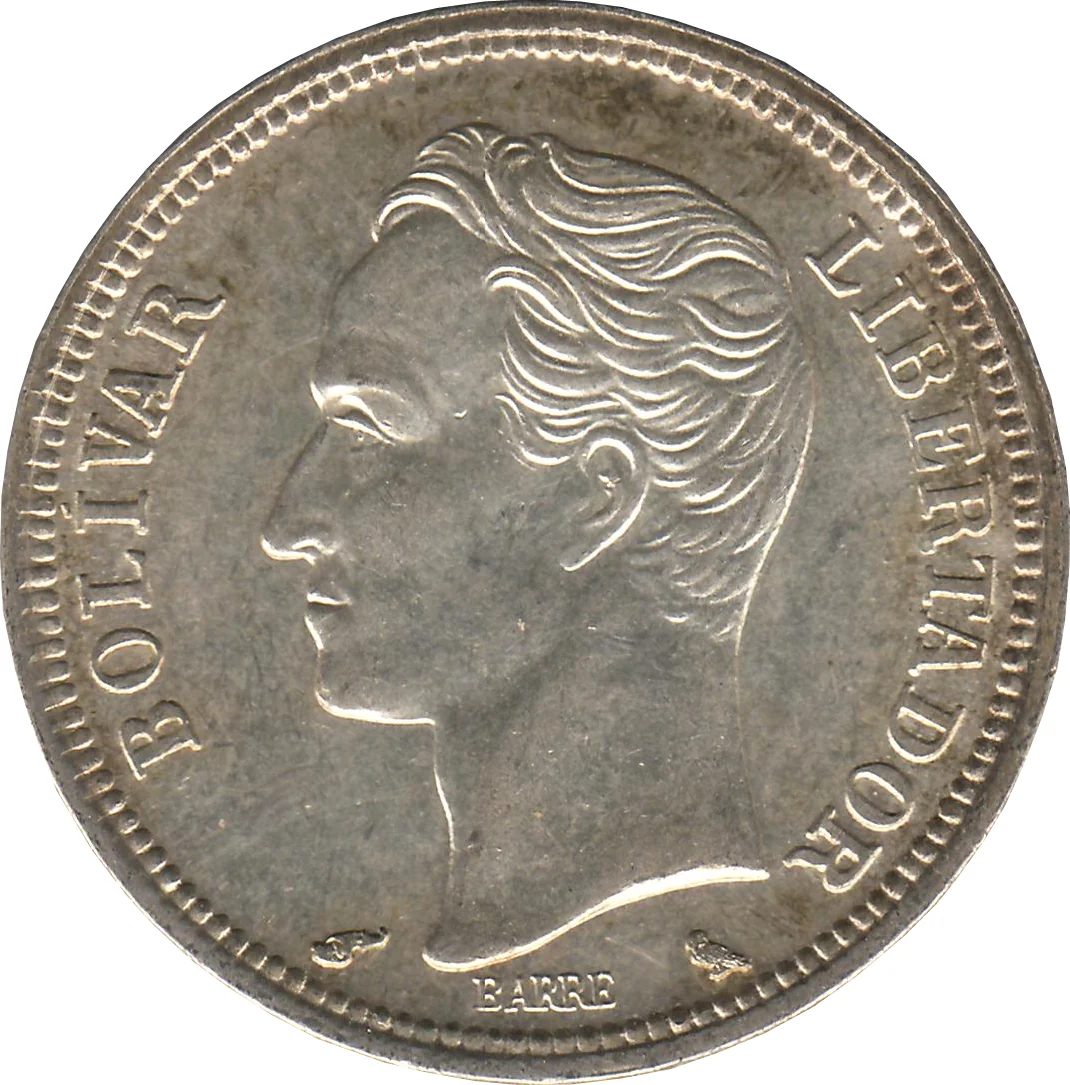
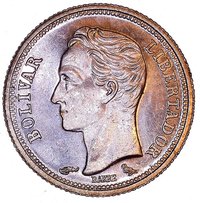
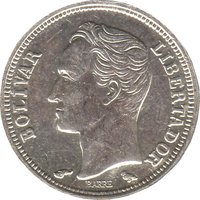
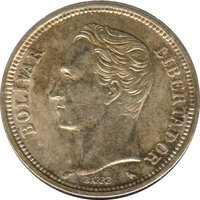
Obverse
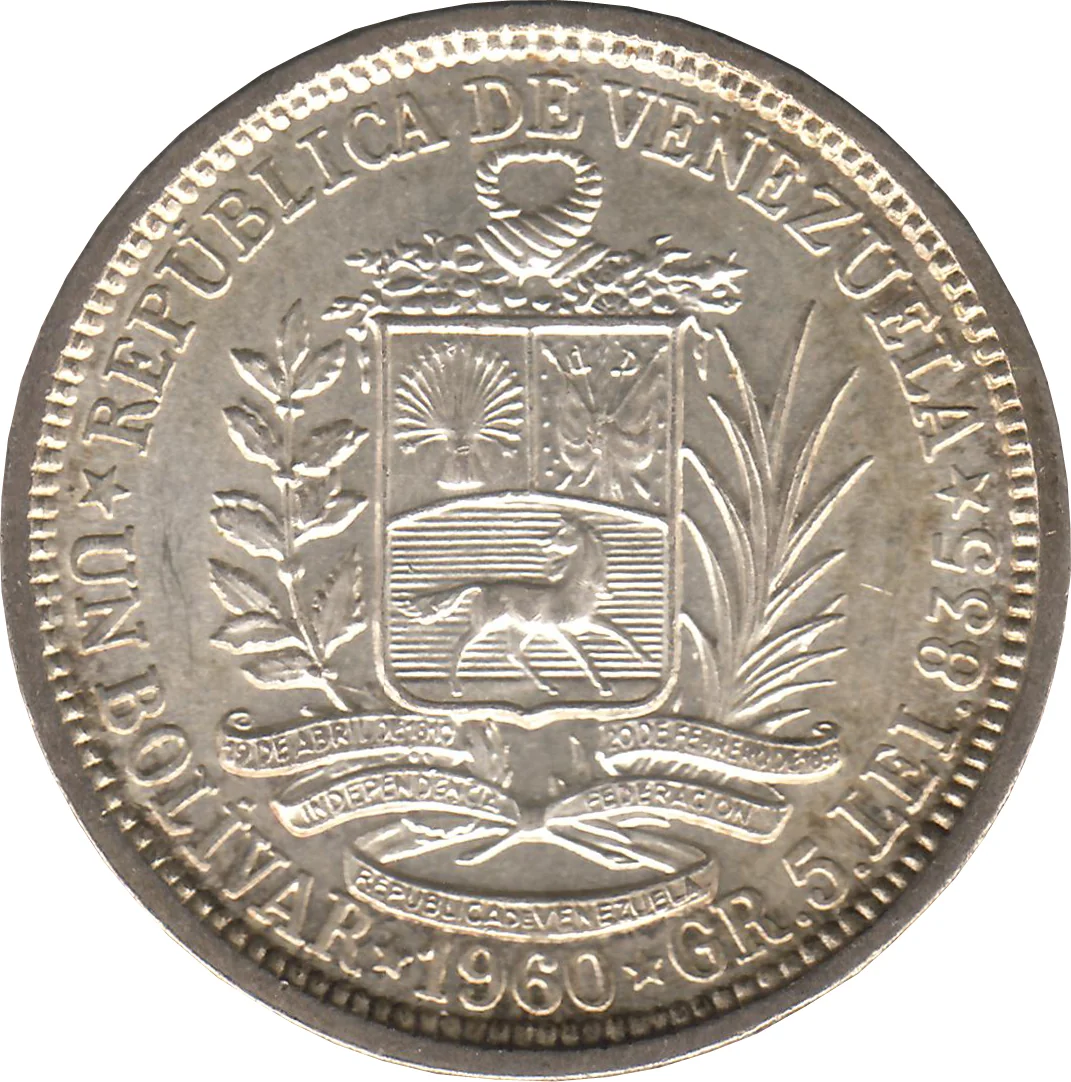
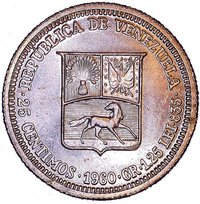
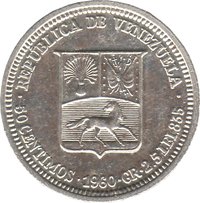
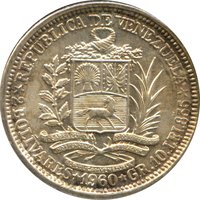
Reverse
Description:
Bust left, flanked by legend, with engraver's name and privy marks at base.
Inscription:
BOLÍVAR LIBERTADOR
BARRE
BARRE
Translation:
Bolivar Liberator
Barre
Barre
Script: Latin
Language: Spanish
Engraver: Désiré-Albert Barre
Edge
Milled
Categories
| Animal> Horse |
| Person> Military leader |
| Person> Politician |
| Symbols> Coat of Arms |
| Symbol> Cornucopia |
Mints
| Name | Mark |
|---|---|
| Monnaie de Paris | — |
| Royal Mint (Tower Hill) | — |
Mintings
| Year | Mint Mark | Mintage | Quality | Collection |
|---|---|---|---|---|
| 1960 | — | — | ||
| 1965 | — | 20,000,000 |
Historical background
In 1960, Venezuela's currency, the bolívar, was a symbol of exceptional stability and strength in Latin America, underpinned by the nation's booming oil economy. Since the discovery of massive petroleum reserves in the early 20th century, Venezuela had transformed into the world's leading oil exporter. This hydrocarbon wealth fueled rapid modernization and provided the government with substantial foreign exchange reserves, allowing it to peg the bolívar to the U.S. dollar at a fixed and favorable rate of 3.35 bolívares per dollar—a parity maintained since 1941.
This monetary stability was institutionalized with the creation of the Central Bank of Venezuela (Banco Central de Venezuela, BCV) in 1939, which managed the currency and the nation's considerable gold and dollar reserves. The fixed exchange rate provided a predictable environment for international trade and investment, fostering a period of significant economic growth and high per-capita income. The bolívar was so trusted that it was often described as "petro-money" and even circulated informally in neighboring countries.
However, the apparent robustness of 1960 masked underlying vulnerabilities. The economy was dangerously dependent on a single commodity, making it highly susceptible to global oil price fluctuations. Furthermore, the fixed exchange rate, while a pillar of stability, began to create distortions as government spending increased and inflation started to creep upward. Although the full crisis of devaluation and hyperinflation was decades away, the seeds of future currency troubles were present in this over-reliance on oil revenues and a rigid monetary policy that would later struggle to adapt to changing economic realities.
This monetary stability was institutionalized with the creation of the Central Bank of Venezuela (Banco Central de Venezuela, BCV) in 1939, which managed the currency and the nation's considerable gold and dollar reserves. The fixed exchange rate provided a predictable environment for international trade and investment, fostering a period of significant economic growth and high per-capita income. The bolívar was so trusted that it was often described as "petro-money" and even circulated informally in neighboring countries.
However, the apparent robustness of 1960 masked underlying vulnerabilities. The economy was dangerously dependent on a single commodity, making it highly susceptible to global oil price fluctuations. Furthermore, the fixed exchange rate, while a pillar of stability, began to create distortions as government spending increased and inflation started to creep upward. Although the full crisis of devaluation and hyperinflation was decades away, the seeds of future currency troubles were present in this over-reliance on oil revenues and a rigid monetary policy that would later struggle to adapt to changing economic realities.
Series: 1960 Venezuela circulation coins
🌱 Very Common