

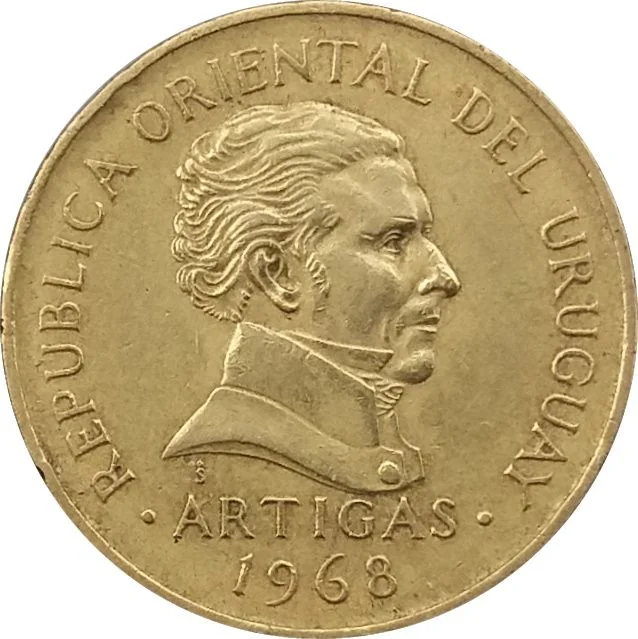
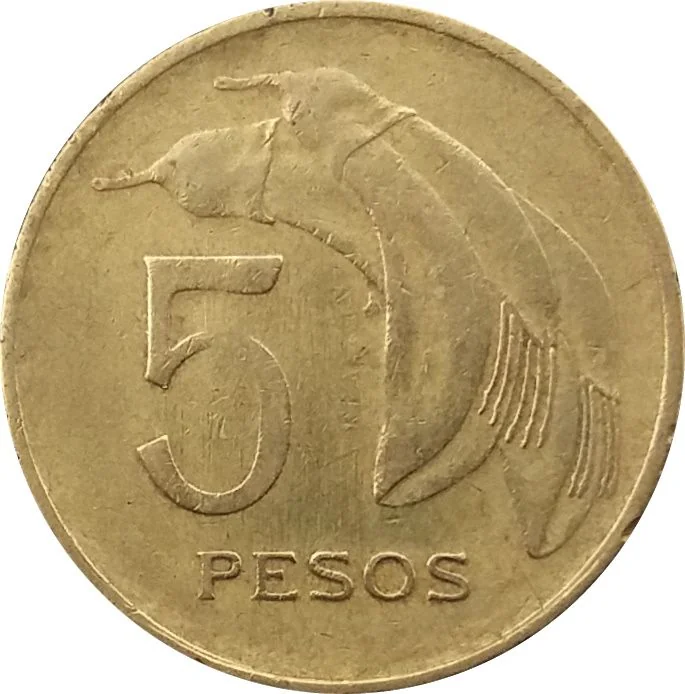
5 pesos – Uruguay
Add to wishlist
Uruguay
Context
Year: 1968
Issuer: Uruguay
Period:
(since 1825)
Currency:
(1863—1975)
Demonetization: 1 July 1975
Total mintage: 42,680,050
Material
Diameter: 20 mm
Weight: 3 g
Thickness: 1.45 mm
Shape: Round
Composition: Nickel brass
Magnetic: No
Technique: Milled
Alignment: Medal alignment
flip
References
KM: #
Numista: #5290
Value
Exchange value: 5 UYP
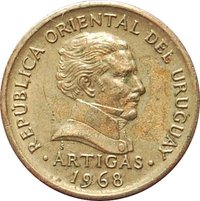
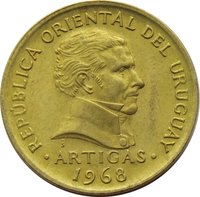
Obverse
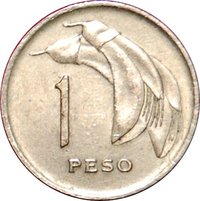
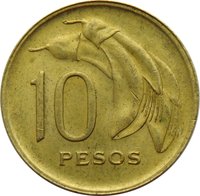
Reverse
Edge
Plain
Categories
| Person> Military leader |
| Person> Politician |
| Plants> Flower |
Mints
| Name | Mark |
|---|---|
| Casa de Moneda de Chile | (So) |
Mintings
| Year | Mint Mark | Mintage | Quality | Collection |
|---|---|---|---|---|
| 1968 | So | 42,680,000 | ||
| 1968 | So | 50 | Proof |
Historical background
In 1968, Uruguay was in the midst of a prolonged period of economic stagnation and inflationary pressure, a condition known as "estanflación." The country's traditional export-led growth model, heavily reliant on wool and beef, had been in decline for over a decade, leading to chronic balance of payments deficits. To manage this, a system of multiple exchange rates was employed by the Banco de la República, a complex mechanism designed to subsidize essential imports and penalize luxury goods. However, this system created distortions, encouraged speculation, and failed to address underlying structural weaknesses.
The year itself was marked by significant political and social tension, which directly impacted economic policy. Following the broad devaluation of the Uruguayan peso in December 1967, the government of President Jorge Pacheco Areco implemented a harsh shock stabilization plan in June 1968. This included a wage and price freeze, alongside a commitment to a single, unified exchange rate. The goal was to curb inflation, which exceeded 100% annually, and restore confidence. However, these austerity measures provoked intense opposition from labor unions, leading to widespread strikes and further social unrest.
Ultimately, the currency situation in 1968 reflected a state in crisis, attempting to transition from a controlled, multi-tiered exchange regime to a more unified system under severe duress. While the government's orthodox measures achieved a temporary reduction in inflation, they came at a high social cost and did not resolve the fundamental lack of competitiveness and industrial diversification. The economic struggles of this period contributed to the rising political instability that would culminate in the authoritarian presidency of Juan María Bordaberry and the dissolution of Congress in 1973.
The year itself was marked by significant political and social tension, which directly impacted economic policy. Following the broad devaluation of the Uruguayan peso in December 1967, the government of President Jorge Pacheco Areco implemented a harsh shock stabilization plan in June 1968. This included a wage and price freeze, alongside a commitment to a single, unified exchange rate. The goal was to curb inflation, which exceeded 100% annually, and restore confidence. However, these austerity measures provoked intense opposition from labor unions, leading to widespread strikes and further social unrest.
Ultimately, the currency situation in 1968 reflected a state in crisis, attempting to transition from a controlled, multi-tiered exchange regime to a more unified system under severe duress. While the government's orthodox measures achieved a temporary reduction in inflation, they came at a high social cost and did not resolve the fundamental lack of competitiveness and industrial diversification. The economic struggles of this period contributed to the rising political instability that would culminate in the authoritarian presidency of Juan María Bordaberry and the dissolution of Congress in 1973.
🌱 Very Common