

1 Peso – Uruguay
Uruguay
Context
Year: 1965
Issuer: Uruguay 
Issuing organization: Bank of Oriental Republic of Uruguay
Period:
(since 1825)
Currency:
(1863—1975)
Demonetized: Yes
Total mintage: 60,000,025
Material
Diameter: 22 mm
Weight: 5 g
Thickness: 1.9 mm
Shape: Round
Composition: Aluminium bronze
Magnetic: No
Technique: Milled
Alignment: Medal alignment
flip
References
KM: #Click to copy to clipboard46
Numista: #5289
Value
Exchange value: 1 UYP
Obverse
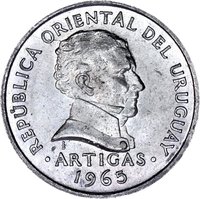
Description:
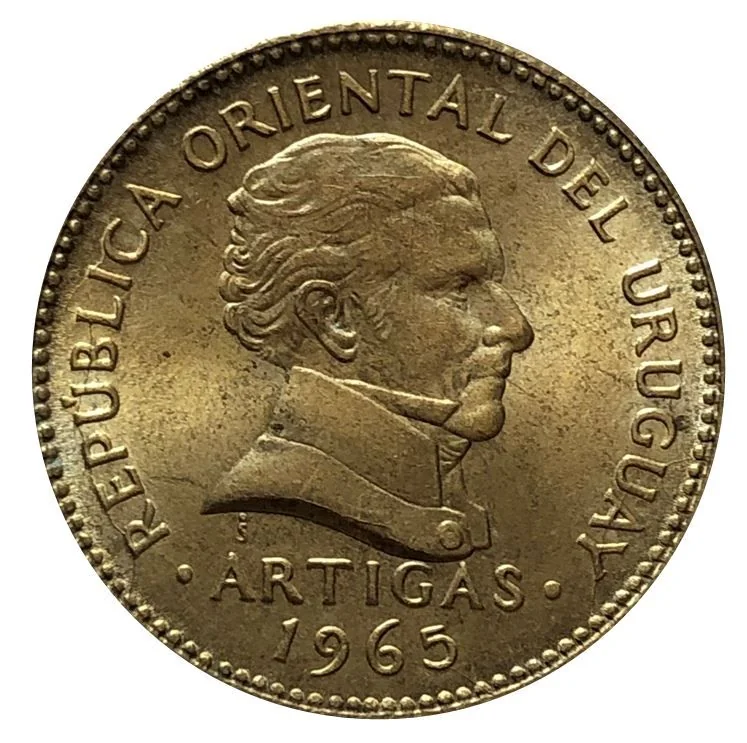
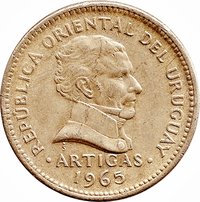
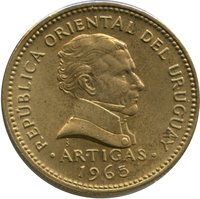
Artigas facing right, date below, country name encircling.
Inscription:
REPÚBLICA ORIENTAL DEL URUGUAY
So
• ARTIGAS •
1965
So
• ARTIGAS •
1965
Translation:
Eastern Republic of Uruguay
South
• ARTIGAS •
1965
South
• ARTIGAS •
1965
Script: Latin
Language: Spanish
Engraver: Santiago Urzúa Valenzuela
Reverse
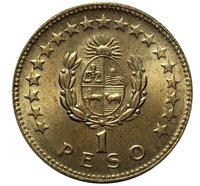
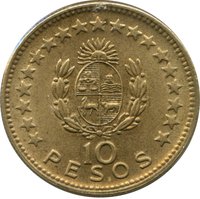
Description:
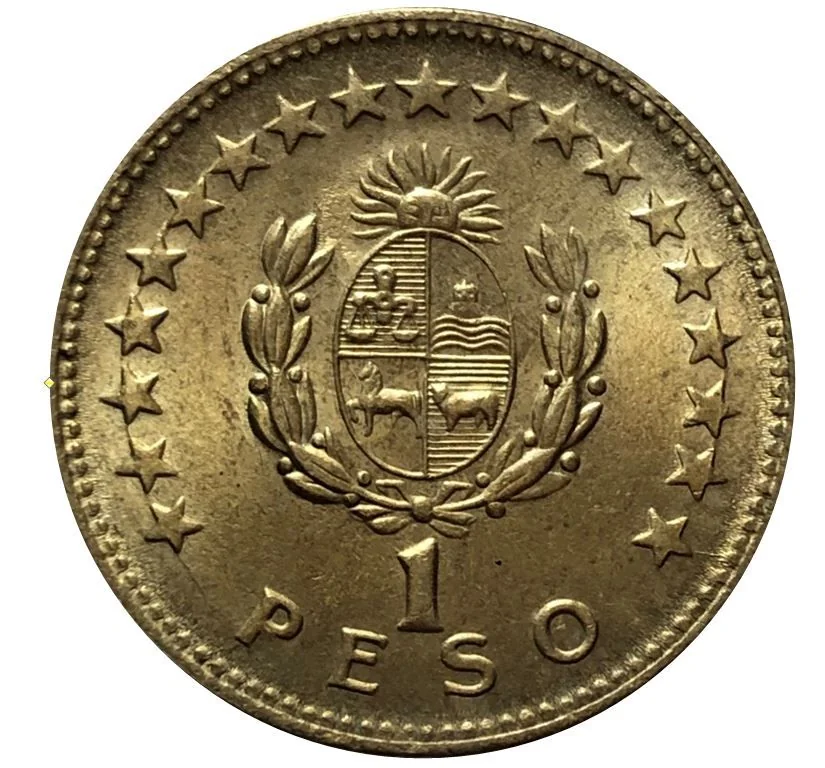
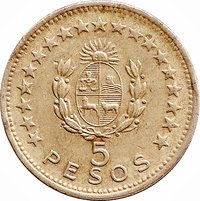
Uruguayan coat of arms, flanked by 19 stars in a circle.
Inscription:
1
PESO
PESO
Translation:
One Peso
Script: Latin
Language: Spanish
Engraver: Santiago Urzúa Valenzuela
Edge
Reeded
Categories
| Person> Military leader |
| Person> Politician |
| Symbol> Sun |
| Symbol> Wreath |
| Symbols> Coat of Arms |
Mints
| Name | Mark |
|---|---|
| Casa de Moneda de Chile | (So) |
Mintings
| Year | Mint Mark | Mintage | Quality | Collection |
|---|---|---|---|---|
| 1965 | So | 60,000,000 | ||
| 1965 | So | 25 | Proof |
Historical background
In 1965, Uruguay was in the midst of a prolonged period of economic stagnation and political tension, a phase that would later be termed the "Uruguayan Crisis." The country's traditional economic model, heavily reliant on agricultural exports like wool and beef, was struggling. A key symptom and cause of this malaise was a severe and persistent currency crisis. The Uruguayan peso was under immense pressure, suffering from chronic devaluation and rampant inflation, which eroded purchasing power and created widespread economic uncertainty.
This currency instability was fundamentally linked to deep structural problems. The state had expanded dramatically through a vast welfare system and a bloated, inefficient public sector, leading to large fiscal deficits. These deficits were increasingly financed by the Central Bank, effectively printing money, which directly fueled inflation. Furthermore, a complex system of multiple exchange rates (a "crawling peg" system with various tiers) was used in an attempt to manage the peso's value, control capital flight, and protect certain sectors. However, this system created distortions, encouraged speculation, and failed to halt the loss of foreign reserves.
The currency turmoil of 1965 was not an isolated event but a critical chapter in a downward spiral. It exacerbated social unrest, contributed to the decline of the once-stable "Switzerland of South America," and set the stage for the severe political and economic upheavals that would culminate in the 1973 civic-military coup. The inability to stabilize the peso reflected a broader failure to adapt the national economy to changing global markets and internal fiscal realities.
This currency instability was fundamentally linked to deep structural problems. The state had expanded dramatically through a vast welfare system and a bloated, inefficient public sector, leading to large fiscal deficits. These deficits were increasingly financed by the Central Bank, effectively printing money, which directly fueled inflation. Furthermore, a complex system of multiple exchange rates (a "crawling peg" system with various tiers) was used in an attempt to manage the peso's value, control capital flight, and protect certain sectors. However, this system created distortions, encouraged speculation, and failed to halt the loss of foreign reserves.
The currency turmoil of 1965 was not an isolated event but a critical chapter in a downward spiral. It exacerbated social unrest, contributed to the decline of the once-stable "Switzerland of South America," and set the stage for the severe political and economic upheavals that would culminate in the 1973 civic-military coup. The inability to stabilize the peso reflected a broader failure to adapt the national economy to changing global markets and internal fiscal realities.
Series: 1965 Uruguay circulation coins
🌱 Very Common