

5000 lire – Italy
Add to wishlist
Non-circulating coins
Commemoration: Towards 2000 (second issue): The Solidarity and the Earth
Series: Towards 2000
Italy
Context
Material
References
KM: #
Numista: #52733
Value
Exchange value: 5000 ITL
Bullion value: $37.73
Inflation-adjusted value: 8376.80 ITL
Obverse
Description:
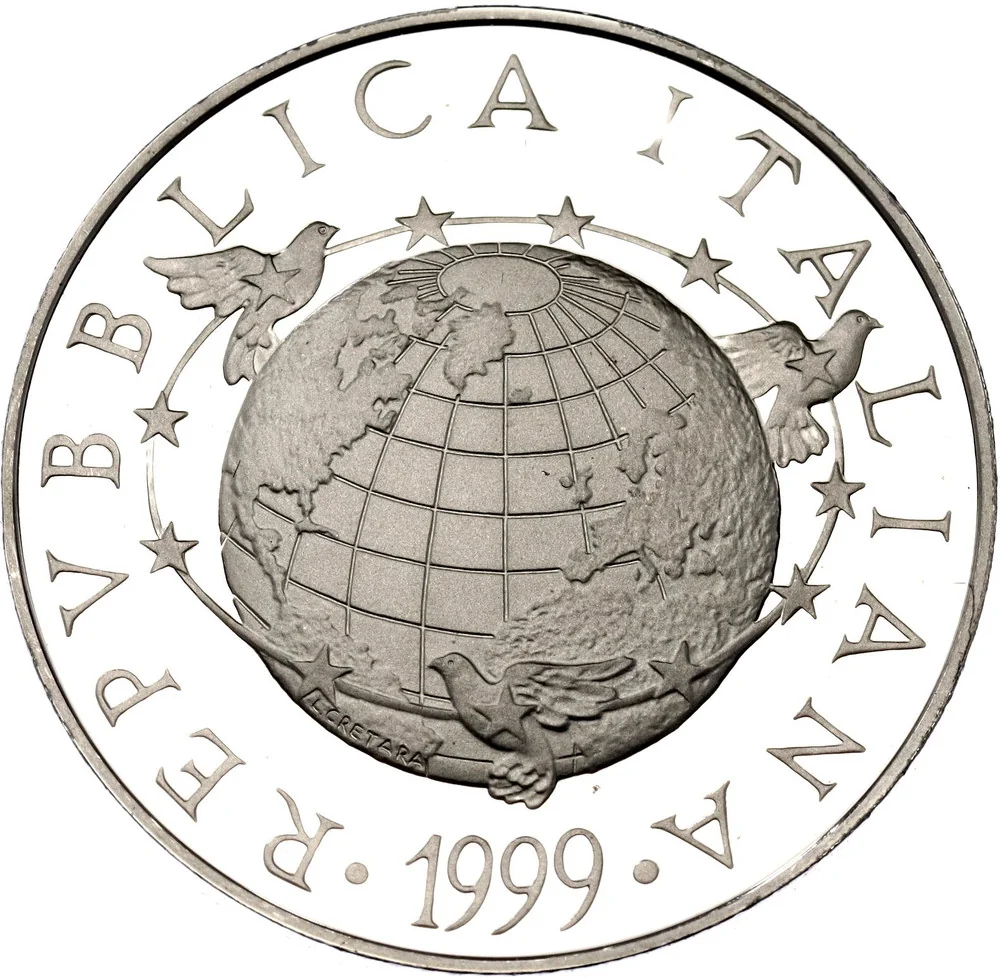
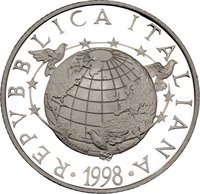
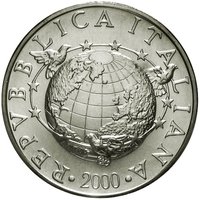
Globe encircled by twelve stars and three doves, representing peace and the third millennium. Date below; author's name near the South Pole.
Inscription:
REPVBBLICA ITALIANA
⠂1999⠂
L.CRETARA
⠂1999⠂
L.CRETARA
Translation:
Italian Republic
1999
L. Cretara
1999
L. Cretara
Script: Latin
Engraver: Laura Cretara
Reverse
Description:
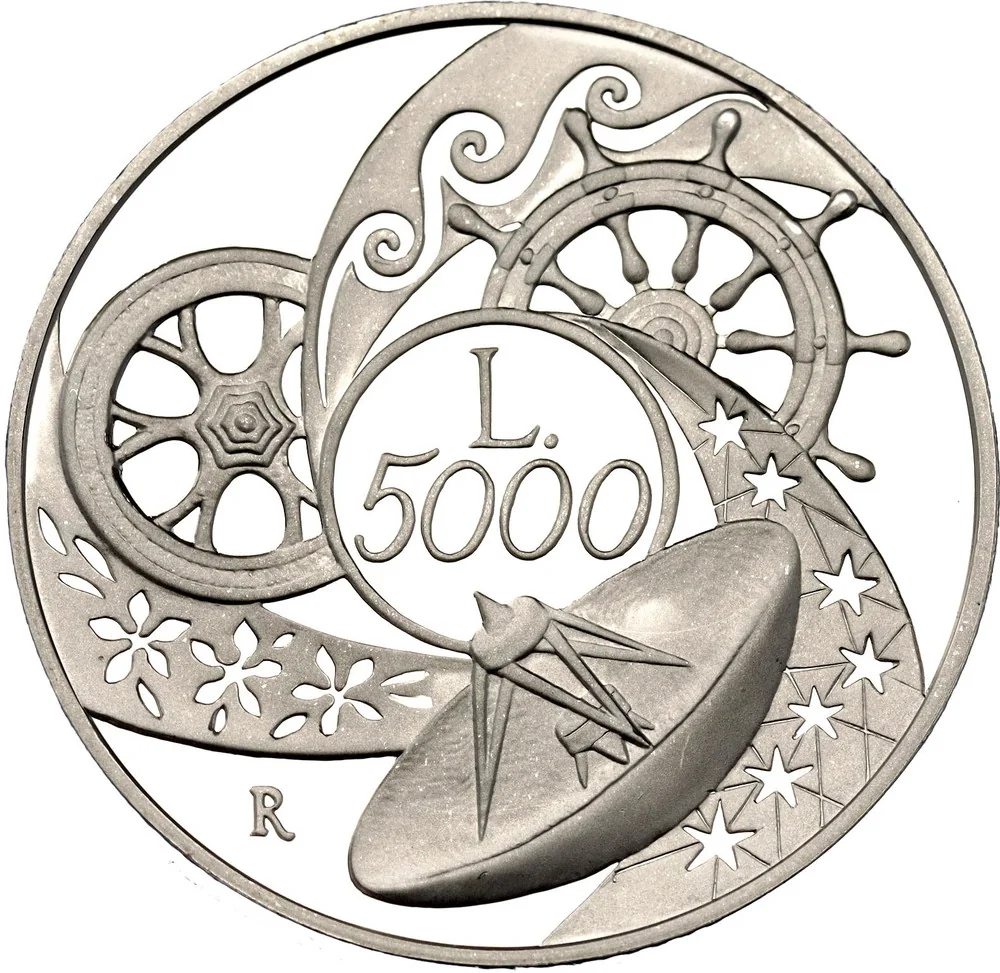
A central circle’s value is encircled clockwise by a wheel, rudder, and radio telescope—key discoveries enabling a “global village.” Three helical bands of flowers, waves, and stars radiate between them. Mintmark at lower left.
Inscription:
L.
5000
R
5000
R
Script: Latin
Engraver: Laura Cretara
Edge
Discountinuous milled.
Mints
| Name | Mark |
|---|---|
| Rome | R |
Historical background
In 1999, Italy was a founding member of the European Economic and Monetary Union (EMU) and adopted the euro as its official currency on January 1st. However, this adoption was purely "virtual" or scriptural for the first three years. The lira remained the physical medium of exchange for everyday transactions, but its value was irrevocably fixed to the euro at a rate of 1,936.27 lire to the euro. During this transitional period, all financial markets, banking, and government transactions were conducted in euros, and prices were often displayed in both currencies to help the public adjust.
This period followed a strenuous decade of economic convergence for Italy, driven by the strict criteria of the Maastricht Treaty. To qualify for the euro, successive Italian governments had implemented tough austerity measures in the 1990s, including significant budget cuts and tax increases, to reduce the country's high public debt and control inflation. The entry into the eurozone was seen as a major political and economic achievement, symbolizing Italy's core place in Europe and promising lower interest rates and greater monetary stability by abandoning the historically volatile lira.
Nevertheless, the 1999 fixation also locked Italy into a relatively strong exchange rate, a point of later economic debate. While the immediate benefits included reduced transaction costs for trade and the elimination of currency risk within the EU, some analysts argued that the conversion rate overvalued Italian industry's competitiveness. This, combined with the loss of independent monetary policy and the ability to devalue the lira, would later be cited as a contributing factor to Italy's prolonged economic stagnation and loss of export share in the subsequent decades, especially compared to Germany. Thus, 1999 marked a moment of both triumph and a fundamental, irreversible shift in Italy's economic policy framework.
This period followed a strenuous decade of economic convergence for Italy, driven by the strict criteria of the Maastricht Treaty. To qualify for the euro, successive Italian governments had implemented tough austerity measures in the 1990s, including significant budget cuts and tax increases, to reduce the country's high public debt and control inflation. The entry into the eurozone was seen as a major political and economic achievement, symbolizing Italy's core place in Europe and promising lower interest rates and greater monetary stability by abandoning the historically volatile lira.
Nevertheless, the 1999 fixation also locked Italy into a relatively strong exchange rate, a point of later economic debate. While the immediate benefits included reduced transaction costs for trade and the elimination of currency risk within the EU, some analysts argued that the conversion rate overvalued Italian industry's competitiveness. This, combined with the loss of independent monetary policy and the ability to devalue the lira, would later be cited as a contributing factor to Italy's prolonged economic stagnation and loss of export share in the subsequent decades, especially compared to Germany. Thus, 1999 marked a moment of both triumph and a fundamental, irreversible shift in Italy's economic policy framework.
Series: Towards 2000

⭐ Somewhat Rare