

5 lepta – Greece
Add to wishlist
Greece
Context
Material
Diameter: 20.5 mm
Weight: 0.85 g
Thickness: 1.2 mm
Shape: Round with a round hole
Magnetic: No
Technique: Milled
Alignment: Medal alignment
flip
References
KM: #
Numista: #527
Value
Exchange value: 0.05 GRD
Obverse
Description:
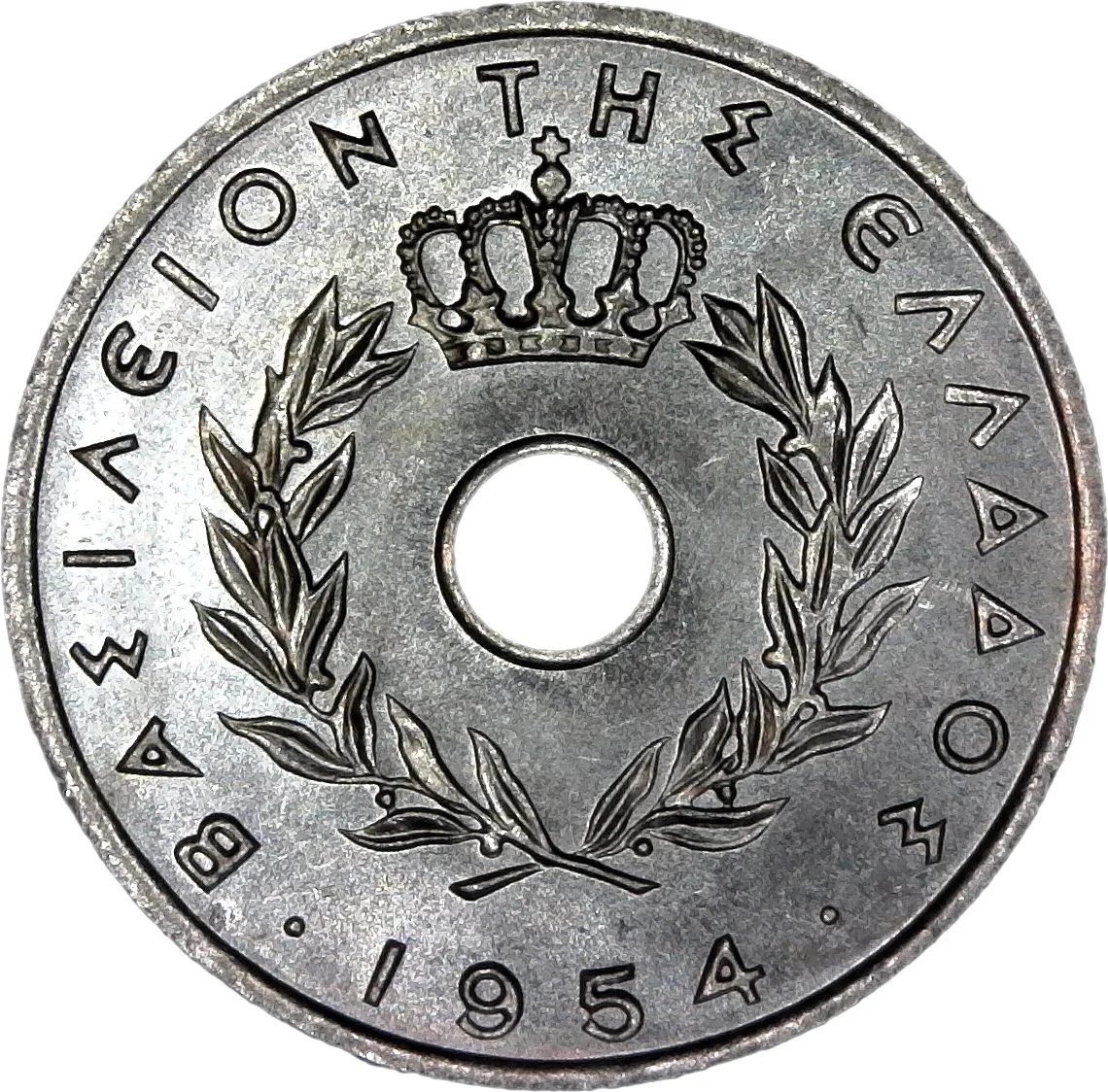
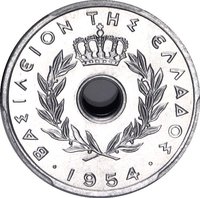
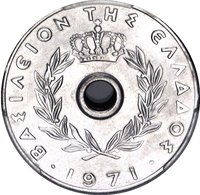
Crowned wreath encircling center hole.
Inscription:
ΒΑΣΙΛΕΙΟΝ ΤΗΣ ΕΛΛΑΔΟΣ • 1954 •
Translation:
KINGDOM OF GREECE • 1954 •
Script: Greek
Language: Greek
Engraver: Vasos Falireas
Reverse
Description:
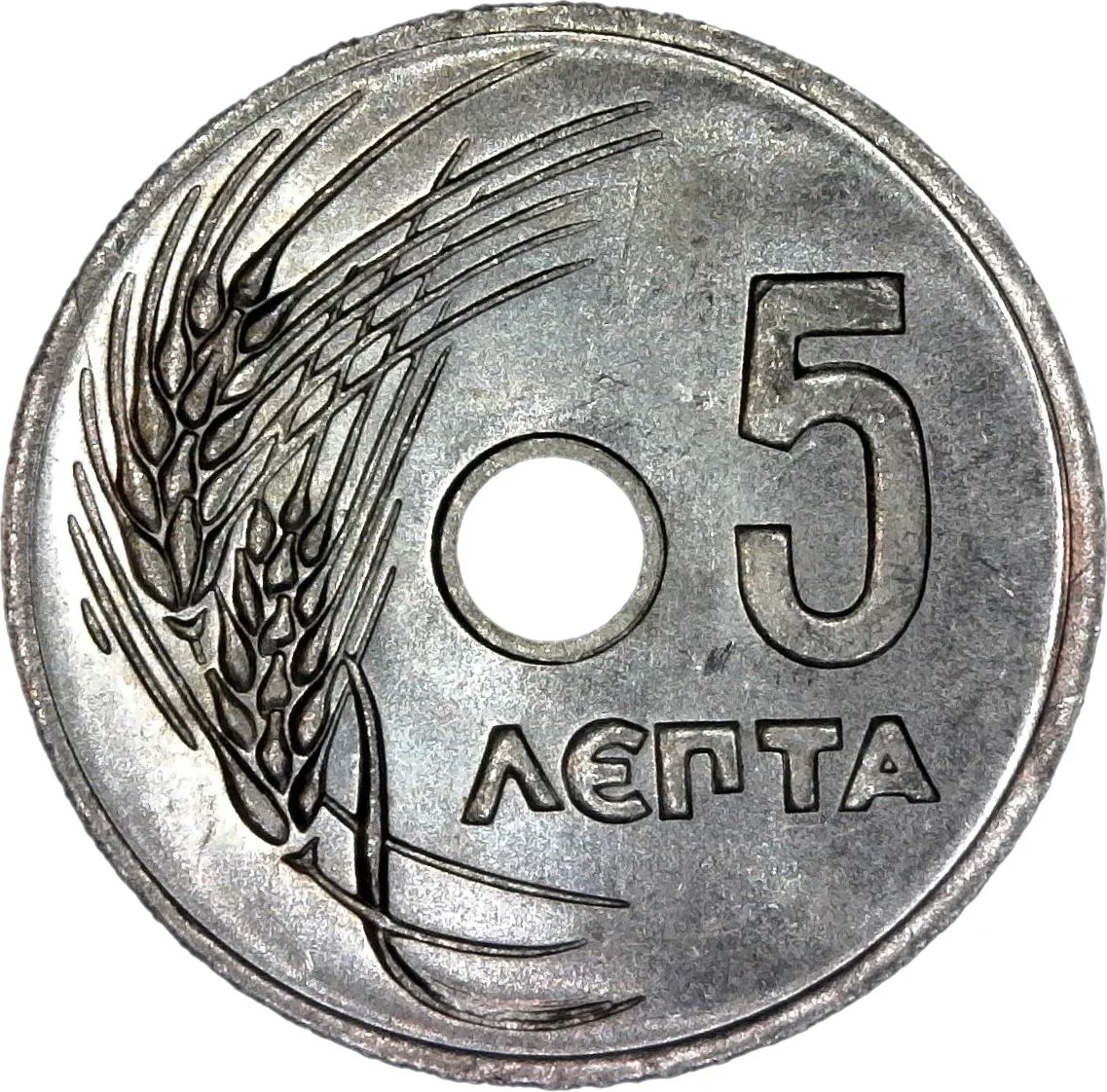
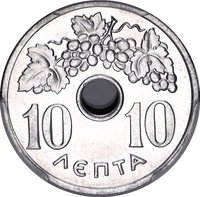
Wheat ears left, denomination right of center hole.
Inscription:
5 ΛΕΠΤΑ
Translation:
Five Lepta
Script: Greek
Language: Greek
Engraver: Vasos Falireas
Edge
Plain
Mints
| Name | Mark |
|---|---|
| Bern | — |
Mintings
| Year | Mint Mark | Mintage | Quality | Collection |
|---|---|---|---|---|
| 1954 | — | 15,000,000 | ||
| 1971 | — | 1,002,174 |
Historical background
In 1954, Greece's currency situation was defined by the aftermath of the devastating Civil War (1946-1949) and the ongoing struggle to achieve monetary stability and economic reconstruction. The national currency, the drachma, was severely weakened by years of occupation, hyperinflation during World War II, and the financial burdens of the subsequent conflict. While the worst hyperinflation had been curbed by earlier reforms, the economy remained fragile, reliant on significant foreign aid, primarily from the United States through the Marshall Plan, to fund essential imports and infrastructure projects.
The government maintained a strict system of exchange controls to manage the drachma's value and conserve scarce foreign reserves. A complex multi-tiered exchange rate regime was in effect, with an official fixed rate for essential transactions and a much less favorable free market rate for others. This created a significant black market for foreign currency, particularly US dollars, which undermined official policy and reflected a lack of confidence in the drachma. The primary economic focus was on controlling inflation and attempting to stabilize the currency as a foundation for growth.
This precarious monetary environment was part of a broader push toward economic normalization. The period saw Greece aligning more closely with Western European systems, having joined NATO in 1952. The currency instability of 1954 set the stage for more decisive reforms later in the decade, culminating in the 1953 devaluation and the pivotal 1955 currency reform that introduced the "heavy drachma" (1 new drachma = 1000 old drachma) in an effort to restore confidence and simplify transactions, marking a critical step in Greece's post-war economic integration.
The government maintained a strict system of exchange controls to manage the drachma's value and conserve scarce foreign reserves. A complex multi-tiered exchange rate regime was in effect, with an official fixed rate for essential transactions and a much less favorable free market rate for others. This created a significant black market for foreign currency, particularly US dollars, which undermined official policy and reflected a lack of confidence in the drachma. The primary economic focus was on controlling inflation and attempting to stabilize the currency as a foundation for growth.
This precarious monetary environment was part of a broader push toward economic normalization. The period saw Greece aligning more closely with Western European systems, having joined NATO in 1952. The currency instability of 1954 set the stage for more decisive reforms later in the decade, culminating in the 1953 devaluation and the pivotal 1955 currency reform that introduced the "heavy drachma" (1 new drachma = 1000 old drachma) in an effort to restore confidence and simplify transactions, marking a critical step in Greece's post-war economic integration.
Series: 1954 Greece circulation coins
🌱 Very Common