

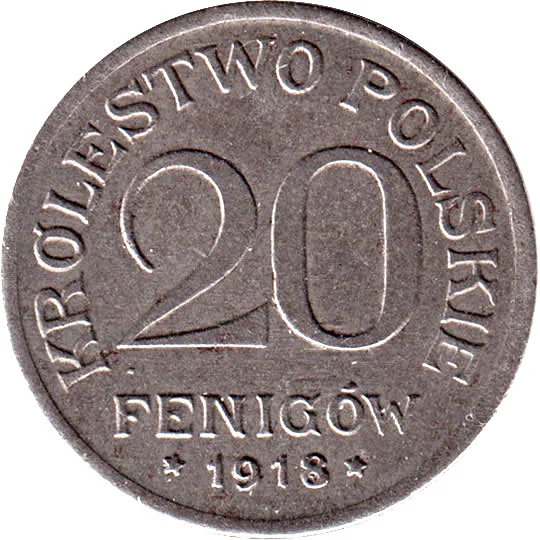
20 Pfennigs – Poland
Poland

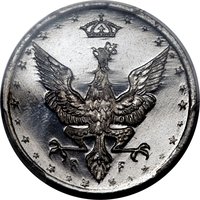
Obverse
Description:
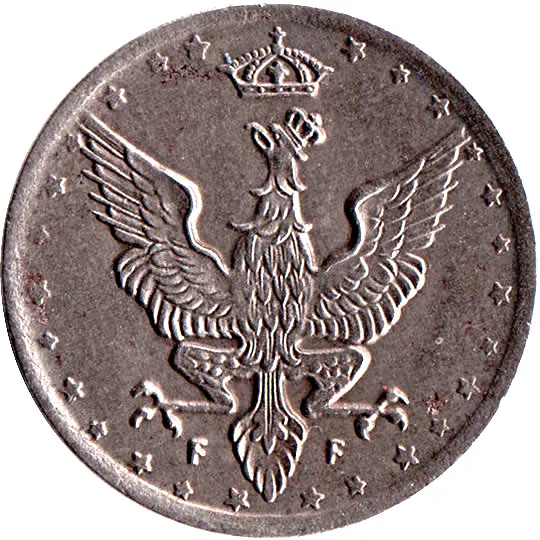
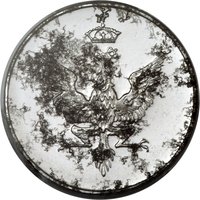
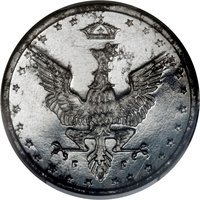
Crowned eagle in flight, facing left.
Inscription:
F F
Script: Latin
Engraver: Ludwig Habich
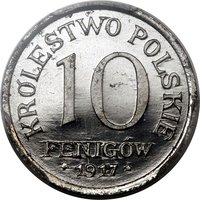
Reverse
Edge
Plain
Mints
| Name | Mark |
|---|---|
| Staatliche Münze Baden-Württemberg | F F |
Mintings
| Year | Mint Mark | Mintage | Quality | Collection |
|---|---|---|---|---|
| 1917 | FF | — | Proof | |
| 1917 | FF | 1,900,000 | ||
| 1918 | FF | 19,260,800 | ||
| 1918 | FF | — | Proof |
Historical background
In 1917, Poland found itself in a unique and complex currency situation, a direct consequence of its occupation and partition by the Central Powers (Germany and Austria-Hungary) during the First World War. The pre-war Russian ruble, Austrian krone, and German mark all circulated in their respective occupation zones, but these were increasingly unstable due to wartime inflation and a lack of public trust. Recognizing the need for economic stability to secure their occupied territory, the German and Austrian authorities established the Polish Loan Bank (Polska Krajowa Kasa Pożyczkowa) in Warsaw in late 1916, granting it the exclusive right to issue a new currency.
The new currency, the Polish mark (marka polska), was introduced in 1917. However, it was not an independent national currency; it was a form of occupation money, backed not by Polish reserves but by the German Reichsmark and tied to the German financial system. While it replaced the multitude of circulating currencies with a single, unified medium of exchange across the former Russian partition, its value was entirely dependent on the fiscal and military fortunes of Germany. This meant the Polish mark was vulnerable to inflation from the outset, inheriting the economic pressures of the Central Powers' war effort.
Thus, the currency landscape of 1917 was one of fragile and imposed unification. The creation of the Polish mark was a significant administrative step that laid a technical foundation for a future Polish financial system, yet it underscored Poland's lack of true sovereignty. The currency's fate, and that of the Polish economy, remained inextricably linked to the outcome of the war and the political struggle to re-establish an independent Polish state, which would eventually have to confront the legacy of this occupation money and its severe depreciation.
The new currency, the Polish mark (marka polska), was introduced in 1917. However, it was not an independent national currency; it was a form of occupation money, backed not by Polish reserves but by the German Reichsmark and tied to the German financial system. While it replaced the multitude of circulating currencies with a single, unified medium of exchange across the former Russian partition, its value was entirely dependent on the fiscal and military fortunes of Germany. This meant the Polish mark was vulnerable to inflation from the outset, inheriting the economic pressures of the Central Powers' war effort.
Thus, the currency landscape of 1917 was one of fragile and imposed unification. The creation of the Polish mark was a significant administrative step that laid a technical foundation for a future Polish financial system, yet it underscored Poland's lack of true sovereignty. The currency's fate, and that of the Polish economy, remained inextricably linked to the outcome of the war and the political struggle to re-establish an independent Polish state, which would eventually have to confront the legacy of this occupation money and its severe depreciation.
Series: 1917 Poland circulation coins
🌱 Common