

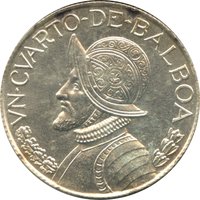
Obverse
Description:
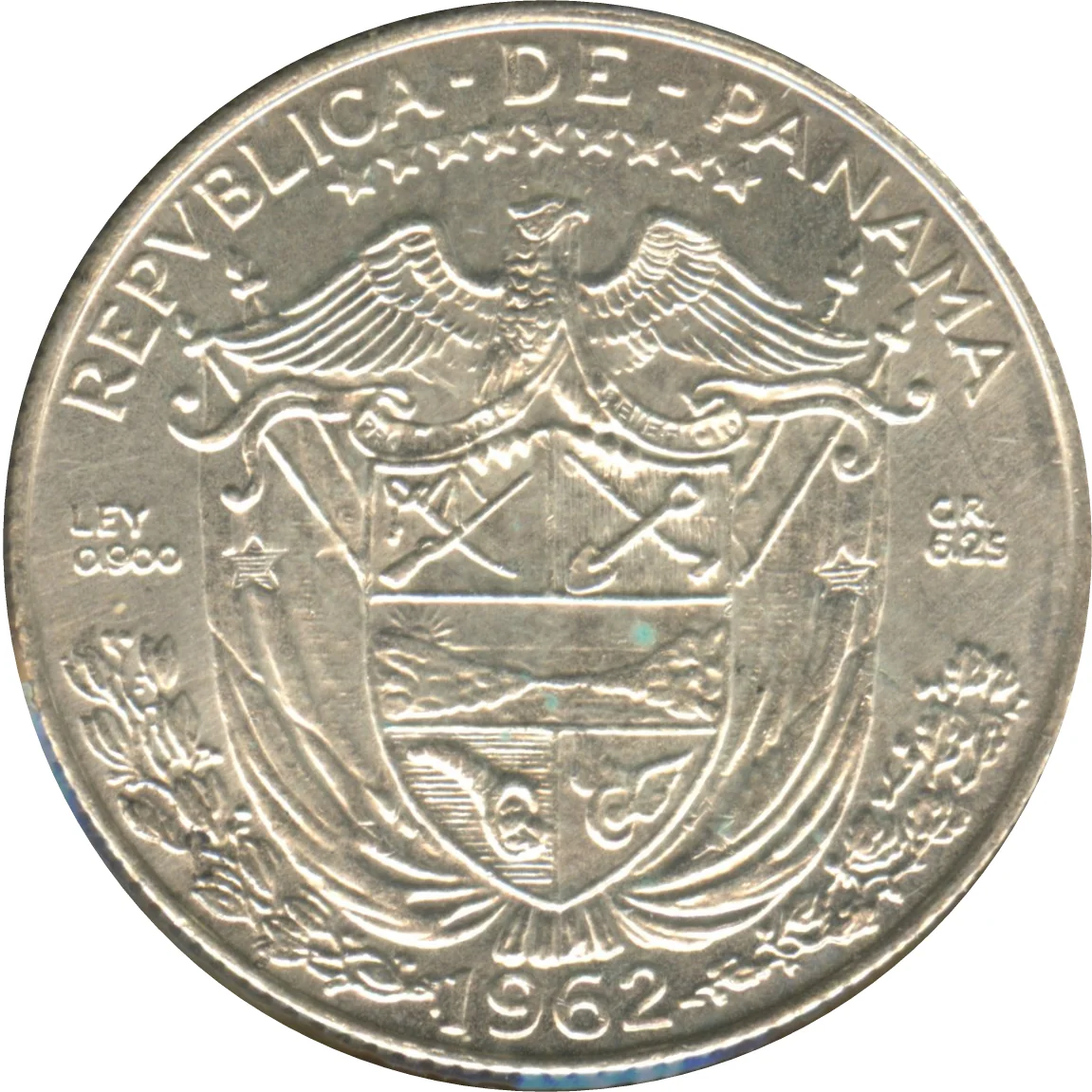
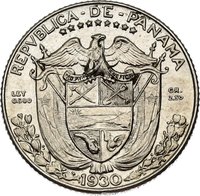
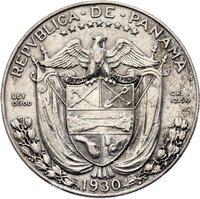
Panama’s coat of arms with nine stars (for the original provinces) and country name above, silver content on both sides, and date below.
Inscription:
REPUBLICA DE PANAMA
*********
PRO MUNDI BENEFICIO
LEY GR
0.900 6.25
1962
*********
PRO MUNDI BENEFICIO
LEY GR
0.900 6.25
1962
Translation:
REPUBLIC OF PANAMA
FOR THE BENEFIT OF THE WORLD
LAW GR
0.900 6.25
1962
FOR THE BENEFIT OF THE WORLD
LAW GR
0.900 6.25
1962
Script: Latin
Reverse
Edge
Reeded
Categories
| Symbols> Coat of Arms |
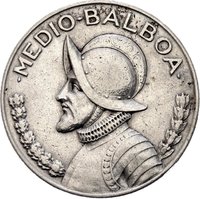
| Person> Explorer |
Mints
| Name | Mark |
|---|---|
| Royal Mint (Tower Hill) | — |
| United States Mint of Philadelphia | — |
| United States Mint of San Francisco | — |
Mintings
| Year | Mint Mark | Mintage | Quality | Collection |
|---|---|---|---|---|
| 1930 | — | 400,000 | ||
| 1930 | — | 20 | Proof | |
| 1931 | — | 48,000 | ||
| 1932 | — | 126,000 | ||
| 1933 | — | 120,000 | ||
| 1934 | — | 90,000 | ||
| 1947 | — | 700,000 | ||
| 1962 | — | 4,000,000 | ||
| 1962 | — | 25 | Proof |
Historical background
In 1930, Panama’s currency situation was uniquely defined by its relationship with the United States, established at the nation's birth in 1904. Unlike its neighbors, Panama did not issue its own paper currency. Instead, the official legal tender was the Balboa, which was pegged at par (1:1) to the United States dollar. This dollar was itself still on the gold standard, meaning the Balboa was indirectly backed by gold through this fixed link. U.S. paper dollars and coins circulated freely alongside Panamanian silver coins (centésimos and balboas), creating a de facto dollarized economy.
This monetary arrangement provided exceptional stability during the early onset of the Great Depression. While other Latin American nations faced banking crises, devaluations, and rampant inflation due to collapsing export revenues, Panama's economy was insulated from currency shocks. The fixed link to the dollar ensured price stability and maintained international creditworthiness, which was crucial for a country whose economy was heavily dependent on the U.S.-run Panama Canal and associated trade. The system also facilitated seamless financial transactions with its largest economic partner.
However, this stability came with a significant cost: the surrender of independent monetary policy. The National Bank of Panama, established in 1904, could not act as a central bank to devalue the currency to boost exports or print money to stimulate the domestic economy. As the global depression deepened after 1930, Panama was therefore forced to rely solely on fiscal policy and direct economic adjustments to confront the severe downturn in global trade, which drastically reduced Canal traffic and agricultural export income. Thus, while its currency was a bastion of stability, it also limited the nation's tools for economic recovery.
This monetary arrangement provided exceptional stability during the early onset of the Great Depression. While other Latin American nations faced banking crises, devaluations, and rampant inflation due to collapsing export revenues, Panama's economy was insulated from currency shocks. The fixed link to the dollar ensured price stability and maintained international creditworthiness, which was crucial for a country whose economy was heavily dependent on the U.S.-run Panama Canal and associated trade. The system also facilitated seamless financial transactions with its largest economic partner.
However, this stability came with a significant cost: the surrender of independent monetary policy. The National Bank of Panama, established in 1904, could not act as a central bank to devalue the currency to boost exports or print money to stimulate the domestic economy. As the global depression deepened after 1930, Panama was therefore forced to rely solely on fiscal policy and direct economic adjustments to confront the severe downturn in global trade, which drastically reduced Canal traffic and agricultural export income. Thus, while its currency was a bastion of stability, it also limited the nation's tools for economic recovery.
🌱 Very Common