

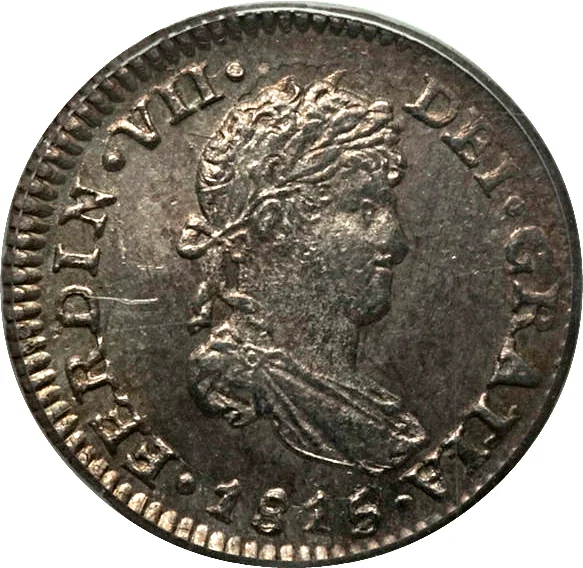
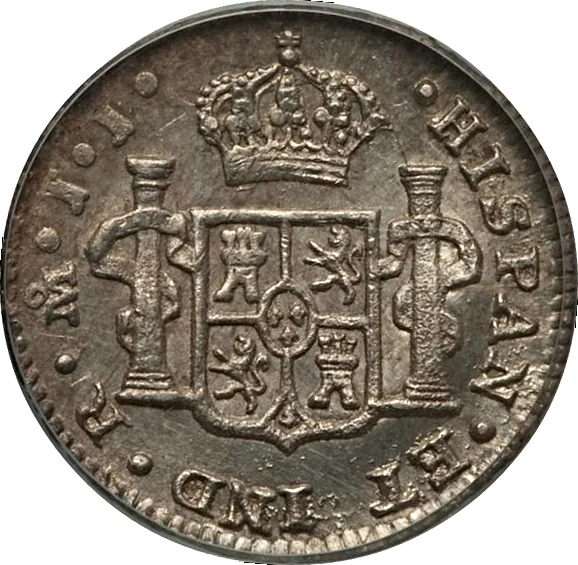
½ real – New Spain
Add to wishlist
Mexico
Context
Years: 1815–1821
Country: Mexico
Issuer: New Spain
Ruler: Ferdinand VII
Currency:
(1535—1897)
Demonetized: Yes
Material
References
KM: #
Numista: #52211
Value
Bullion value: $3.74
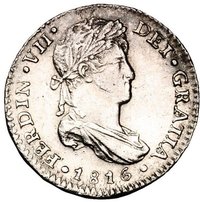
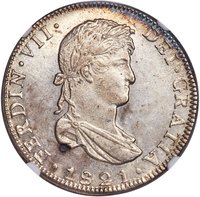
Obverse
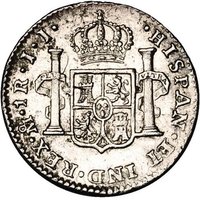
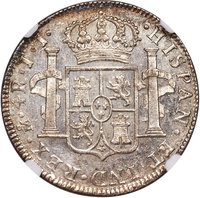
Reverse
Description:
Spain's Royal coat of arms, encircled by the colonial motto "Hispania * et * Indias * Rex", mint, and assayer's initials.
Inscription:
•HISPAN•ET IND•R•Mo•J•J•
Translation:
Hispaniarum et Indiarum Rex, Josephus Junctim.
King of the Spains and the Indies, Joseph, Jointly.
King of the Spains and the Indies, Joseph, Jointly.
Script: Latin
Language: Latin
Edge
MILLED
Mintings
| Year | Mint Mark | Mintage | Quality | Collection |
|---|---|---|---|---|
| 1815 | Mo | — | ||
| 1816 | Mo | — | ||
| 1817 | Mo | — | ||
| 1818 | Mo | — | ||
| 1819 | Mo | — | ||
| 1820 | Mo | — | ||
| 1821 | Mo | — | ||
| 1821 | Z | — |
Historical background
By 1815, the currency situation in New Spain was one of profound crisis and confusion, a direct reflection of the wider political and military turmoil of the ongoing War of Independence. The royalist government, controlling Mexico City and the central core of the viceroyalty, faced immense financial strain from funding the counter-insurgency campaign. To meet these escalating costs, the authorities resorted to the heavy debasement of the silver coinage. The famous "pieces of eight," once renowned for their purity, were now being minted with significantly reduced silver content, leading to a loss of public trust and the hoarding of older, higher-quality coins.
This monetary degradation created a chaotic multi-currency environment. Alongside the debased official coinage, a vast quantity of tlacos (copper tokens issued by merchants and haciendas) and pilones (even smaller fractional tokens) circulated locally, while older full-weight Spanish and colonial coins remained in hiding. Furthermore, in territories controlled by insurgent forces, various revolutionary leaders issued their own crude copper or silver coins to fund their cause, adding another layer of complexity. The result was a breakdown in the standardized monetary system, with widespread uncertainty about the real value of any coin, stifling commerce and fueling inflation.
Ultimately, the currency chaos of 1815 was both a symptom and a cause of the collapsing colonial order. The royalist government's fiscal desperation eroded the very symbol of New Spain's economic stability—its reliable silver currency—undermining its own legitimacy. For the populace, the daily experience of unreliable money compounded the hardships of war, disrupting markets and creating a tangible sense of administrative and economic collapse. This financial disintegration mirrored the political reality: by 1815, the unified monetary system of the viceroyalty, like its political authority, was fractured beyond repair.
This monetary degradation created a chaotic multi-currency environment. Alongside the debased official coinage, a vast quantity of tlacos (copper tokens issued by merchants and haciendas) and pilones (even smaller fractional tokens) circulated locally, while older full-weight Spanish and colonial coins remained in hiding. Furthermore, in territories controlled by insurgent forces, various revolutionary leaders issued their own crude copper or silver coins to fund their cause, adding another layer of complexity. The result was a breakdown in the standardized monetary system, with widespread uncertainty about the real value of any coin, stifling commerce and fueling inflation.
Ultimately, the currency chaos of 1815 was both a symptom and a cause of the collapsing colonial order. The royalist government's fiscal desperation eroded the very symbol of New Spain's economic stability—its reliable silver currency—undermining its own legitimacy. For the populace, the daily experience of unreliable money compounded the hardships of war, disrupting markets and creating a tangible sense of administrative and economic collapse. This financial disintegration mirrored the political reality: by 1815, the unified monetary system of the viceroyalty, like its political authority, was fractured beyond repair.
🌟 Limited