

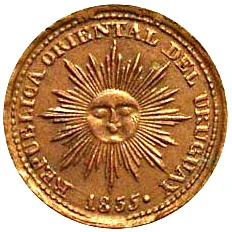
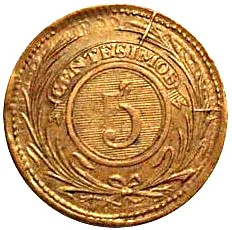
5 Centésimos – Uruguay
Uruguay
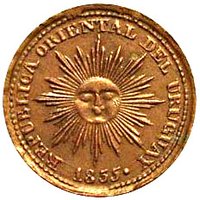
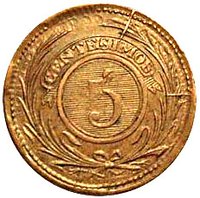
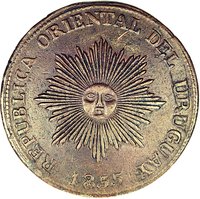
Obverse
Description:
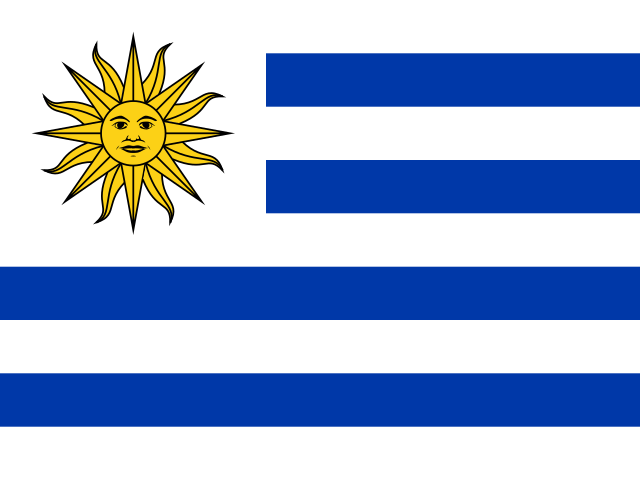
Radiant sun with a face, larger than before with smaller rays, encircled by the country name and the date below.
Inscription:
REPUBLICA ORIENTAL DEL URUGUAY
1855
1855
Translation:
Eastern Republic of the Uruguay
1855
1855
Script: Latin
Language: Spanish
Engraver: Agustín Rivero
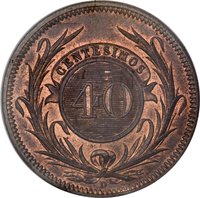
Reverse
Edge
SmoothLiso
Mints
| Name | Mark |
|---|---|
| Casa de Moneda | — |
Mintings
| Year | Mint Mark | Mintage | Quality | Collection |
|---|---|---|---|---|
| 1855 | — | 8,000 |
Historical background
In 1855, Uruguay's currency situation was characterized by profound instability and complexity, a direct legacy of the Guerra Grande (1839-1851). The prolonged civil war had devastated the national treasury and led to the issuance of vast quantities of irredeemable paper money by both the Montevideo-based Gobierno de la Defensa and the rival Gobierno del Cerrito. By the war's end, the country was flooded with devalued paper notes, while scarce silver and gold coins (specie) commanded a high premium and were used for international trade.
The post-war government, under President Juan Francisco Giró and later Venancio Flores, faced the monumental task of unifying this chaotic monetary system. The primary currency in circulation was the peso moneda corriente, a paper currency that had lost most of its value. Efforts to establish a stable national currency were hindered by a lack of precious metal reserves and persistent fiscal deficits. Consequently, foreign coins, particularly Argentine, Brazilian, French, and British, circulated widely alongside the depreciated paper, creating a confusing and inefficient multi-currency environment.
This monetary anarchy severely hampered economic recovery and state-building. The government's attempts to contract foreign loans to bolster reserves were largely unsuccessful at this time, and it would not be until the 1860s and the reforms of Finance Minister José Cándido Bustamante that more decisive steps—like the creation of the peso fuerte—were taken toward stabilization. Thus, in 1855, Uruguay remained in a transitional and precarious monetary state, with its currency chaos serving as a daily reminder of the economic costs of civil strife.
The post-war government, under President Juan Francisco Giró and later Venancio Flores, faced the monumental task of unifying this chaotic monetary system. The primary currency in circulation was the peso moneda corriente, a paper currency that had lost most of its value. Efforts to establish a stable national currency were hindered by a lack of precious metal reserves and persistent fiscal deficits. Consequently, foreign coins, particularly Argentine, Brazilian, French, and British, circulated widely alongside the depreciated paper, creating a confusing and inefficient multi-currency environment.
This monetary anarchy severely hampered economic recovery and state-building. The government's attempts to contract foreign loans to bolster reserves were largely unsuccessful at this time, and it would not be until the 1860s and the reforms of Finance Minister José Cándido Bustamante that more decisive steps—like the creation of the peso fuerte—were taken toward stabilization. Thus, in 1855, Uruguay remained in a transitional and precarious monetary state, with its currency chaos serving as a daily reminder of the economic costs of civil strife.
✨ Legendary