

1 lats – Latvia
Add to wishlist
Non-circulating coins
Commemoration: Coin commemorating the barricades of January 1991
Latvia
Context
Material
Diameter: 38.61 mm
Weight: 31.47 g
Silver Weight:: 29.11 g
Shape: Round
Composition: 92.5% Silver
Standard: Silver ounce
Magnetic: No
Technique: Milled
Alignment: Medal alignment
flip
References
KM: #
Numista: #51691
Value
Exchange value: 1 LVL
Bullion value: $73.07
Inflation-adjusted value: 2.18 LVL
Obverse
Description:
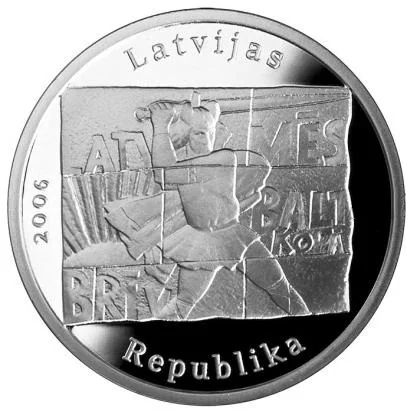
Lāčplēsis, a Latvian mythological hero, stands with a raised sword against concrete barricades and a rising sun. The blocks bear fragments of freedom appeals. "2006" is in a semicircle to the left, with "Latvijas" above and "Republika" below the central image.
Inscription:
Latvijas
2006
Republika
2006
Republika
Translation:
Latvia
2006
Republic
2006
Republic
Script: Latin
Engraver: Andris Vārpa
Designer: Juris Petraškevičs
Reverse
Description:
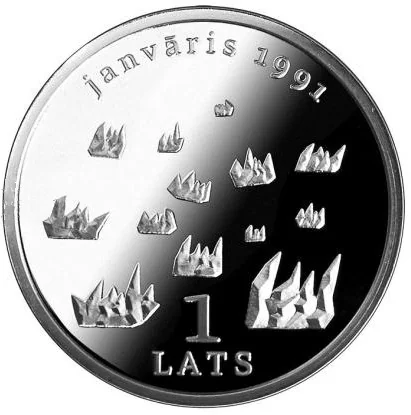
Stylized bonfire flames. "janvāris 1991" arcs above; a large numeral 1 with "LATS" below is centered.
Inscription:
janvāris 1991
1
LATS
1
LATS
Translation:
January 1991
1
LATS
1
LATS
Script: Latin
Language: Latvian
Engraver: Andris Vārpa
Designer: Juris Petraškevičs
Edge
Two inscriptions LATVIJAS BANKA (Bank of Latvia), separated by rhombic dots.
Legend:
LATVIJAS BANKA ◊ LATVIJAS BANKA ◊
Translation:
LATVIJAS BANKA ◊ LATVIJAS BANKA ◊
Language: Latvian
Mints
| Name | Mark |
|---|---|
| Mint of Finland | — |
Mintings
| Year | Mint Mark | Mintage | Quality | Collection |
|---|---|---|---|---|
| 2006 | — | 5,000 | Proof |
Historical background
In 2006, Latvia was in a period of robust economic expansion, often referred to as the "Baltic Tiger" boom, with GDP growth exceeding 10%. This growth was fueled by massive foreign investment, easy credit, and a surge in domestic consumption. However, this prosperity came with significant underlying strains, primarily a rapidly growing current account deficit that exceeded 20% of GDP, one of the highest in the world. This deficit signaled that the nation was consuming far more than it produced, relying heavily on foreign capital inflows, which created vulnerability to a sudden shift in investor sentiment.
The currency situation was defined by Latvia's fixed exchange rate regime, established in 1994. The Latvian lats (LVL) was pegged to the Special Drawing Right (SDR), a basket of major currencies, but was effectively anchored to the euro as part of the country's official strategy to eventually join the Eurozone. This peg provided stability and was a cornerstone of monetary policy, but it also limited the central bank's options. With inflation rising sharply (reaching over 6% by year's end) due to the overheating economy, the Bank of Latvia could not use interest rate adjustments to cool demand, as higher rates would only attract more speculative capital inflows, exacerbating the imbalances.
Consequently, by late 2006, economists and international institutions like the IMF were issuing strong warnings about the sustainability of Latvia's economic trajectory. The fixed exchange rate, combined with high wage growth and rising prices, was leading to a severe loss of competitiveness. The situation was a classic precursor to a "hard landing," setting the stage for the profound crisis that would erupt in 2008 when the global financial freeze triggered the capital flight and deep recession that the 2006 imbalances had made inevitable.
The currency situation was defined by Latvia's fixed exchange rate regime, established in 1994. The Latvian lats (LVL) was pegged to the Special Drawing Right (SDR), a basket of major currencies, but was effectively anchored to the euro as part of the country's official strategy to eventually join the Eurozone. This peg provided stability and was a cornerstone of monetary policy, but it also limited the central bank's options. With inflation rising sharply (reaching over 6% by year's end) due to the overheating economy, the Bank of Latvia could not use interest rate adjustments to cool demand, as higher rates would only attract more speculative capital inflows, exacerbating the imbalances.
Consequently, by late 2006, economists and international institutions like the IMF were issuing strong warnings about the sustainability of Latvia's economic trajectory. The fixed exchange rate, combined with high wage growth and rising prices, was leading to a severe loss of competitiveness. The situation was a classic precursor to a "hard landing," setting the stage for the profound crisis that would erupt in 2008 when the global financial freeze triggered the capital flight and deep recession that the 2006 imbalances had made inevitable.
💎 Extremely Rare