

1 Lats – Latvia
Non-circulating coins
Commemoration: 2006 FIFA World Cup Germany
Latvia
Context

Material
Diameter: 38.61 mm
Weight: 31.47 g
Silver weight: 29.11 g
Shape: Round
Composition: 92.5% Silver
Standard: Silver ounce
Magnetic: No
Technique: Milled
Alignment: Medal alignment
flip
References
KM: #Click to copy to clipboard63
Numista: #51671
Value
Exchange value: 1 LVL
Bullion value: $83.92
Inflation-adjusted value: 2.47 LVL
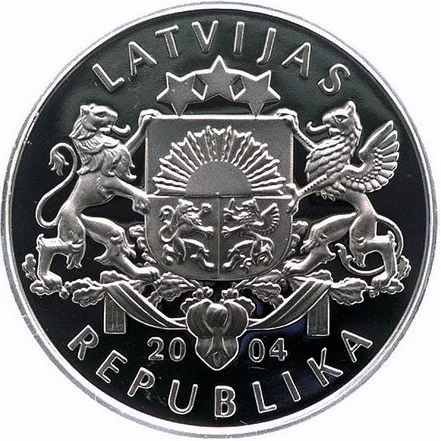
Obverse
Description:
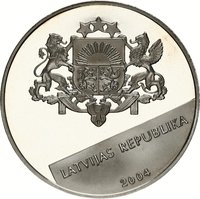
The central large coat of arms of Latvia is flanked above and below by the semicircular inscriptions "LATVIJAS" and "REPUBLIKA," with the year 2004 inscribed beneath.
Inscription:
LATVIJAS
2004
REPUBLIKA
2004
REPUBLIKA
Translation:
REPUBLIC OF LATVIA
2004
2004
Script: Latin
Engraver: Ligita Franckeviča
Designer: Henrihs Vorkals
Reverse
Description:
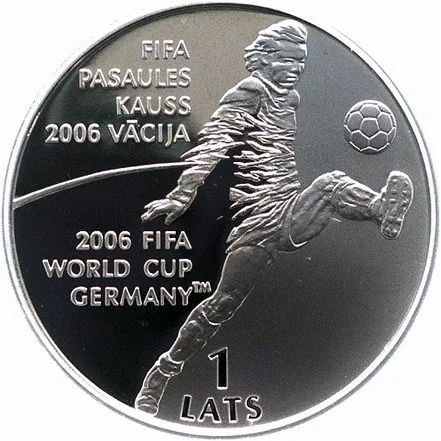
The reverse's left side is smooth with inscriptions "FIFA PASAULES KAUSS 2006 VACIJA" and "2006 FIFA WORLD CUP GERMANYTM" at the top and bottom; the right side has a dull surface featuring a football player with a ball above the inscription "LATS" topped by the numeral 1.
Inscription:
FIFA
PASAULES
KAUSS
2006 VĀCIJA
2006 FIFA
WORLD CUP
GERMANY TM
1
LATS
PASAULES
KAUSS
2006 VĀCIJA
2006 FIFA
WORLD CUP
GERMANY TM
1
LATS
Translation:
FIFA
WORLD
CUP
2006 GERMANY
2006 FIFA
WORLD CUP
GERMANY TM
1
LATS
WORLD
CUP
2006 GERMANY
2006 FIFA
WORLD CUP
GERMANY TM
1
LATS
Script: Latin
Engraver: Ligita Franckeviča
Designer: Henrihs Vorkals
Edge
Three inscriptions LATVIJA, separated by rhombic dots.
Legend:
LATVIJA ◊ LATVIJA ◊ LATVIJA ◊
Translation:
LATVIA ◊ LATVIA ◊ LATVIA ◊
Language: Latvian
Categories
| Sport> Football> FIFA World Cup |
Mints
| Name | Mark |
|---|---|
| Royal Mint | — |
Mintings
| Year | Mint Mark | Mintage | Quality | Collection |
|---|---|---|---|---|
| 2004 | — | 50,000 | Proof |
Historical background
In 2004, Latvia's currency situation was defined by its imminent accession to the European Union on May 1st and its long-term, but still distant, goal of adopting the euro. The national currency was the Latvian lats (LVL), which had been successfully reintroduced in 1993 following independence, replacing the temporary Latvian rublis. The lats was a symbol of national stability and sovereignty, having been pegged to the IMF's Special Drawing Rights (SDR) basket since 1994. This peg provided crucial stability after the hyperinflation of the early 1990s and was a cornerstone of the country's economic policy.
Politically and economically, the focus was on meeting the EU's convergence criteria (the Maastricht criteria) as a prerequisite for future euro adoption. Latvia maintained a strict fixed exchange rate regime, which functioned as a quasi-currency board, ensuring low inflation and fiscal discipline. This policy was largely successful; the economy was growing rapidly, and macroeconomic indicators were strong. However, full eurozone membership was not an immediate prospect, as the country first had to demonstrate sustained compliance with the stability criteria for a minimum of two years within the European Exchange Rate Mechanism (ERM II), a test it had not yet entered.
Consequently, 2004 was a year of preparation and alignment rather than immediate monetary change. The lats remained firmly in place, enjoying public confidence and serving as a stable foundation for EU integration. The national strategy was clear: use the stability of the fixed peg to converge with EU economies, eventually enter ERM II, and then target euro adoption, a process expected to take several more years. The immediate currency situation was thus one of stability and deliberate transition, with the lats serving as the bridge between Latvia's post-Soviet recovery and its future within the core of the European monetary project.
Politically and economically, the focus was on meeting the EU's convergence criteria (the Maastricht criteria) as a prerequisite for future euro adoption. Latvia maintained a strict fixed exchange rate regime, which functioned as a quasi-currency board, ensuring low inflation and fiscal discipline. This policy was largely successful; the economy was growing rapidly, and macroeconomic indicators were strong. However, full eurozone membership was not an immediate prospect, as the country first had to demonstrate sustained compliance with the stability criteria for a minimum of two years within the European Exchange Rate Mechanism (ERM II), a test it had not yet entered.
Consequently, 2004 was a year of preparation and alignment rather than immediate monetary change. The lats remained firmly in place, enjoying public confidence and serving as a stable foundation for EU integration. The national strategy was clear: use the stability of the fixed peg to converge with EU economies, eventually enter ERM II, and then target euro adoption, a process expected to take several more years. The immediate currency situation was thus one of stability and deliberate transition, with the lats serving as the bridge between Latvia's post-Soviet recovery and its future within the core of the European monetary project.
💎 Very Rare