

500 tenge (Congress of World Leaders and Traditional Religions) – Kazakhstan
Add to wishlist
Non-circulating coins
Commemoration: 10th Anniversary of the Congress of World Leaders and Traditional Religions
Series: Outstanding events
Kazakhstan
Context
Material
Diameter: 38.61 mm
Weight: 31.1 g
Silver Weight:: 28.77 g
Thickness: 2.75 mm
Shape: Round
Composition: 92.5% Silver
Standard: Silver ounce
Magnetic: No
Technique: Milled
Alignment: Medal alignment
flip
References
KM: #
Numista: #51616
Value
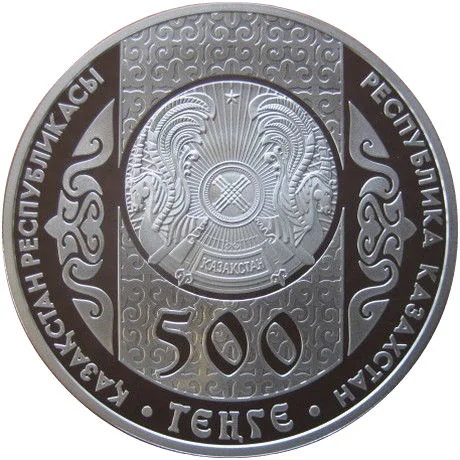
Exchange value: 500 KZT
Bullion value: $72.21
Obverse
Reverse
Description:
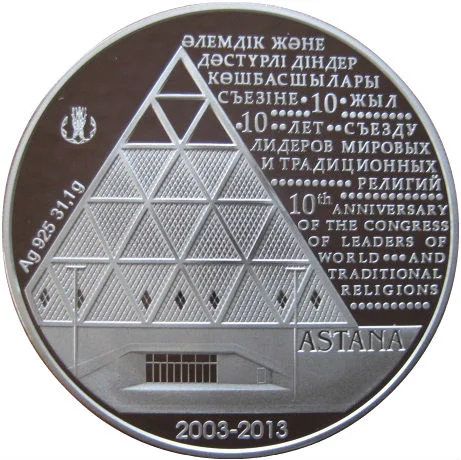
Pyramidal Palace of Peace and Reconciliation in Astana. Trilingual legend (Kazakh, Russian, English).
Inscription:
ӘЛЕМДIК ЖӘНЕ ДӘСТҮРЛI ДIНДЕР КӨШБАСШЫЛАРЫ СЪЕЗIНЕ 10 ЖЫЛ
10 ЛЕТ СЪЕЗДУ ЛИДЕРОВ МИРОВЫХ И ТРАДИЦИОННЫХ РЕЛИГИЙ
10th ANNIVERSARY OF THE CONGRESS OF LEADERS OF WORLD AND TRADITIONAL RELIGIONS
Ag 925 31,1 g
ASTANA
2003-2013
10 ЛЕТ СЪЕЗДУ ЛИДЕРОВ МИРОВЫХ И ТРАДИЦИОННЫХ РЕЛИГИЙ
10th ANNIVERSARY OF THE CONGRESS OF LEADERS OF WORLD AND TRADITIONAL RELIGIONS
Ag 925 31,1 g
ASTANA
2003-2013
Translation:
10 Years to the Congress of Leaders of World and Traditional Religions
10 Years to the Congress of Leaders of World and Traditional Religions
10th Anniversary of the Congress of Leaders of World and Traditional Religions
Ag 925 31.1 g
ASTANA
2003-2013
10 Years to the Congress of Leaders of World and Traditional Religions
10th Anniversary of the Congress of Leaders of World and Traditional Religions
Ag 925 31.1 g
ASTANA
2003-2013
Edge
Reeded
Mints
| Name | Mark |
|---|---|
| Kazakhstan Mint | — |
Mintings
| Year | Mint Mark | Mintage | Quality | Collection |
|---|---|---|---|---|
| 2013 | — | 3,000 | Proof |
Historical background
In 2013, Kazakhstan's currency, the tenge, was operating under a managed exchange rate regime, pegged to a dollar-dominated basket. This policy, maintained by the National Bank of Kazakhstan (NBK) since 2011, provided a crucial anchor of stability following the global financial crisis and the sharp tenge devaluation of 2009. The primary objectives were to control inflation, which had spiked in previous years, and to foster predictability for businesses and foreign investment. Throughout the year, the tenge traded in a tight band around 150 KZT to the US dollar, a rate seen as artificially strong by many exporters who argued it hurt their competitiveness.
However, this stability came under growing pressure. The external economic environment was shifting, with a key factor being the monetary policy of the US Federal Reserve signaling a "taper" of quantitative easing, which strengthened the US dollar globally. Concurrently, Kazakhstan's major trading partner, Russia, was experiencing a weakening ruble, and the price of Kazakhstan's key export, oil, began to show volatility. These factors widened the current account deficit and increased the cost of maintaining the peg, leading to significant foreign exchange reserve depletion as the NBK intervened to defend the tenge's corridor.
By the end of 2013, the currency situation was one of mounting tension and unsustainable equilibrium. While the official policy remained unchanged, market consensus grew that the tenge was overvalued. Economists and investors increasingly debated not if, but when the NBK would be forced to abandon its costly defense and transition to a more flexible exchange rate. This set the stage for the pivotal policy shift that would occur in February 2014, when Kazakhstan unexpectedly moved to a free float, leading to an immediate and significant devaluation of the tenge.
However, this stability came under growing pressure. The external economic environment was shifting, with a key factor being the monetary policy of the US Federal Reserve signaling a "taper" of quantitative easing, which strengthened the US dollar globally. Concurrently, Kazakhstan's major trading partner, Russia, was experiencing a weakening ruble, and the price of Kazakhstan's key export, oil, began to show volatility. These factors widened the current account deficit and increased the cost of maintaining the peg, leading to significant foreign exchange reserve depletion as the NBK intervened to defend the tenge's corridor.
By the end of 2013, the currency situation was one of mounting tension and unsustainable equilibrium. While the official policy remained unchanged, market consensus grew that the tenge was overvalued. Economists and investors increasingly debated not if, but when the NBK would be forced to abandon its costly defense and transition to a more flexible exchange rate. This set the stage for the pivotal policy shift that would occur in February 2014, when Kazakhstan unexpectedly moved to a free float, leading to an immediate and significant devaluation of the tenge.
Series: Outstanding events

✨ Legendary