

10 Francs – Afars and Issas
Djibouti
Context
Years: 1969–1975
Country: Djibouti 
Issuer: Afars and Issas
Period:
(1967—1977)
Currency:
(1967—1977)
Demonetized: Yes
Total mintage: 760,000
Material
References
KM: #Click to copy to clipboard17
Numista: #5159
Obverse
Description:
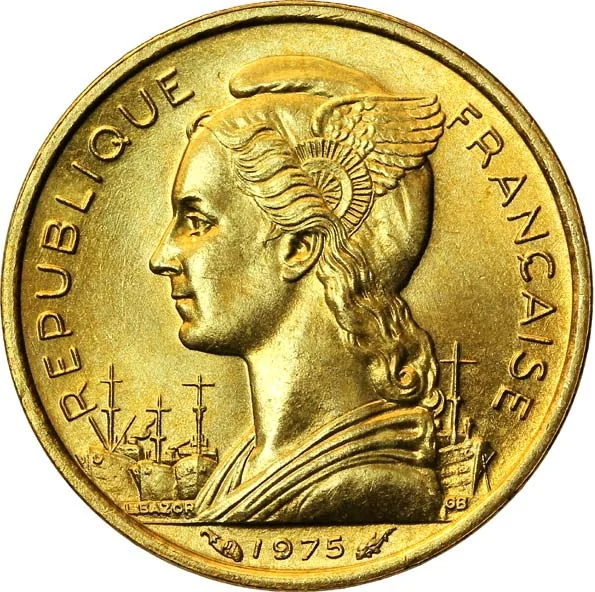
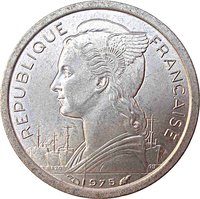
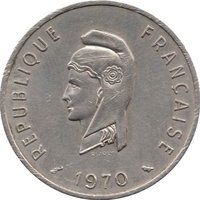
Marianne in a winged Phrygian cap, with four ships behind her and the date below.
Inscription:
REPUBLIQUE FRANÇAISE
L.BAZOR GB
1975
L.BAZOR GB
1975
Translation:
FRENCH REPUBLIC
L.BAZOR GB
1975
L.BAZOR GB
1975
Script: Latin
Language: French
Engraver: Lucien Georges Bazor
Reverse
Description:
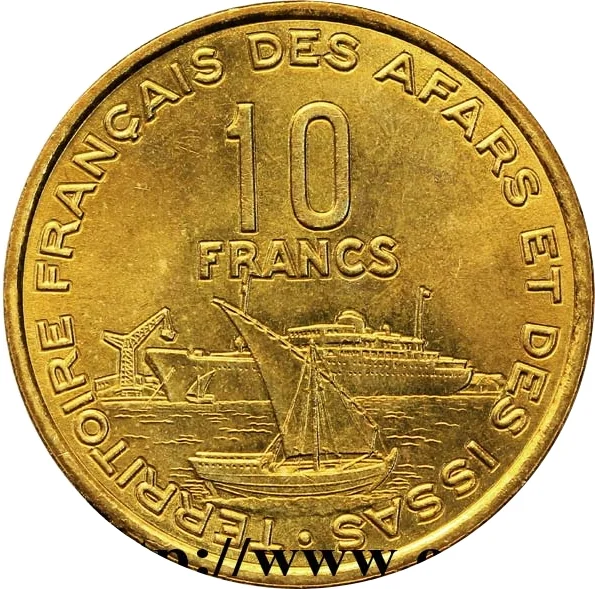
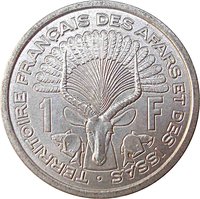
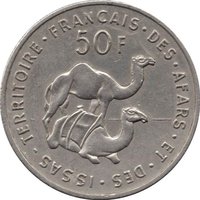
Dhow and ocean liner denominations.
Inscription:
TERRITOIRE FRANÇAIS DES AFARS ET DES ISSAS ·
10
FRANCS
10
FRANCS
Translation:
FRENCH TERRITORY OF THE AFARS AND THE ISSAS
10
FRANCS
10
FRANCS
Script: Latin
Language: French
Engraver: Lucien Georges Bazor
Edge
Plain
Categories
| Transportation> Watercraft |
| Symbol> Allegory |
| Symbol> Phrygian cap |
Mints
| Name | Mark |
|---|---|
| Monnaie de Paris | — |
Mintings
| Year | Mint Mark | Mintage | Quality | Collection |
|---|---|---|---|---|
| 1969 | — | 100,000 | ||
| 1970 | — | 300,000 | ||
| 1975 | — | 360,000 |
Historical background
In 1969, the currency situation in the French Territory of the Afars and the Issas (TFAI) was a direct reflection of its colonial status and strategic importance. The territory, the future Djibouti, used the Djiboutian franc (DF), which was not an independent currency but a local issuance pegged at a fixed and absolute parity with the French franc (FF). This peg, established as 1 DF = 0.0122 FF (or 1 FF = 50 DF), was guaranteed by the French Treasury, ensuring stability and full convertibility. The currency was issued by a public institution, the Caisse Centrale de Coopération Économique, under French authority, with banknotes and coins physically distinct from those used in metropolitan France but identical in monetary value.
This arrangement provided significant monetary stability for the territory, insulating it from the inflationary pressures and devaluations affecting other regional currencies. It was crucial for Djibouti's primary economic function as a regional trade and logistics hub, centered around the port of Djibouti and the Addis Ababa-Djibouti railway. The fixed, French-guaranteed exchange rate fostered confidence among international merchants and shipping companies, facilitating the flow of goods and hard currency, particularly from landlocked Ethiopia.
However, this system also underscored the territory's complete economic dependence on France. There was no independent monetary policy; decisions made in Paris regarding the French franc directly governed the Djiboutian franc. Furthermore, while beneficial for commerce, the strong, stable currency did little to stimulate broader internal economic development or industrialization within the impoverished territory. Thus, in 1969, the currency was a symbol of both colonial control and the enclave's unique, service-oriented economy, remaining firmly within the Franc Zone's orbit a full decade after most other French African colonies had gained political independence.
This arrangement provided significant monetary stability for the territory, insulating it from the inflationary pressures and devaluations affecting other regional currencies. It was crucial for Djibouti's primary economic function as a regional trade and logistics hub, centered around the port of Djibouti and the Addis Ababa-Djibouti railway. The fixed, French-guaranteed exchange rate fostered confidence among international merchants and shipping companies, facilitating the flow of goods and hard currency, particularly from landlocked Ethiopia.
However, this system also underscored the territory's complete economic dependence on France. There was no independent monetary policy; decisions made in Paris regarding the French franc directly governed the Djiboutian franc. Furthermore, while beneficial for commerce, the strong, stable currency did little to stimulate broader internal economic development or industrialization within the impoverished territory. Thus, in 1969, the currency was a symbol of both colonial control and the enclave's unique, service-oriented economy, remaining firmly within the Franc Zone's orbit a full decade after most other French African colonies had gained political independence.
🌱 Common