

20 Francs – Afars and Issas
Djibouti
Context
Years: 1968–1975
Country: Djibouti 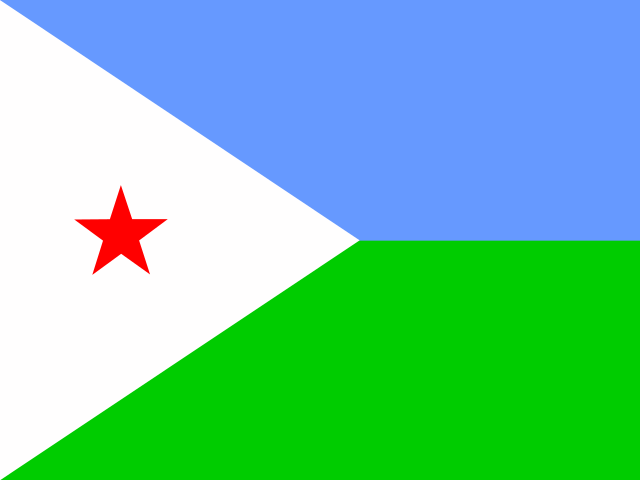
Issuer: Afars and Issas
Period:
(1967—1977)
Currency:
(1967—1977)
Demonetized: Yes
Total mintage: 600,000
Material
References
KM: #Click to copy to clipboard15
Numista: #5158
Obverse
Description:
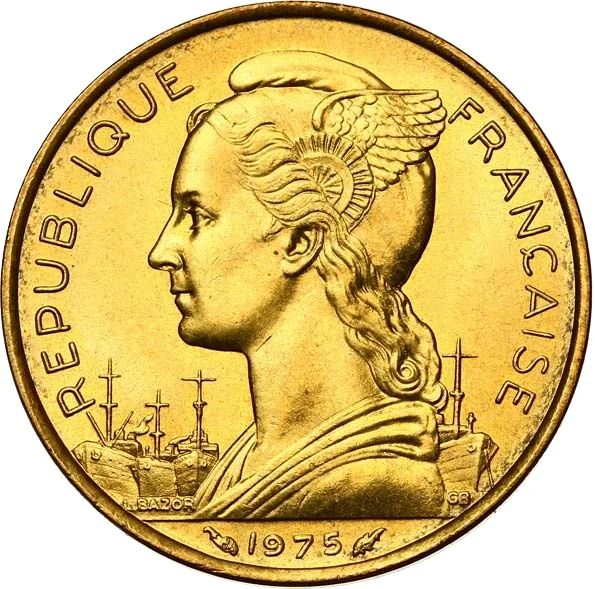
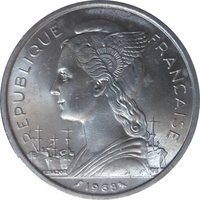
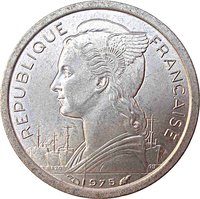
Marianne in a winged Phrygian cap, with four ships behind her and the date below.
Inscription:
REPUBLIQUE FRANÇAISE
L.BAZOR GB
1975
L.BAZOR GB
1975
Translation:
FRENCH REPUBLIC
L.BAZOR GB
1975
L.BAZOR GB
1975
Script: Latin
Language: French
Engraver: Lucien Georges Bazor
Reverse
Description:
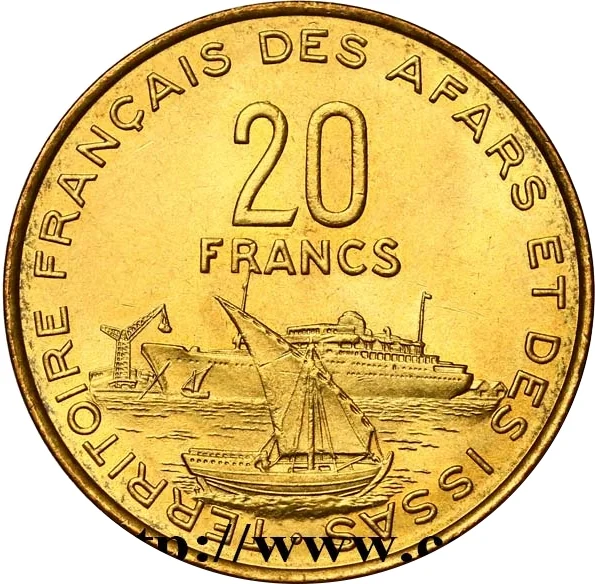
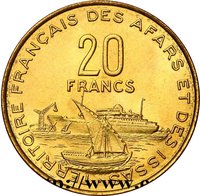
Dhow: sailboat and ocean liner class.
Inscription:
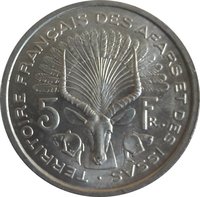
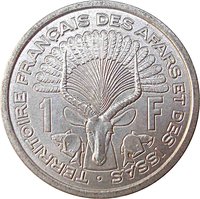
TERRITOIRE FRANÇAIS DES AFARS ET DES ISSAS ·
20
FRANCS
20
FRANCS
Translation:
FRENCH TERRITORY OF THE AFARS AND THE ISSAS
20
FRANCS
20
FRANCS
Script: Latin
Language: French
Engraver: Lucien Georges Bazor
Edge
Plain
Categories
| Transportation> Watercraft |
| Symbol> Allegory |
| Symbol> Phrygian cap |
Mints
| Name | Mark |
|---|---|
| Monnaie de Paris | — |
Mintings
| Year | Mint Mark | Mintage | Quality | Collection |
|---|---|---|---|---|
| 1968 | — | 300,000 | ||
| 1975 | — | 300,000 |
Historical background
In 1968, the currency situation in the French Territory of the Afars and Issas (present-day Djibouti) was defined by its integration into the Franc Zone and its unique role as a regional financial hub. The official currency was the Djibouti franc (DF), which had been pegged at a fixed and stable parity of 214.392 DF to 1 US dollar since 1949. This peg was maintained through the Caisse Centrale de Coopération Économique (Central Fund for Economic Cooperation), which guaranteed full convertibility with the French franc and, by extension, the US dollar. This stability was crucial for the territory's economy, which was almost entirely dependent on its strategic port and railway, servicing landlocked Ethiopia.
The monetary system was managed by two key institutions: the Banque de l'Indochine until 1965, and thereafter by the Banque pour le Commerce et l'Industrie (Mer Rouge). These banks issued the local currency, which circulated alongside the French franc. The fixed exchange rate and free convertibility made the territory, and particularly its capital city, a stable financial center in the volatile Horn of Africa, attracting commercial activity and foreign exchange operations from neighboring countries.
This monetary arrangement underscored the territory's deep colonial economic ties to France, providing stability but also highlighting its lack of independent monetary policy. The system functioned smoothly in 1968, but it was inherently linked to France's continued sovereignty. The currency's future would become a point of negotiation in the lead-up to independence in 1977, with the new Republic of Djibouti choosing to maintain the fixed peg and Franc Zone membership to preserve economic stability after colonial rule.
The monetary system was managed by two key institutions: the Banque de l'Indochine until 1965, and thereafter by the Banque pour le Commerce et l'Industrie (Mer Rouge). These banks issued the local currency, which circulated alongside the French franc. The fixed exchange rate and free convertibility made the territory, and particularly its capital city, a stable financial center in the volatile Horn of Africa, attracting commercial activity and foreign exchange operations from neighboring countries.
This monetary arrangement underscored the territory's deep colonial economic ties to France, providing stability but also highlighting its lack of independent monetary policy. The system functioned smoothly in 1968, but it was inherently linked to France's continued sovereignty. The currency's future would become a point of negotiation in the lead-up to independence in 1977, with the new Republic of Djibouti choosing to maintain the fixed peg and Franc Zone membership to preserve economic stability after colonial rule.
🌱 Common