

Obverse
Description:
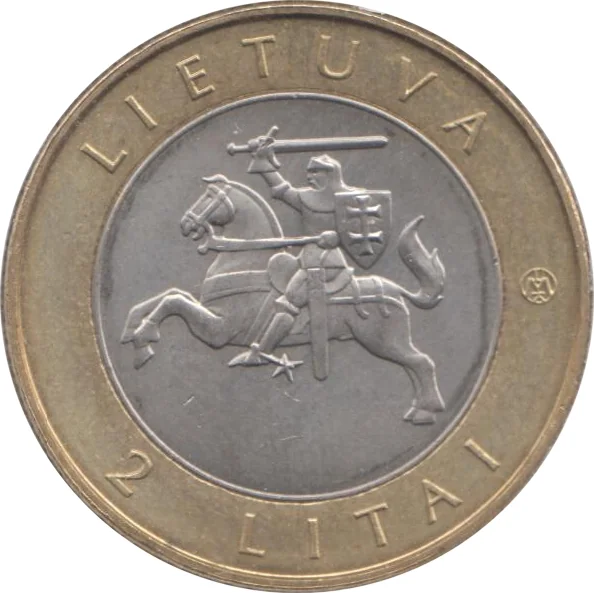
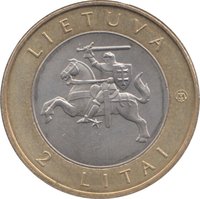
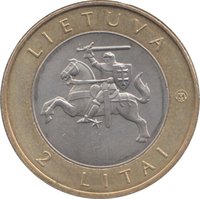
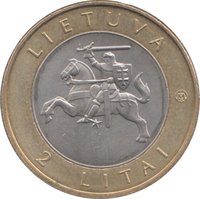
Stylized Vytis emblem with semicircular inscriptions "LIETUVA" and "2 LITAI," plus the Lithuanian Mint mark.
Inscription:
LIETUVA
LMK
2 LITAI
LMK
2 LITAI
Translation:
2 LITAS
Script: Latin
Languages: Lithuanian, English
Designer: Giedrius Paulauskis
Reverse
Description:
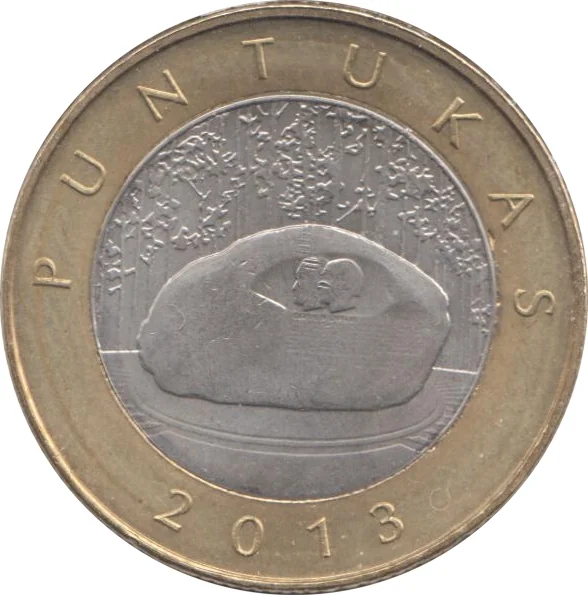
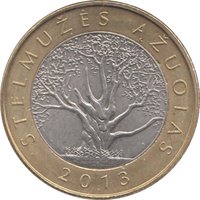
PUNTUKAS STONE, 2013.
Inscription:
PUNTUKAS
2013
2013
Script: Latin
Designer: Giedrius Paulauskis
Edge
Segmented reeding
Mints
| Name | Mark |
|---|---|
| Lithuanian Mint | (LMK) |
Mintings
| Year | Mint Mark | Mintage | Quality | Collection |
|---|---|---|---|---|
| 2013 | LMK | 100,000 |
Historical background
In 2013, Lithuania was in the final and decisive phase of its long-standing strategic goal to adopt the euro. Having pegged its currency, the litas (LTL), to the euro in a currency board arrangement since 2002, the country's monetary policy was already de facto aligned with the Eurozone. The primary focus of the year was on meeting the strict Maastricht convergence criteria, particularly after the setback of the 2007-08 global financial crisis, which had delayed earlier adoption plans. The government, under Prime Minister Algirdas Butkevičius, pursued a disciplined fiscal policy to reduce the budget deficit, successfully bringing it below the EU's 3% of GDP threshold, a crucial step for European Commission approval.
Public opinion, however, presented a significant challenge. Throughout 2013, polls consistently showed a majority of Lithuanians were opposed to abandoning the litas, with concerns centered on fears of rising prices (the perceived "euro effect"), a loss of national identity, and skepticism about the benefits of joining a currency bloc still recovering from its own debt crisis. Despite this resistance, the political and business elite remained overwhelmingly in favor, viewing euro adoption as essential for enhancing investment security, reducing transaction costs, and solidifying Lithuania's place within the core of the European Union.
By the end of 2013, Lithuania had received the European Commission's positive recommendation to join the euro, having met all nominal convergence criteria. The European Council gave its final formal approval in July 2014, setting the stage for Lithuania to become the 19th Eurozone member on January 1, 2015. Thus, 2013 was a year of technical preparation and political determination, marking the conclusive chapter of Lithuania's journey to replace the litas with the euro.
Public opinion, however, presented a significant challenge. Throughout 2013, polls consistently showed a majority of Lithuanians were opposed to abandoning the litas, with concerns centered on fears of rising prices (the perceived "euro effect"), a loss of national identity, and skepticism about the benefits of joining a currency bloc still recovering from its own debt crisis. Despite this resistance, the political and business elite remained overwhelmingly in favor, viewing euro adoption as essential for enhancing investment security, reducing transaction costs, and solidifying Lithuania's place within the core of the European Union.
By the end of 2013, Lithuania had received the European Commission's positive recommendation to join the euro, having met all nominal convergence criteria. The European Council gave its final formal approval in July 2014, setting the stage for Lithuania to become the 19th Eurozone member on January 1, 2015. Thus, 2013 was a year of technical preparation and political determination, marking the conclusive chapter of Lithuania's journey to replace the litas with the euro.
🌱 Common