

1 Shilling – East Africa
Context
Years: 1948–1952
Issuer: East Africa
Ruler: George VI
Currency:
(1921—1967)
Demonetized: Yes
Total mintage: 237,472,999
Material
Diameter: 27.8 mm
Weight: 7.78 g
Thickness: 1.6 mm
Shape: Round
Composition: Copper-nickel
Standard: Silver quarter ounce
Technique: Milled
Alignment: Medal alignment
flip
References
KM: #Click to copy to clipboard31
Numista: #5151
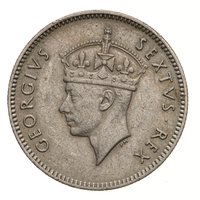
Obverse
Description:
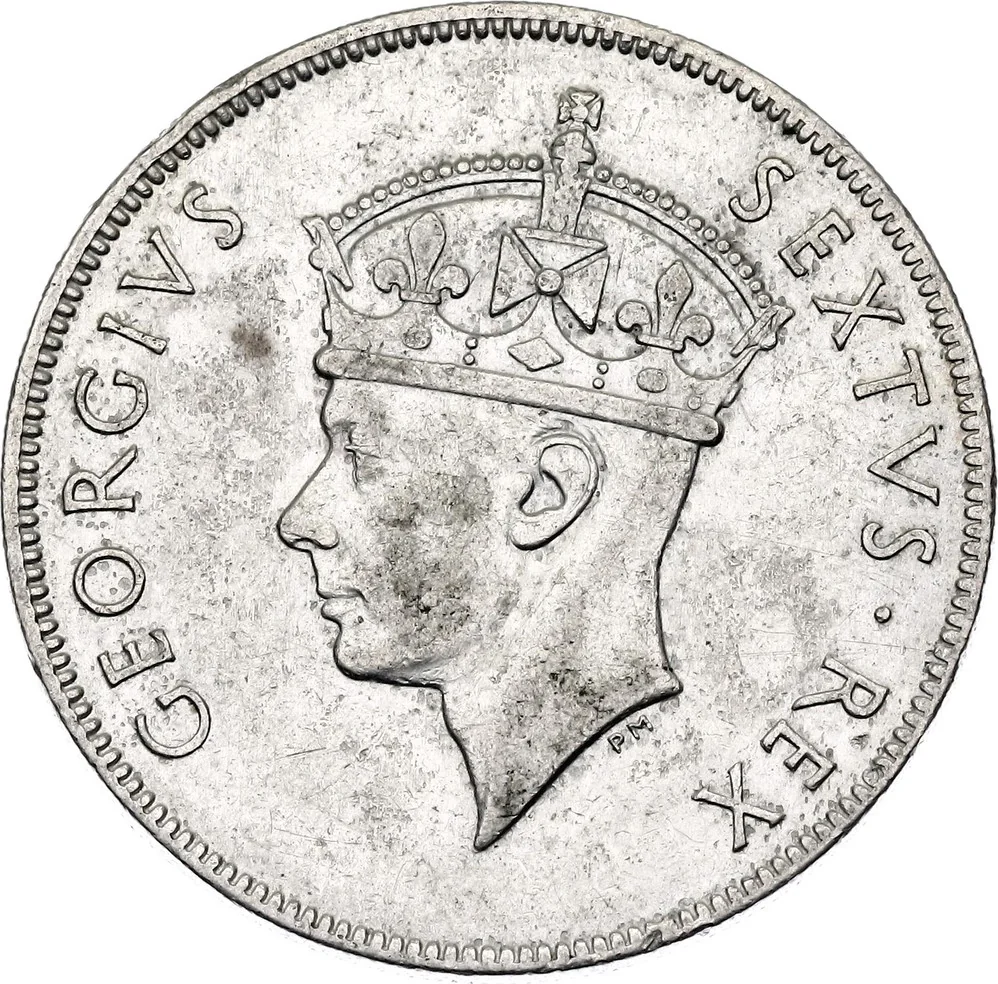
King George VI left profile.
Inscription:
GEORGIVS SEXTVS·REX
PM
PM
Translation:
George the Sixth, King
Defender of the Faith
Defender of the Faith
Script: Latin
Language: Latin
Engraver: Percy Metcalfe
Reverse
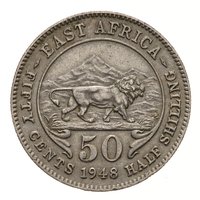
Description:
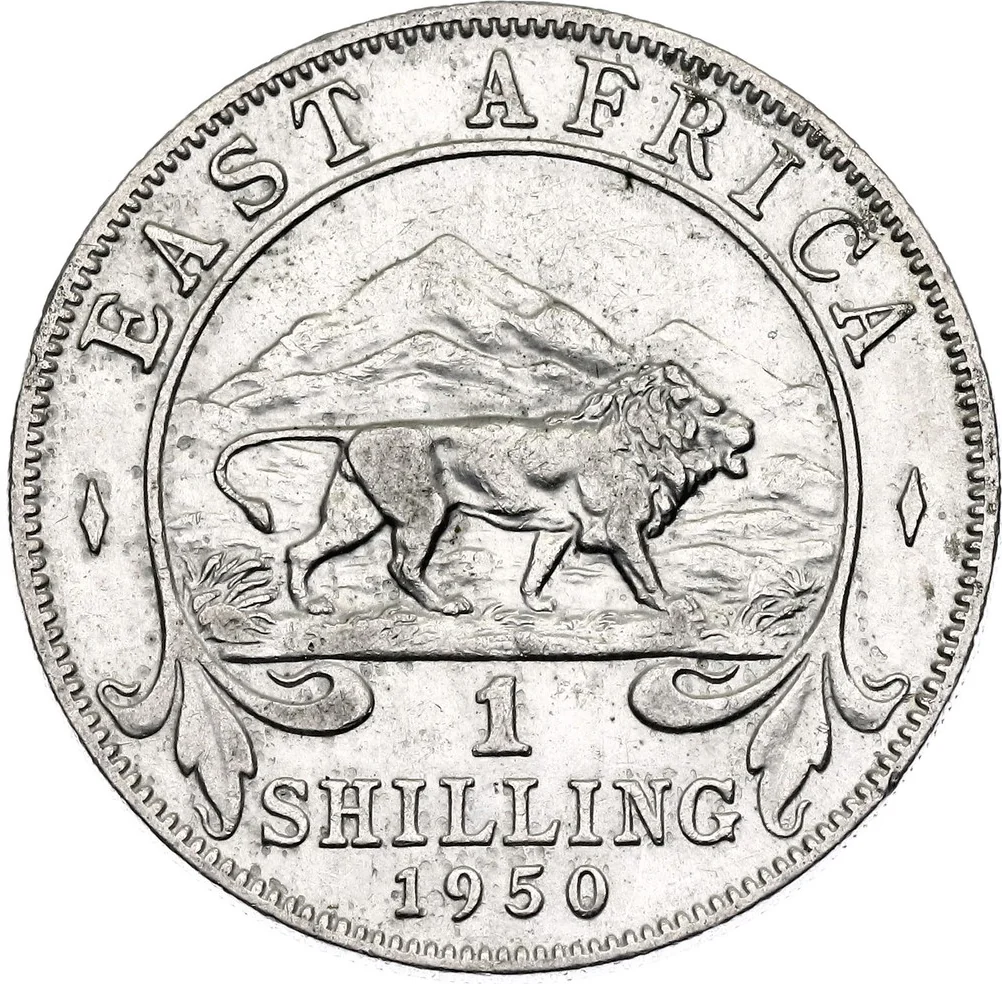
Lion and mountains inside a three-quarter circle.
Inscription:
EAST AFRICA
1
SHILLING
1952
1
SHILLING
1952
Script: Latin
Edge
Reeded
Mints
| Name | Mark |
|---|---|
| Royal Mint (Tower Hill) | — |
| Heaton and Sons / The Mint Birmingham | H |
| Kings Norton Metal Company | KN |
Mintings
Historical background
In 1948, the currency situation in East Africa was defined by the dominance of the East African Shilling, issued by the East African Currency Board (EACB). Established in 1919 and headquartered in London, the EACB served the British territories of Kenya, Uganda, Tanganyika (a UN trust territory under British administration), and Zanzibar. This system provided a stable and uniform currency, pegged at a fixed rate to the British Pound Sterling (20 shillings = £1), which facilitated trade within the region and with the sterling area. The currency was fully backed by sterling reserves held in London, ensuring convertibility and monetary stability, but it also meant that monetary policy was entirely subservient to British economic interests and the Board had no capacity to respond to local economic conditions.
The period was one of post-war economic adjustment and growing political change. The fixed link to sterling, while stable, imported Britain's own post-war economic challenges, including inflation and exchange controls, directly into East Africa. Furthermore, the system was inherently colonial, with currency issuance and control physically and administratively centered in the metropole. This arrangement began to face subtle pressures from the early stirrings of nationalist movements and a growing desire for economic self-determination. The economies themselves were increasingly monetized, moving beyond simple subsistence, with cash crops like coffee, cotton, and sisal driving export earnings, all conducted through the framework of the EACB shilling.
Thus, the currency landscape in 1948 appeared superficially stable and unified under the EACB. However, it was a stability imposed from outside, lacking local institutional capacity. The system was efficient for colonial administration and the extraction of primary commodities, but it was not designed to foster independent economic development or respond to regional needs. The seeds of its eventual dissolution—which would occur in the 1960s as each territory gained independence and established its own central bank and national currency—were already present in the political and economic currents of the time.
The period was one of post-war economic adjustment and growing political change. The fixed link to sterling, while stable, imported Britain's own post-war economic challenges, including inflation and exchange controls, directly into East Africa. Furthermore, the system was inherently colonial, with currency issuance and control physically and administratively centered in the metropole. This arrangement began to face subtle pressures from the early stirrings of nationalist movements and a growing desire for economic self-determination. The economies themselves were increasingly monetized, moving beyond simple subsistence, with cash crops like coffee, cotton, and sisal driving export earnings, all conducted through the framework of the EACB shilling.
Thus, the currency landscape in 1948 appeared superficially stable and unified under the EACB. However, it was a stability imposed from outside, lacking local institutional capacity. The system was efficient for colonial administration and the extraction of primary commodities, but it was not designed to foster independent economic development or respond to regional needs. The seeds of its eventual dissolution—which would occur in the 1960s as each territory gained independence and established its own central bank and national currency—were already present in the political and economic currents of the time.
🌱 Very Common