

50 centimos – Paraguay
Add to wishlist
Paraguay
Context
Years: 1944–1951
Issuer: Paraguay
Issuing organization: Bank of Paraguay
Period:
(since 1811)
Currency:
(since 1944)
Demonetization: 1966
Total mintage: 5,377,500
Material
References
KM: #
Numista: #5150
Value
Exchange value: 0.50 PYG
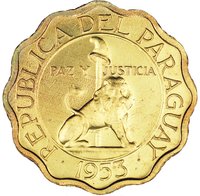
Obverse
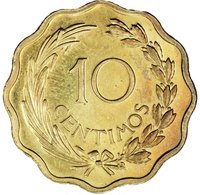
Reverse
Edge
Reeded
Categories
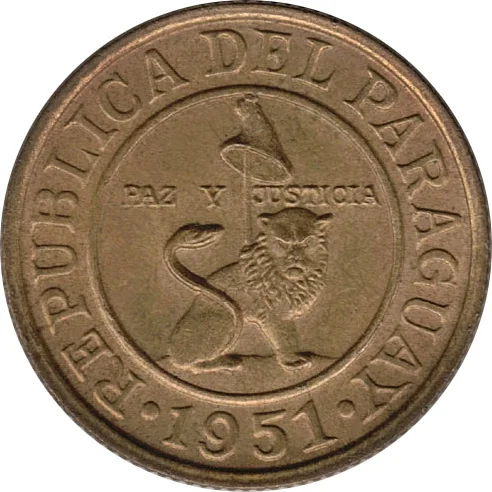
| Animal> Feline |
| Symbols> Coat of Arms |
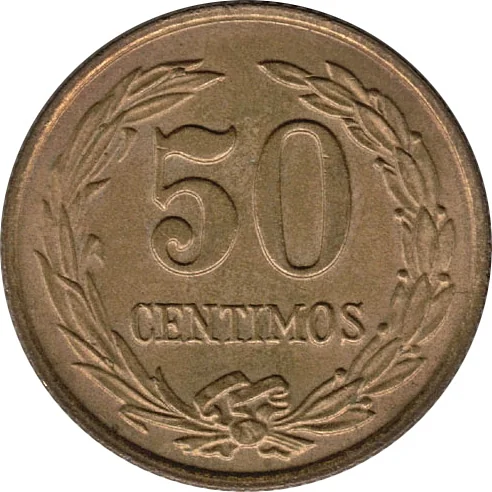
| Symbol> Wreath |
| Symbol> Phrygian cap |
Mints
| Name | Mark |
|---|---|
| Buenos Aires | — |
| Huguenin | — |
Mintings
| Year | Mint Mark | Mintage | Quality | Collection |
|---|---|---|---|---|
| 1944 | — | 2,485,000 | ||
| 1951 | — | 2,892,500 |
Historical background
In 1944, Paraguay's currency situation was characterized by the dominance of the Paraguayan peso, which had been the national currency since 1856. However, the period was marked by significant inflation and economic instability, legacies of the devastating Chaco War (1932-1935) and the ongoing political turbulence of the Higinio Morínigo dictatorship (1940-1948). The war had crippled the economy, leading to large fiscal deficits that were financed by the Central Bank, resulting in a sustained increase in the money supply and a steady erosion of the peso's purchasing power.
The government's economic policy during this time was one of intervention and control. Morínigo's regime maintained strict foreign exchange controls and a fixed official exchange rate, which created a thriving black market for currencies like the US dollar and Argentine peso. This dual system reflected the disconnect between the official economy and market realities. While Paraguay officially maintained a neutral stance during World War II, it experienced some economic benefits from Allied demand for its raw materials (like cotton and tannin), but this did not translate into monetary stability.
Ultimately, the currency pressures of 1944 were a prelude to a major monetary reform. The persistent inflation and the impracticality of the heavily devalued peso led to the introduction of a new currency just three years later. In 1947, the guaraní was established, replacing the peso at a rate of 1 guaraní = 100 pesos, in an effort to reset the monetary system and restore confidence. Thus, the currency situation in 1944 represents the final, inflationary chapter of the historic peso before its eventual demonetization.
The government's economic policy during this time was one of intervention and control. Morínigo's regime maintained strict foreign exchange controls and a fixed official exchange rate, which created a thriving black market for currencies like the US dollar and Argentine peso. This dual system reflected the disconnect between the official economy and market realities. While Paraguay officially maintained a neutral stance during World War II, it experienced some economic benefits from Allied demand for its raw materials (like cotton and tannin), but this did not translate into monetary stability.
Ultimately, the currency pressures of 1944 were a prelude to a major monetary reform. The persistent inflation and the impracticality of the heavily devalued peso led to the introduction of a new currency just three years later. In 1947, the guaraní was established, replacing the peso at a rate of 1 guaraní = 100 pesos, in an effort to reset the monetary system and restore confidence. Thus, the currency situation in 1944 represents the final, inflationary chapter of the historic peso before its eventual demonetization.
Series: 1944 Paraguay circulation coins
🌱 Common