

50 centimos – Paraguay
Add to wishlist
Paraguay
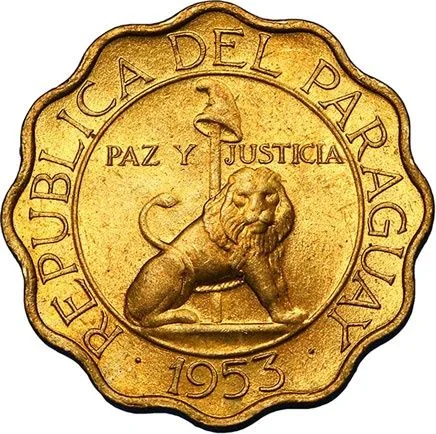
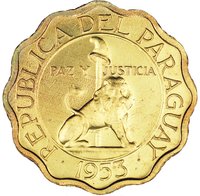
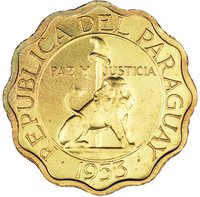
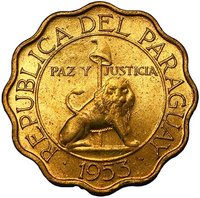
Obverse
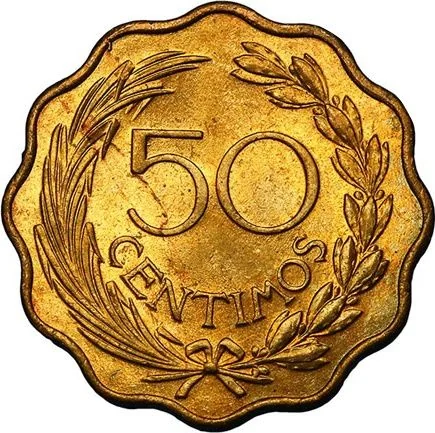
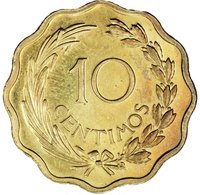
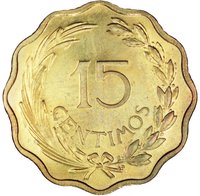
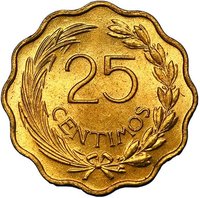
Reverse
Edge
Plain (with 12 curves)
Categories
| Animal> Feline |
| Symbols> Coat of Arms |
| Symbol> Wreath |
| Symbol> Phrygian cap |
Mints
| Name | Mark |
|---|---|
| Royal Mint (Tower Hill) | — |
Mintings
| Year | Mint Mark | Mintage | Quality | Collection |
|---|---|---|---|---|
| 1953 | — | 2,000,000 | ||
| 1953 | — | 1 | Proof |
Historical background
In 1953, Paraguay's currency situation was characterized by the dominance of the Guaraní, established as the national currency in 1943 to replace the Paraguayan peso. However, the economy was still grappling with the profound after-effects of the devastating Chaco War (1932-1935) and the subsequent political instability, including the recent Civil War of 1947. The government of President Federico Chávez (1949-1954) operated within a framework of economic nationalism and state intervention, but the country's reliance on a few primary agricultural exports (like cotton and yerba mate) made it vulnerable to volatile international prices and trade imbalances.
Monetarily, Paraguay struggled with persistent inflation and a chronic shortage of foreign exchange reserves. The Central Bank of Paraguay, created in 1952 just a year prior, faced the immense challenge of managing monetary policy with limited tools and reserves. The official exchange rate was fixed by the government, but this often led to a thriving black market for U.S. dollars and Argentine pesos, where the Guaraní traded at a significant discount. This dual system reflected the gap between the official economic policy and the realities of an underdeveloped, isolated economy with limited industrial capacity.
Overall, the currency situation in 1953 was one of fragile stability, heavily dependent on the political control of the ruling Colorado Party and the personalist leadership style that would soon give way to the long dictatorship of Alfredo Stroessner (beginning in 1954). The economic model prioritized political goals and urban development in Asunción over broad-based growth, leaving the currency susceptible to pressure from fiscal deficits and a narrow export base. The period thus represents a prelude to the more rigid, but initially stabilizing, monetary reforms that would be implemented under the Stroessner regime in the subsequent decades.
Monetarily, Paraguay struggled with persistent inflation and a chronic shortage of foreign exchange reserves. The Central Bank of Paraguay, created in 1952 just a year prior, faced the immense challenge of managing monetary policy with limited tools and reserves. The official exchange rate was fixed by the government, but this often led to a thriving black market for U.S. dollars and Argentine pesos, where the Guaraní traded at a significant discount. This dual system reflected the gap between the official economic policy and the realities of an underdeveloped, isolated economy with limited industrial capacity.
Overall, the currency situation in 1953 was one of fragile stability, heavily dependent on the political control of the ruling Colorado Party and the personalist leadership style that would soon give way to the long dictatorship of Alfredo Stroessner (beginning in 1954). The economic model prioritized political goals and urban development in Asunción over broad-based growth, leaving the currency susceptible to pressure from fiscal deficits and a narrow export base. The period thus represents a prelude to the more rigid, but initially stabilizing, monetary reforms that would be implemented under the Stroessner regime in the subsequent decades.
Series: 1953 Paraguay circulation coins
🌱 Very Common