

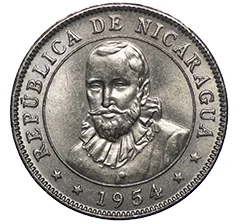
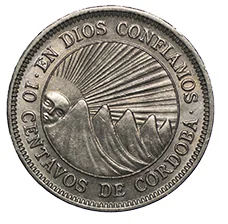
10 centavos de córdoba – Nicaragua
Add to wishlist
Nicaragua
Context
Years: 1939–1972
Issuer: Nicaragua
Issuing organization: National Bank of Nicaragua
Period:
(since 1854)
Currency:
(1912—1987)
Demonetization: 15 February 1988
Total mintage: 36,020,000
Material
References
KM: #
Numista: #5139
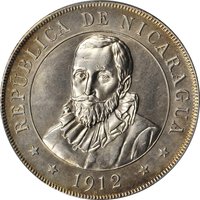
Obverse
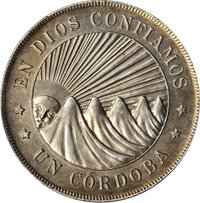
Reverse
Edge
Mints
| Name | Mark |
|---|---|
| Royal Mint (Tower Hill) | — |
Mintings
| Year | Mint Mark | Mintage | Quality | Collection |
|---|---|---|---|---|
| 1939 | — | 2,500,000 | ||
| 1939 | — | — | Proof | |
| 1946 | — | 2,000,000 | ||
| 1946 | — | — | Proof | |
| 1950 | — | 2,000,000 | ||
| 1950 | — | — | Proof | |
| 1952 | — | — | Proof | |
| 1952 | — | 1,500,000 | ||
| 1954 | — | 3,000,000 | ||
| 1954 | — | — | Proof | |
| 1956 | — | 5,000,000 | ||
| 1956 | — | — | Proof | |
| 1962 | — | 4,000,000 | ||
| 1962 | — | — | Proof | |
| 1964 | — | 4,000,000 | ||
| 1965 | — | 12,000,000 | ||
| 1972 | — | 20,000 | Proof |
Historical background
In 1939, Nicaragua's currency system was defined by the official adoption of the Córdoba, established in 1912 to replace the peso and named after the Spanish conquistador Francisco Hernández de Córdoba. However, the currency's stability and management were deeply influenced by external actors, most notably the United States. Following U.S. military interventions and the establishment of a U.S.-supervised customs receivership in 1911, Nicaragua's financial sovereignty was limited. The National Bank of Nicaragua, founded in 1912, operated under significant American oversight, with its reserve holdings and note issuance tied to the U.S. dollar, effectively placing the córdoba on a gold-exchange standard pegged to the dollar.
Economically, the country remained heavily dependent on agricultural exports, particularly coffee and bananas. This made the currency vulnerable to fluctuations in global commodity prices, a precarious position as the world emerged from the Great Depression and edged toward war. While the fixed peg to the dollar provided a measure of stability for foreign trade, it also meant Nicaragua imported U.S. monetary policy and inflation trends. Domestically, the circulation of physical currency was limited, with much of the economy, especially in rural areas, still functioning through barter and informal credit systems.
Politically, the currency situation was managed under the authoritarian rule of President Anastasio Somoza García, who had consolidated power after the assassination of Augusto César Sandino in 1934. Somoza’s regime used control over the financial system, including the U.S.-backed National Bank, to reward allies and centralize economic power. Thus, in 1939, the córdoba was stable on paper due to its dollar peg and U.S. oversight, but this stability was underpinned by a lack of full monetary sovereignty and served the interests of a consolidating dictatorship and its foreign backers, rather than fostering broad-based domestic economic development.
Economically, the country remained heavily dependent on agricultural exports, particularly coffee and bananas. This made the currency vulnerable to fluctuations in global commodity prices, a precarious position as the world emerged from the Great Depression and edged toward war. While the fixed peg to the dollar provided a measure of stability for foreign trade, it also meant Nicaragua imported U.S. monetary policy and inflation trends. Domestically, the circulation of physical currency was limited, with much of the economy, especially in rural areas, still functioning through barter and informal credit systems.
Politically, the currency situation was managed under the authoritarian rule of President Anastasio Somoza García, who had consolidated power after the assassination of Augusto César Sandino in 1934. Somoza’s regime used control over the financial system, including the U.S.-backed National Bank, to reward allies and centralize economic power. Thus, in 1939, the córdoba was stable on paper due to its dollar peg and U.S. oversight, but this stability was underpinned by a lack of full monetary sovereignty and served the interests of a consolidating dictatorship and its foreign backers, rather than fostering broad-based domestic economic development.
Series: 1939 series
🌱 Very Common