

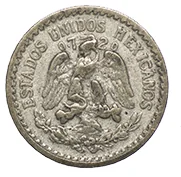
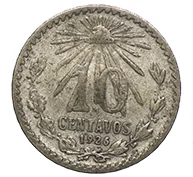
10 Centavos – Mexico
Mexico
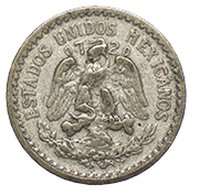
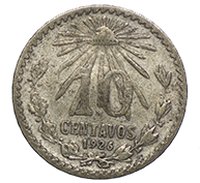
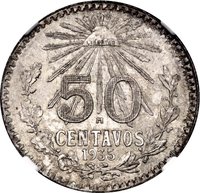
Obverse
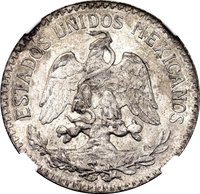
Reverse
Edge
Reeded: lines grouped in two
Categories
| Symbol> Phrygian cap |
Mints
| Name | Mark |
|---|---|
| Mexican Mint | (M) |
Mintings
| Year | Mint Mark | Mintage | Quality | Collection |
|---|---|---|---|---|
| 1925 | M | 5,350,000 | ||
| 1926 | M | 2,650,000 | ||
| 1927 | M | 2,810,000 | ||
| 1928 | M | 5,270,000 | ||
| 1930 | M | 2,000,000 | ||
| 1933 | M | 5,000,000 | ||
| 1934 | M | 8,000,000 | ||
| 1935 | M | 3,500,000 |
Historical background
In 1925, Mexico's currency situation was one of profound instability and transition, emerging from the decade-long Mexican Revolution (1910-1920). The revolutionary period had devastated the economy, destroyed infrastructure, and led to massive capital flight. The government, under President Plutarco Elías Calles, faced a severe shortage of metallic currency, as gold and silver coins had been hoarded or exported. In their place, a chaotic mix of paper money issued by various revolutionary factions, state governments, and even private companies circulated, most of it heavily depreciated and lacking public trust. This monetary anarchy severely hampered national reconstruction and economic recovery.
To resolve this crisis, the Calles administration undertook a radical reform by establishing the Banco de México (Bank of Mexico) on September 1, 1925, as the nation's first true central bank. Its primary mission was to unify the currency and restore stability. The bank was granted the exclusive right to issue paper money and was initially backed by a gold-exchange standard, meaning the new peso was convertible into foreign gold-based currencies. This move was a deliberate effort to reintegrate Mexico into the international financial system and attract foreign investment by promising monetary discipline and an end to arbitrary emissions of currency.
The reform, however, faced immediate and significant challenges. The new banknotes, while a step toward order, circulated alongside the old discredited paper, and the public remained deeply skeptical. Furthermore, Mexico's limited gold reserves and a persistent budget deficit put immense pressure on the gold-standard peg. Within just a few years, falling global silver prices and domestic fiscal pressures would force Mexico to abandon gold convertibility, demonstrating that the 1925 reforms, while foundational, could not instantly overcome the deep-seated economic legacies of the revolution. Nevertheless, the creation of the Banco de México provided the essential institutional framework for the eventual achievement of monetary stability in the decades that followed.
To resolve this crisis, the Calles administration undertook a radical reform by establishing the Banco de México (Bank of Mexico) on September 1, 1925, as the nation's first true central bank. Its primary mission was to unify the currency and restore stability. The bank was granted the exclusive right to issue paper money and was initially backed by a gold-exchange standard, meaning the new peso was convertible into foreign gold-based currencies. This move was a deliberate effort to reintegrate Mexico into the international financial system and attract foreign investment by promising monetary discipline and an end to arbitrary emissions of currency.
The reform, however, faced immediate and significant challenges. The new banknotes, while a step toward order, circulated alongside the old discredited paper, and the public remained deeply skeptical. Furthermore, Mexico's limited gold reserves and a persistent budget deficit put immense pressure on the gold-standard peg. Within just a few years, falling global silver prices and domestic fiscal pressures would force Mexico to abandon gold convertibility, demonstrating that the 1925 reforms, while foundational, could not instantly overcome the deep-seated economic legacies of the revolution. Nevertheless, the creation of the Banco de México provided the essential institutional framework for the eventual achievement of monetary stability in the decades that followed.
🌱 Common