

50 centimes – Belgium
Add to wishlist
Belgium
Context
Year: 1918
Issuer: Belgium
Period:
(1914—1918)
Currency:
(1832—2001)
Demonetization: 20 July 1922
Total mintage: 7,394,400
Material
Diameter: 24 mm
Weight: 5 g
Thickness: 2 mm
Shape: Round with a round hole
Composition: Zinc
Magnetic: No
Technique: Milled
Alignment: Coin alignment
flip
References
KM: #
Numista: #512
Value
Exchange value: 0.50 BEF
Obverse
Description:
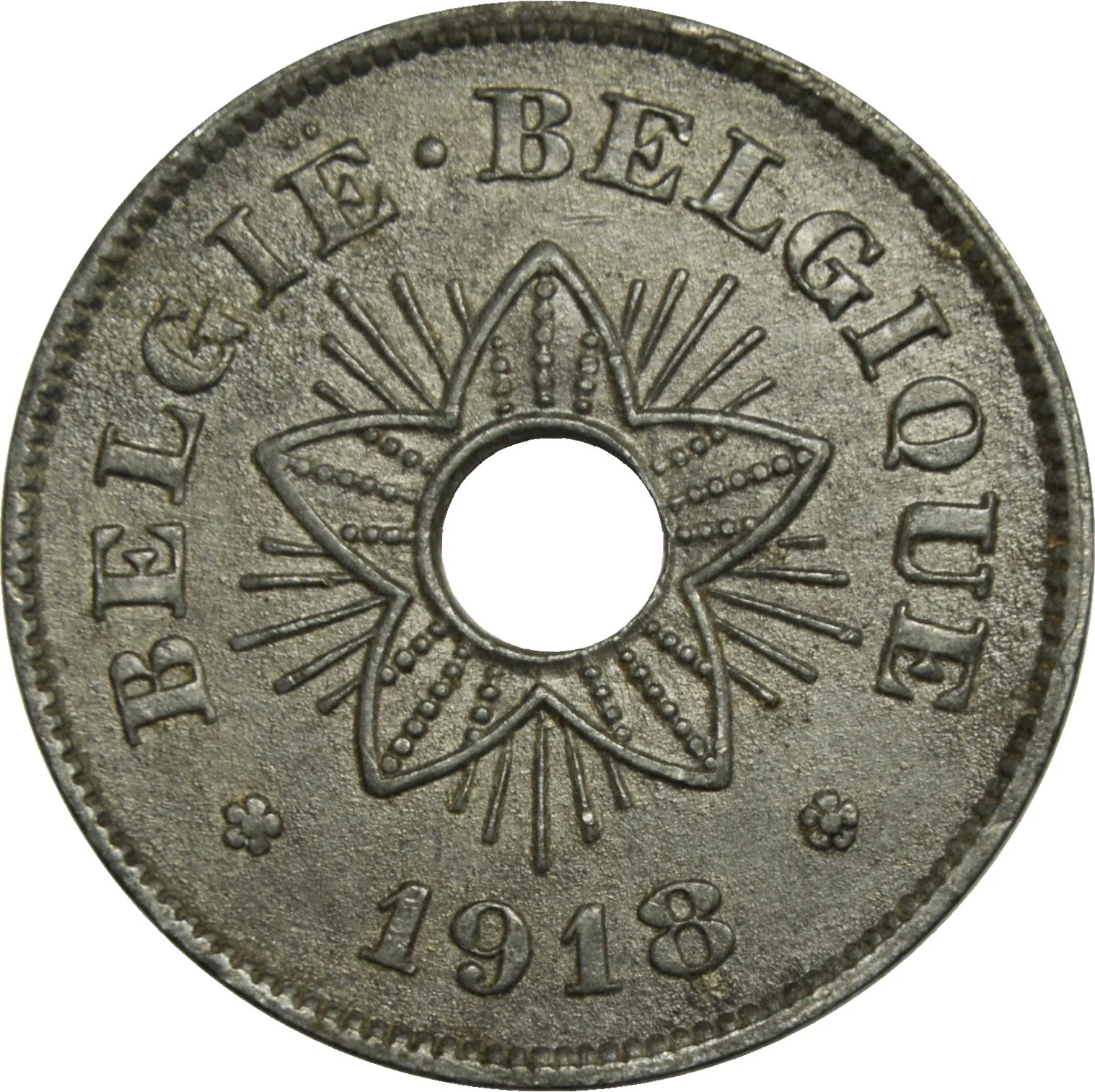
A bilingual Dutch/French inscription encircles a central hole, flanked by a five-pointed star. The date is between two stars below.
Inscription:
BELGIË·BELGIQUE
❀ 1918 ❀
❀ 1918 ❀
Translation:
Belgium Belgium
❀ 1918 ❀
❀ 1918 ❀
Script: Latin
Engraver: Alphonse Michaux
Reverse
Description:
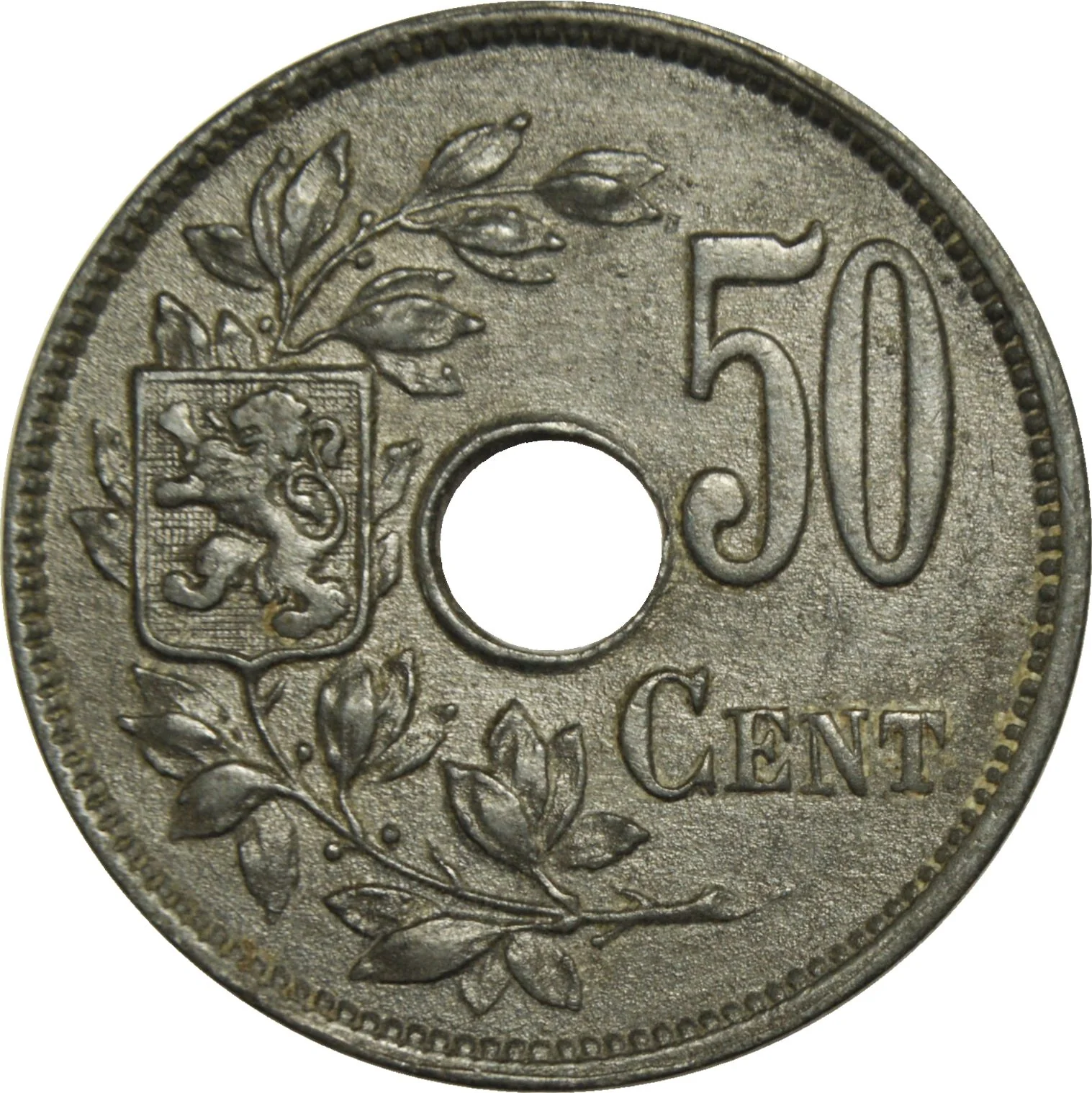
The face value is on the right, opposite an olive branch overlaid with Belgium's coat of arms.
Inscription:
50
CENT
CENT
Script: Latin
Engraver: Alphonse Michaux
Edge
Plain
Categories
| Symbols> Coat of Arms |
Mints
| Name | Mark |
|---|---|
| Royal Mint of Belgium | — |
Mintings
| Year | Mint Mark | Mintage | Quality | Collection |
|---|---|---|---|---|
| 1918 | — | 7,394,400 |
Historical background
In the autumn of 1918, Belgium's currency situation was one of profound dislocation and complexity, a direct legacy of four years of German occupation during the First World War. The occupying authorities had introduced a parallel currency system, most notably the Reichskreditkassenscheine (RKK notes), to finance their operations and extract resources from the Belgian economy. Alongside these, the pre-war Belgian franc and a flood of other emergency issues circulated, leading to monetary chaos, severe inflation, and a deep loss of public confidence in the value of paper money.
The core of the problem was the existence of two competing central banks. The genuine National Bank of Belgium (NBB) had relocated its operations to London and Havana, while a collaborationist "National Bank" in Brussels under German control issued notes without proper backing. This resulted in a massive over-issuance of currency; the money supply had increased roughly fivefold since 1914. As the German retreat began, the fear was that the worthless RKK notes and the suspect Brussels issues would render the entire currency system untenable, threatening economic collapse at the moment of liberation.
Consequently, even before the Armistice, the Belgian government-in-exile in Le Havre, under Minister of Finance Aloys Van de Vyvere, was urgently planning a radical monetary reform. The plan, enacted by decree on October 4, 1918, aimed to restore sovereignty and stability by demonetizing the occupation currencies and forcing a conversion of all banknotes into new issues from the legitimate NBB. This set the stage for the immense and contentious task of identifying "good" and "bad" money, a process that would define Belgium's challenging economic transition from war to peace.
The core of the problem was the existence of two competing central banks. The genuine National Bank of Belgium (NBB) had relocated its operations to London and Havana, while a collaborationist "National Bank" in Brussels under German control issued notes without proper backing. This resulted in a massive over-issuance of currency; the money supply had increased roughly fivefold since 1914. As the German retreat began, the fear was that the worthless RKK notes and the suspect Brussels issues would render the entire currency system untenable, threatening economic collapse at the moment of liberation.
Consequently, even before the Armistice, the Belgian government-in-exile in Le Havre, under Minister of Finance Aloys Van de Vyvere, was urgently planning a radical monetary reform. The plan, enacted by decree on October 4, 1918, aimed to restore sovereignty and stability by demonetizing the occupation currencies and forcing a conversion of all banknotes into new issues from the legitimate NBB. This set the stage for the immense and contentious task of identifying "good" and "bad" money, a process that would define Belgium's challenging economic transition from war to peace.
🌱 Common