

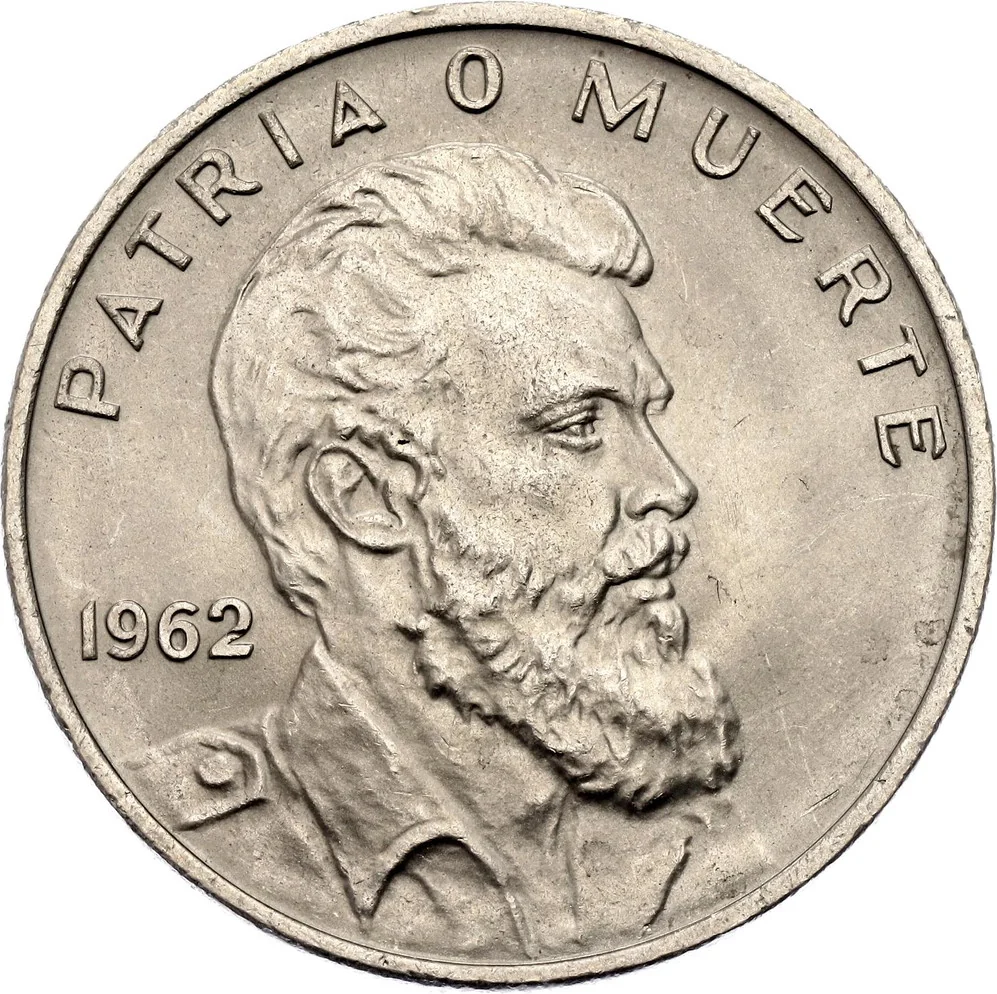
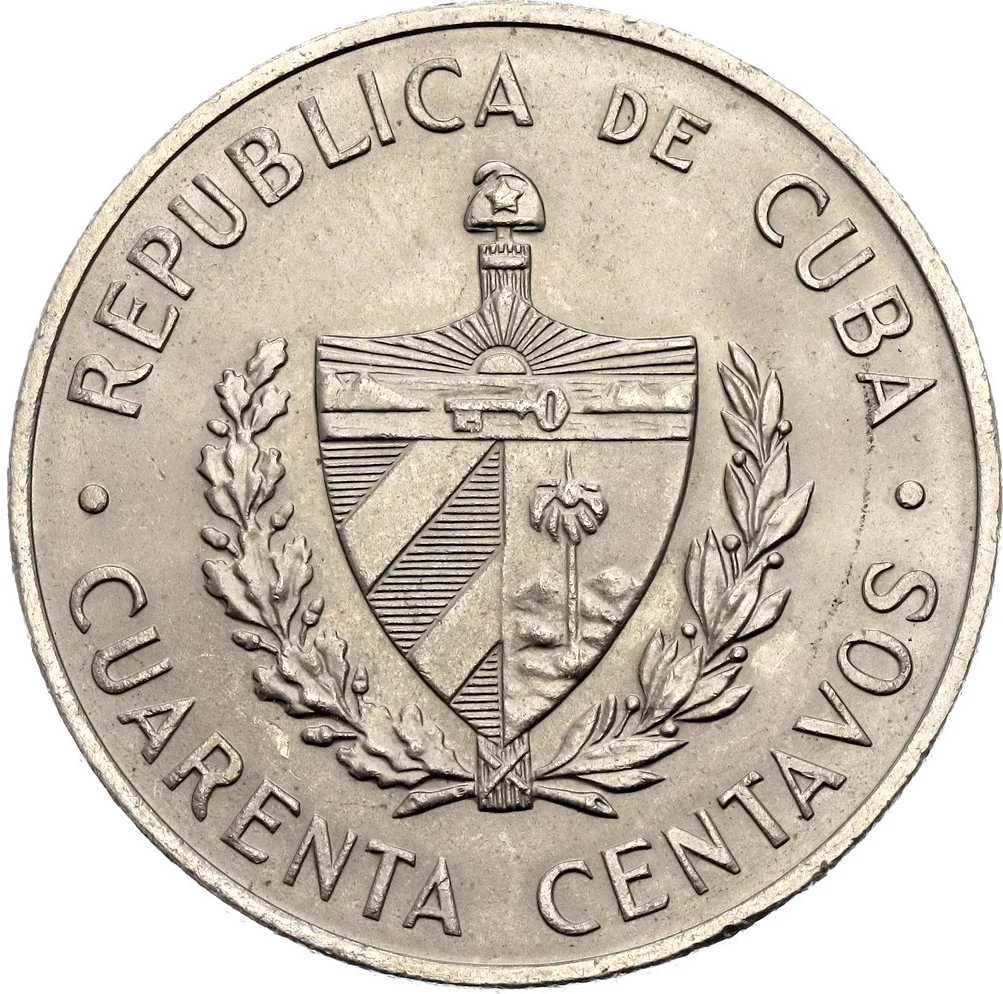
40 centavos (Camilo Cienfuegos Gorriarán) – Cuba
Add to wishlist
Circulating commemorative coins
Commemoration: 30th Anniversary of Camilo Cienfuegos Gorriarán birth
Cuba
Context
Year: 1962
Issuer: Cuba
Period:
(since 1959)
Currency:
(since 1914)
Demonetization: 9 October 1997
Total mintage: 15,250,000
Material
References
KM: #
Numista: #5118
Value
Exchange value: 0.40 CUP
Obverse
Description:
Cuban coat of arms with curved country name above and curved lettered value below.
Inscription:
REPUBLICA DE CUBA
• CUARENTA CENTAVOS •
• CUARENTA CENTAVOS •
Translation:
REPUBLIC OF CUBA
• FORTY CENTS •
• FORTY CENTS •
Script: Latin
Language: Spanish
Engraver: Charles Edward Barber
Reverse
Edge
Reeded
Categories
| Symbols> Coat of Arms |
| Person> Politician |
Mints
| Name | Mark |
|---|---|
| Saint Petersburg | — |
Mintings
| Year | Mint Mark | Mintage | Quality | Collection |
|---|---|---|---|---|
| 1962 | — | 15,250,000 |
Historical background
In 1962, Cuba's currency situation was defined by a profound and rapid transition from a dollar-dependent economy to a centralized socialist system under the new revolutionary government. Following the 1959 revolution and the subsequent U.S. embargo, the Cuban government, led by Fidel Castro, moved to sever financial ties with the United States and nationalize major industries. A critical step was the elimination of the U.S. dollar's free circulation, which had been ubiquitous during the Batista era, and its replacement with the Cuban peso as the sole official currency for domestic transactions. This was part of a broader effort to assert economic sovereignty and break from perceived imperialist control.
The year saw the consolidation of a state-controlled banking system following the nationalization of all private banks in late 1960. The government, through the newly created National Bank of Cuba (Banco Nacional de Cuba), assumed absolute control over monetary policy, foreign exchange, and credit allocation. The Cuban peso was officially pegged to the U.S. dollar at par (1:1), but this was a symbolic administrative rate. In reality, a complex system of exchange controls was implemented, severely restricting the convertibility of the peso and centralizing all foreign currency transactions within the state apparatus to conserve scarce hard currency for essential imports.
This period established the foundational monetary duality that would characterize Cuba for decades. While the domestic peso became the currency for salaries and most local goods, a separate stream of foreign exchange—primarily from the nascent Soviet alliance—was vital for international trade. The economic model prioritized political objectives over market stability, leading to the emergence of rationing for basic goods via the libreta de abastecimiento (supply booklet) to manage scarcity and ensure equitable distribution in the face of shortages and a shifting economic structure. Thus, 1962 solidified a state-monopolized, non-convertible currency system insulated from the global market and entirely directed by central planning.
The year saw the consolidation of a state-controlled banking system following the nationalization of all private banks in late 1960. The government, through the newly created National Bank of Cuba (Banco Nacional de Cuba), assumed absolute control over monetary policy, foreign exchange, and credit allocation. The Cuban peso was officially pegged to the U.S. dollar at par (1:1), but this was a symbolic administrative rate. In reality, a complex system of exchange controls was implemented, severely restricting the convertibility of the peso and centralizing all foreign currency transactions within the state apparatus to conserve scarce hard currency for essential imports.
This period established the foundational monetary duality that would characterize Cuba for decades. While the domestic peso became the currency for salaries and most local goods, a separate stream of foreign exchange—primarily from the nascent Soviet alliance—was vital for international trade. The economic model prioritized political objectives over market stability, leading to the emergence of rationing for basic goods via the libreta de abastecimiento (supply booklet) to manage scarcity and ensure equitable distribution in the face of shortages and a shifting economic structure. Thus, 1962 solidified a state-monopolized, non-convertible currency system insulated from the global market and entirely directed by central planning.
🌱 Common