

1 centavo – Cuba
Add to wishlist
Cuba
Obverse
Description:
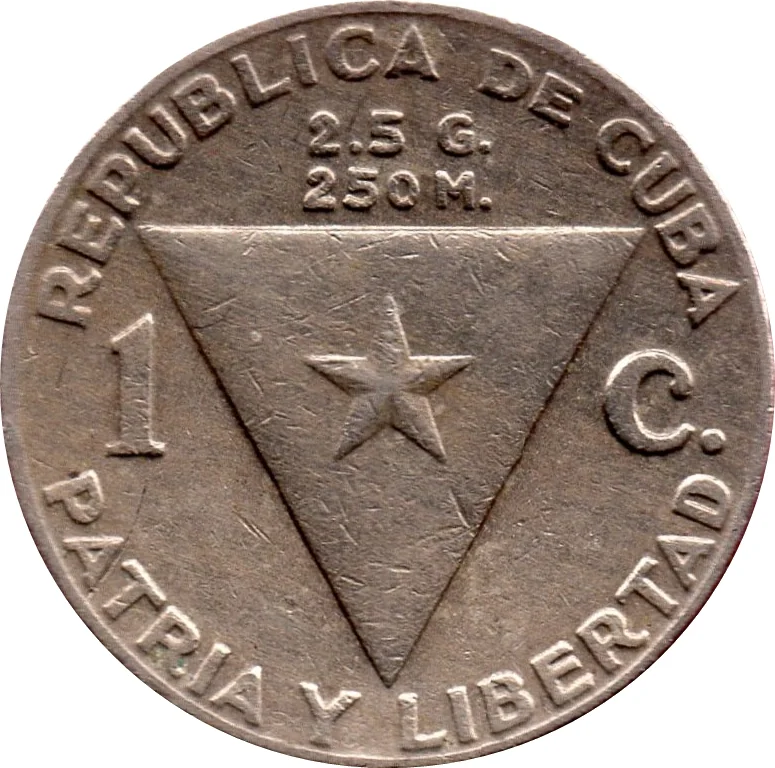
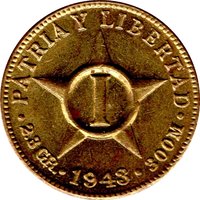
Star in triangle. Circular legend: country name above, "Fatherland and Freedom" below. Triangle separates denomination, weight, and fineness.
Inscription:
REPUBLICA DE CUBA
2.5 G.
250 M.
1 C.
PATRIA Y LIBERTAD
2.5 G.
250 M.
1 C.
PATRIA Y LIBERTAD
Translation:
REPUBLIC OF CUBA
2.5 G.
250 M.
1 C.
HOMELAND AND LIBERTY
2.5 G.
250 M.
1 C.
HOMELAND AND LIBERTY
Script: Latin
Language: Spanish
Engraver: Esteban Valderrama Peña
Reverse
Description:
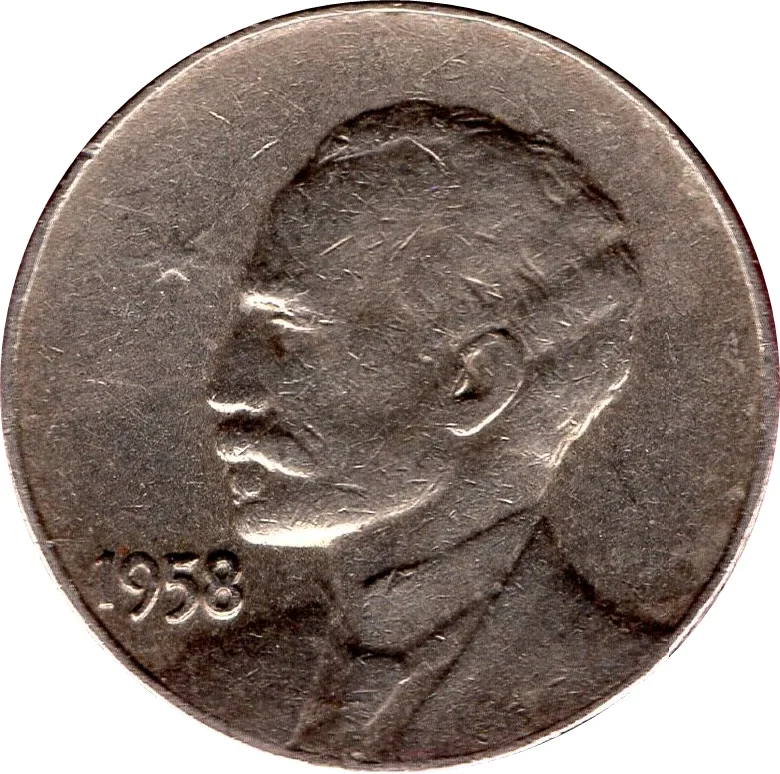
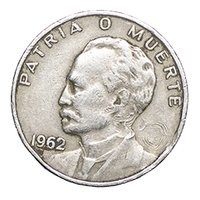
Portrait of Cuban hero José Martí (1853-1895) with a sparkling star near his face; date over shoulder.
Inscription:
1958
Script: Latin
Engraver: Esteban Valderrama Peña
Edge
Plain
Categories
| Person> Politician |
Mints
| Name | Mark |
|---|---|
| United States Mint of Philadelphia | — |
Mintings
| Year | Mint Mark | Mintage | Quality | Collection |
|---|---|---|---|---|
| 1958 | — | 50,000,000 |
Historical background
In 1958, Cuba's currency situation was characterized by relative stability and strength, but this was underpinned by deep economic distortions and dependence on the United States. The Cuban peso was pegged to the U.S. dollar at a fixed rate of 1:1, a parity maintained since 1914, and both currencies circulated interchangeably on the island. This arrangement facilitated immense U.S. investment and trade, making the peso one of Latin America's most stable currencies. However, this stability was largely artificial, reflecting Cuba's role as a sugar-exporting monoculture and a financial satellite of Washington rather than a diversified, sovereign economy.
The national economy was overwhelmingly dominated by the sugar industry, which accounted for approximately 80% of exports, leaving the country vulnerable to global price fluctuations. Furthermore, a significant portion of the banking sector and vital industries were owned by U.S. interests or a small Cuban elite aligned with the authoritarian regime of Fulgencio Batista. While Havana showcased a vibrant, dollar-fueled economy with luxury imports, this prosperity was geographically and socially concentrated, masking widespread rural poverty and unemployment outside the sugar harvest season (zafra).
By late 1958, the currency's apparent strength was becoming increasingly detached from the country's collapsing political reality. As Fidel Castro's 26th of July Movement gained military victories, capital flight accelerated, draining reserves and creating underlying pressures. The fixed exchange rate and healthy foreign reserves reported by the Batista government on the eve of its fall did not reflect the profound economic inequalities and structural weaknesses that fueled the revolution. The stable peso of 1958 was, therefore, a facade that would shatter immediately following the revolutionary triumph in January 1959, leading to rapid monetary reform and the eventual dissolution of its direct link to the dollar.
The national economy was overwhelmingly dominated by the sugar industry, which accounted for approximately 80% of exports, leaving the country vulnerable to global price fluctuations. Furthermore, a significant portion of the banking sector and vital industries were owned by U.S. interests or a small Cuban elite aligned with the authoritarian regime of Fulgencio Batista. While Havana showcased a vibrant, dollar-fueled economy with luxury imports, this prosperity was geographically and socially concentrated, masking widespread rural poverty and unemployment outside the sugar harvest season (zafra).
By late 1958, the currency's apparent strength was becoming increasingly detached from the country's collapsing political reality. As Fidel Castro's 26th of July Movement gained military victories, capital flight accelerated, draining reserves and creating underlying pressures. The fixed exchange rate and healthy foreign reserves reported by the Batista government on the eve of its fall did not reflect the profound economic inequalities and structural weaknesses that fueled the revolution. The stable peso of 1958 was, therefore, a facade that would shatter immediately following the revolutionary triumph in January 1959, leading to rapid monetary reform and the eventual dissolution of its direct link to the dollar.
🌱 Common