

Obverse
Description:
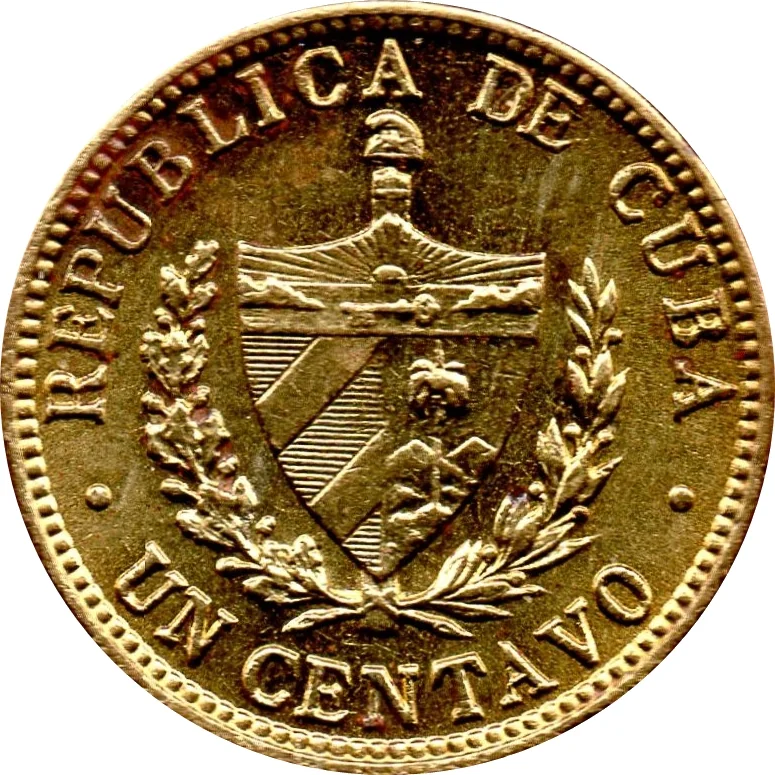
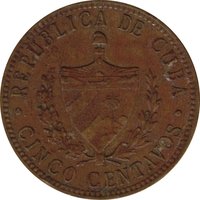
Cuban coat of arms. Top legend: country name. Bottom legend: face value in letters. Denticles near rim.
Inscription:
REPUBLICA DE CUBA
• UN CENTAVO •
• UN CENTAVO •
Translation:
REPUBLIC OF CUBA
• ONE CENT •
• ONE CENT •
Script: Latin
Language: Spanish
Engraver: Charles Edward Barber
Reverse
Description:
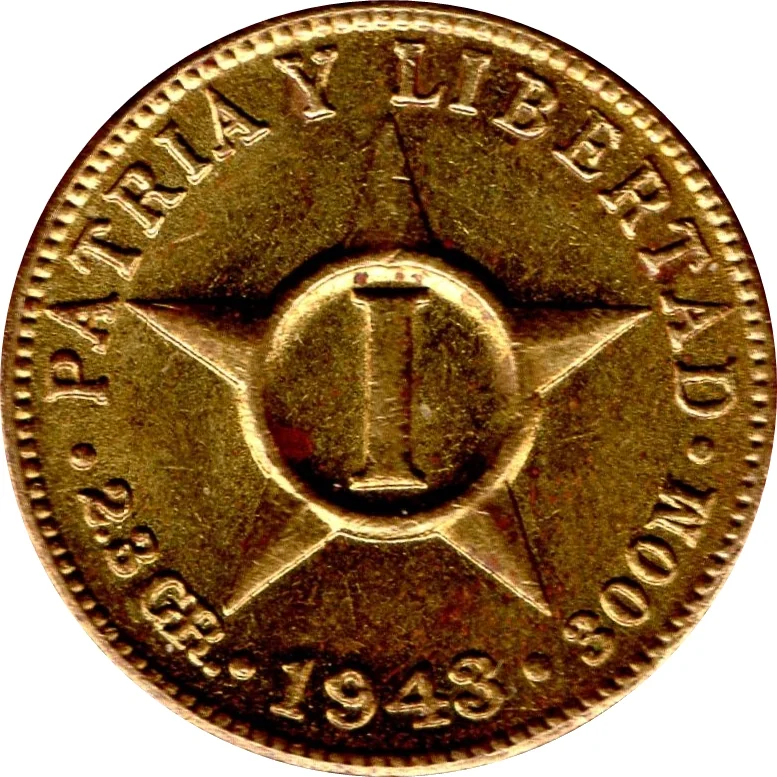
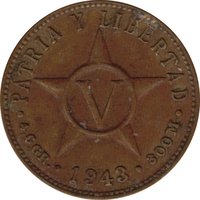
Roman numeral in circled star, "Fatherland and Freedom" above, date below, weight and fineness on sides, denticled rim.
Inscription:
PATRIA Y LIBERTAD
I
• 2.3 GR. • 1943 • 300M •
I
• 2.3 GR. • 1943 • 300M •
Translation:
Country and Liberty
I
• 2.3 GR. • 1943 • 300M •
I
• 2.3 GR. • 1943 • 300M •
Script: Latin
Language: Spanish
Engraver: Charles Edward Barber
Edge
Plain
Categories
| Symbols> Coat of Arms |
Mints
| Name | Mark |
|---|---|
| United States Mint of Philadelphia | — |
Mintings
| Year | Mint Mark | Mintage | Quality | Collection |
|---|---|---|---|---|
| 1943 | — | 20,000,000 |
Historical background
In 1943, Cuba's currency situation was characterized by stability and a strong link to the United States dollar, a direct result of the island's deep economic integration with its northern neighbor. The Cuban peso was legally pegged to the U.S. dollar at a 1:1 parity, a system established by the Monetary Law of 1914 and reinforced by the Jones-Costigan Amendment. This fixed exchange rate facilitated predictable trade and investment, with U.S. dollars circulating freely alongside Cuban pesos, effectively making Cuba a dual-currency economy. The nation's central bank, the Banco Nacional de Cuba, had been established just two years prior in 1941, but ultimate monetary authority still largely resided with the U.S.-backed Cuban Currency Stabilization Fund.
This financial stability was underpinned by Cuba's booming wartime economy. As a major Allied supplier, Cuba experienced high demand for its sugar, nickel, and tobacco, leading to substantial U.S. dollar inflows and healthy foreign reserves. The economic activity was further stimulated by the presence of U.S. military installations and personnel on the island. Consequently, inflation was controlled, and there was no black market for currency, a stark contrast to later periods in Cuban history. The peso was considered a strong and fully convertible currency, with its value unquestioned in both domestic and international contexts.
However, this apparent stability was structurally dependent on the U.S. relationship and the singular sugar-based economy. Wealth distribution remained highly unequal, and the economy was vulnerable to shifts in the U.S. market and global commodity prices. While 1943 represented a peak of monetary confidence, the system's fragility would be exposed in the post-war years when sugar prices fluctuated and political instability grew. Thus, the currency situation of 1943 reflected a moment of prosperous but dependent equilibrium, entirely shaped by Cuba's role in the Allied war effort and its quasi-colonial economic ties to the United States.
This financial stability was underpinned by Cuba's booming wartime economy. As a major Allied supplier, Cuba experienced high demand for its sugar, nickel, and tobacco, leading to substantial U.S. dollar inflows and healthy foreign reserves. The economic activity was further stimulated by the presence of U.S. military installations and personnel on the island. Consequently, inflation was controlled, and there was no black market for currency, a stark contrast to later periods in Cuban history. The peso was considered a strong and fully convertible currency, with its value unquestioned in both domestic and international contexts.
However, this apparent stability was structurally dependent on the U.S. relationship and the singular sugar-based economy. Wealth distribution remained highly unequal, and the economy was vulnerable to shifts in the U.S. market and global commodity prices. While 1943 represented a peak of monetary confidence, the system's fragility would be exposed in the post-war years when sugar prices fluctuated and political instability grew. Thus, the currency situation of 1943 reflected a moment of prosperous but dependent equilibrium, entirely shaped by Cuba's role in the Allied war effort and its quasi-colonial economic ties to the United States.
🌱 Common