

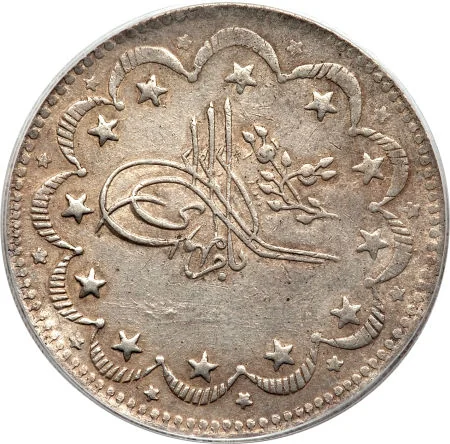
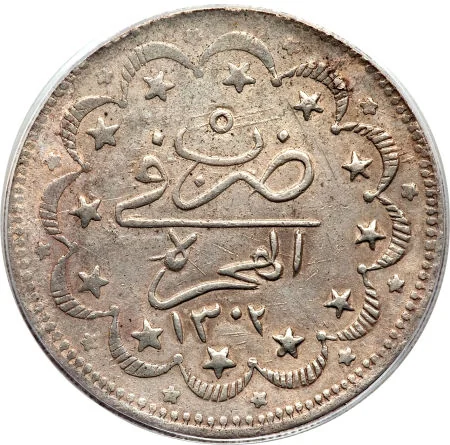
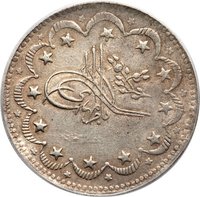
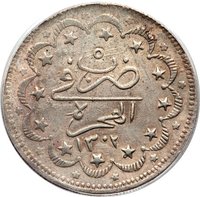
20 Qirsh – Mahdist State
Sudan
Context
Year: 1885
Islamic (Hijri) Year: 1302
Country: Sudan 
Issuer: Mahdist State
Currency:
(1885—1898)
Demonetized: Yes
Material
References
KM: #Click to copy to clipboard2
Numista: #50935
Value
Bullion value: $67.81
Mintings
| Year | Mint Mark | Mintage | Quality | Collection |
|---|---|---|---|---|
| 1885 | — | — |
Historical background
The Mahdist State (1885-1898), born from a successful revolt against Anglo-Egyptian rule, faced immediate and severe monetary challenges. The new theocratic government inherited a collapsed treasury and found itself economically isolated, with European powers and Egypt refusing to recognize its currency. Furthermore, the Mahdists' religious ideology viewed the use of coins bearing the likeness of the Ottoman Sultan or other rulers as idolatrous, creating a doctrinal imperative to replace the existing monetary system. This combination of empty coffers, international blockade, and religious decree forced the state to devise a unique and ultimately unstable currency solution.
The primary currency became the riyal maqbul ("accepted riyal"), a crude silver coin minted from melted-down jewelry, ornaments, and existing foreign coins. Its value was not intrinsic but was declared by fiat (hisba), backed by the authority of the Mahdist state and its strict legal codes. To facilitate smaller transactions, the government introduced a much-derided currency of brass dirhams and copper fals. These base metal coins had virtually no intrinsic value and their acceptance relied entirely on coercion. The state enforced their use at officially decreed rates, mandating that merchants and markets accept them for daily purchases under threat of punishment.
This system proved economically disastrous. The overproduction of the brass and copper coins, without any precious metal reserve, led to rapid inflation and a catastrophic loss of public confidence. Markets increasingly reverted to barter or clandestine use of older Egyptian and Ottoman coins, which held more stable value. By the mid-1890s, the currency was in a state of effective collapse, severely weakening the Mahdist economy and undermining its ability to provision armies and administer territories. This internal financial breakdown was a critical, though often overlooked, factor that contributed to the state's vulnerability prior to its military defeat at the Battle of Omdurman in 1898.
The primary currency became the riyal maqbul ("accepted riyal"), a crude silver coin minted from melted-down jewelry, ornaments, and existing foreign coins. Its value was not intrinsic but was declared by fiat (hisba), backed by the authority of the Mahdist state and its strict legal codes. To facilitate smaller transactions, the government introduced a much-derided currency of brass dirhams and copper fals. These base metal coins had virtually no intrinsic value and their acceptance relied entirely on coercion. The state enforced their use at officially decreed rates, mandating that merchants and markets accept them for daily purchases under threat of punishment.
This system proved economically disastrous. The overproduction of the brass and copper coins, without any precious metal reserve, led to rapid inflation and a catastrophic loss of public confidence. Markets increasingly reverted to barter or clandestine use of older Egyptian and Ottoman coins, which held more stable value. By the mid-1890s, the currency was in a state of effective collapse, severely weakening the Mahdist economy and undermining its ability to provision armies and administer territories. This internal financial breakdown was a critical, though often overlooked, factor that contributed to the state's vulnerability prior to its military defeat at the Battle of Omdurman in 1898.

✨ Legendary