

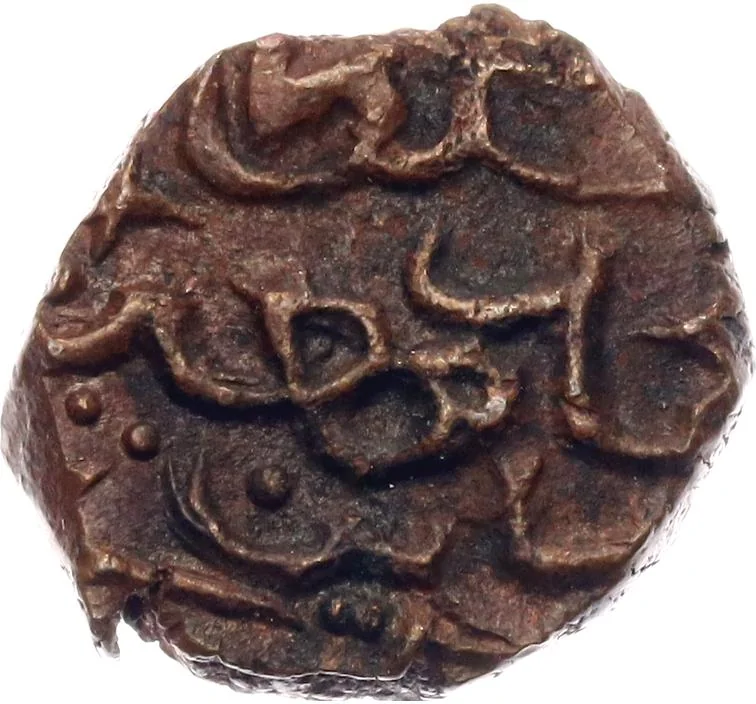
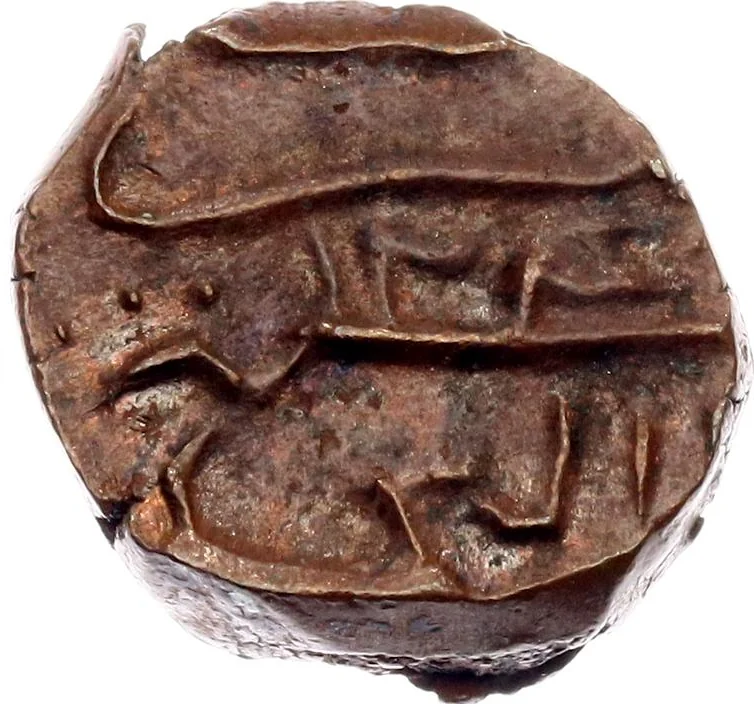
½ larin – Maldives
Add to wishlist
Maldives
Context
Years: 1802–1833
Issuer: Maldives
Ruler: Muhammad Mueenuddeen I
Currency:
(1660—1947)
Demonetized: Yes
Material
Diameter: 10.76 mm
Weight: 1.68 g
Thickness: 2.75 mm
Shape: Irregular round
Composition: Copper
Magnetic: No
References
KM: #
Numista: #50918
Obverse
Reverse
Inscription:
سلطان
البر والبحر
١٢۴۰
سنة
البر والبحر
١٢۴۰
سنة
Translation:
Sultan
of the Land and the Sea
1240
Year
of the Land and the Sea
1240
Year
Language: Arabic
Edge
Plain
Mintings
| Year | Mint Mark | Mintage | Quality | Collection |
|---|---|---|---|---|
| 1802 | — | — | ||
| 1805 | — | — | ||
| 1806 | — | — | ||
| 1815 | — | — | ||
| 1823 | — | — | ||
| 1824 | — | — | ||
| 1825 | — | — | ||
| 1833 | — | — |
Historical background
In 1802, the Maldives operated under a fragmented and informal currency system, heavily influenced by its strategic position in Indian Ocean trade routes. The primary medium of exchange was the Larín, a silver wire coin often bent into a hook shape, which had circulated for centuries across the Persian Gulf and South Asia. However, the most significant and practical currency in daily use was the cowrie shell, imported in vast quantities from the Maldives itself and East Africa. These shells, particularly the Cypraea moneta variety, served as small change for local transactions, forming the bedrock of the domestic subsistence economy.
Internationally, the archipelago was a tributary state to the British Ceylon-based government, following the Dutch transfer of protectorate claims in 1796. Despite this political shift, the economic reality was one of multiple overlapping currencies. Alongside larins and cowries, various foreign silver coins circulated, including Spanish dollars (pieces of eight), Dutch rixdollars, and Indian rupees. These coins entered the islands through trade with Arab, Indian, Malay, and increasingly European merchants, who exchanged them for dried fish, coconut products, and coir rope. There was no unified Maldivian mint; the state's authority over currency was limited to regulating the acceptance and exchange rates of these foreign monies in the main port of Malé.
Consequently, the monetary situation was complex and locally determined. Exchange rates between cowries, larins, and silver coins fluctuated based on supply and the demands of visiting traders. The Sultanate’s administration collected tribute and taxes largely in kind (such as dried fish and woven cloth) and in select foreign silver, highlighting the lack of a standardized national currency. This system reflected the Maldives' dual economic identity: a local economy rooted in traditional shell money and a maritime trade economy integrated into the broader monetary flows of the Indian Ocean world.
Internationally, the archipelago was a tributary state to the British Ceylon-based government, following the Dutch transfer of protectorate claims in 1796. Despite this political shift, the economic reality was one of multiple overlapping currencies. Alongside larins and cowries, various foreign silver coins circulated, including Spanish dollars (pieces of eight), Dutch rixdollars, and Indian rupees. These coins entered the islands through trade with Arab, Indian, Malay, and increasingly European merchants, who exchanged them for dried fish, coconut products, and coir rope. There was no unified Maldivian mint; the state's authority over currency was limited to regulating the acceptance and exchange rates of these foreign monies in the main port of Malé.
Consequently, the monetary situation was complex and locally determined. Exchange rates between cowries, larins, and silver coins fluctuated based on supply and the demands of visiting traders. The Sultanate’s administration collected tribute and taxes largely in kind (such as dried fish and woven cloth) and in select foreign silver, highlighting the lack of a standardized national currency. This system reflected the Maldives' dual economic identity: a local economy rooted in traditional shell money and a maritime trade economy integrated into the broader monetary flows of the Indian Ocean world.

⭐ Rare