

25 rubles – Russian Federation
Add to wishlist
Non-circulating coins
Series: Russian sport
Russia
Context
Year: 2025
Country: Russia
Issuer: Russian Federation
Issuing organization: Central Bank of Russia
Period:
(since 1991)
Currency:
(since 1998)
Total mintage: 50,000
Material
Diameter: 27 mm
Weight: 10 g
Thickness: 2.3 mm
Shape: Round
Composition: Copper-nickel
Alignment: Medal alignment
flip

References
Numista: #508679
Value
Exchange value: 25 RUB
Obverse
Description:
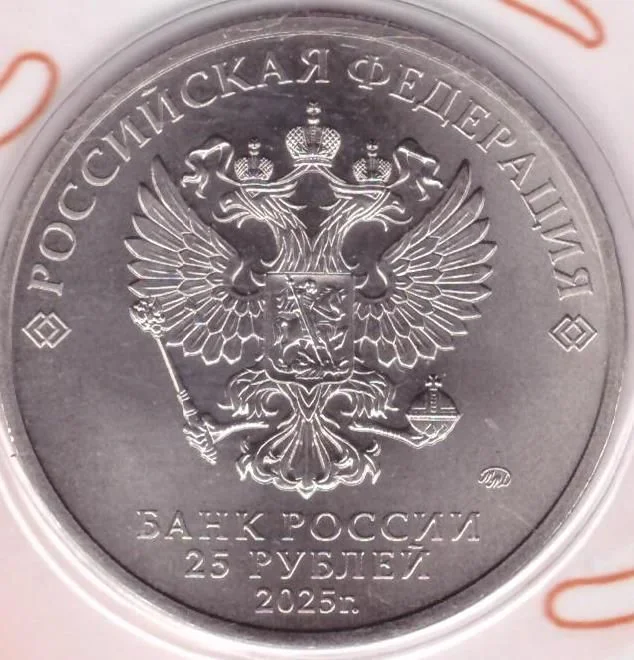
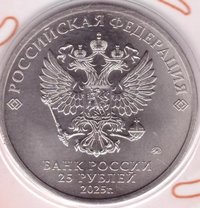
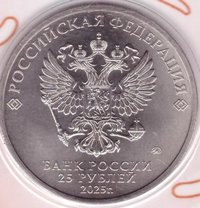
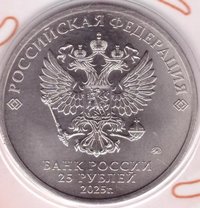
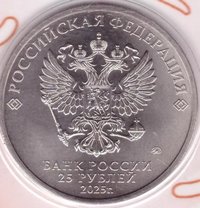
Centered is the national coat of arms, above it a semicircular inscription: "РОССИЙСКАЯ ФЕДЕРАЦИЯ", flanked by doubled rhombuses. Below are "БАНК РОССИИ", "25 РУБЛЕЙ", "2020 г.", and on the right, the mint mark.
Inscription:
РОССИЙСКАЯ ФЕДЕРАЦИЯ
ММД
БАНК РОССИИ
25 РУБЛЕЙ
2025 г.
ММД
БАНК РОССИИ
25 РУБЛЕЙ
2025 г.
Translation:
RUSSIAN FEDERATION
MMD
BANK OF RUSSIA
25 ROUBLES
2025
MMD
BANK OF RUSSIA
25 ROUBLES
2025
Script: Cyrillic
Language: Russian
Reverse
Edge
Reeded
Categories
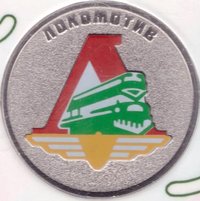
| Sport> Football |
| Symbols> Coat of Arms |
Mints
| Name | Mark |
|---|---|
| Moscow Mint | (ММД) |
Mintings
| Year | Mint Mark | Mintage | Quality | Collection |
|---|---|---|---|---|
| 2025 | ММД | 50,000 |
Historical background
In 2025, the currency situation in the Russian Federation remains defined by a state of managed stability under stringent capital controls, but with underlying structural vulnerabilities. The ruble’s exchange rate is largely decoupled from traditional market fundamentals and is instead a policy tool administered by the Central Bank of Russia (CBR) and the Ministry of Finance. Stability is enforced through a complex regime of mandatory foreign currency sales for exporters, strict limits on capital movement, and the continued use of a "budget rule" that diverts excess oil and gas revenues into the National Wealth Fund. This has prevented the dramatic volatility seen in 2022-2023, but at the cost of a largely artificial exchange rate that masks inflationary pressures and constrains economic dynamism.
The financial landscape is characterized by a deepening "bifurcation" between the domestic and international systems. Domestically, the ruble remains the sole legal tender, supported by a rapid expansion of the Mir payment system and digital financial platforms. Internationally, however, the economy relies on a patchwork of alternatives to circumvent Western sanctions, including a much-increased use of currencies like the Chinese yuan for trade settlement, bilateral local currency agreements, and informal barter mechanisms. This duality creates significant transaction costs, complicates long-term investment, and reflects Russia's continued economic reorientation from Europe towards Asia and other non-aligned partners.
Looking forward, the primary risks to currency stability are less about sudden collapse and more about gradual erosion. Persistent, elevated inflation—driven by high military spending, labor shortages, and import bottlenecks—continues to undermine the ruble's purchasing power. The currency's value is fundamentally tethered to the fiscal health of the state, which remains dependent on volatile global energy prices and the efficacy of sanctions evasion. Therefore, while a technical crisis is unlikely in the short term, the 2025 situation points to a long-term trajectory of controlled depreciation, financial isolation, and the use of the currency as an instrument of sovereign economic defense rather than a fully convertible medium for global exchange.
The financial landscape is characterized by a deepening "bifurcation" between the domestic and international systems. Domestically, the ruble remains the sole legal tender, supported by a rapid expansion of the Mir payment system and digital financial platforms. Internationally, however, the economy relies on a patchwork of alternatives to circumvent Western sanctions, including a much-increased use of currencies like the Chinese yuan for trade settlement, bilateral local currency agreements, and informal barter mechanisms. This duality creates significant transaction costs, complicates long-term investment, and reflects Russia's continued economic reorientation from Europe towards Asia and other non-aligned partners.
Looking forward, the primary risks to currency stability are less about sudden collapse and more about gradual erosion. Persistent, elevated inflation—driven by high military spending, labor shortages, and import bottlenecks—continues to undermine the ruble's purchasing power. The currency's value is fundamentally tethered to the fiscal health of the state, which remains dependent on volatile global energy prices and the efficacy of sanctions evasion. Therefore, while a technical crisis is unlikely in the short term, the 2025 situation points to a long-term trajectory of controlled depreciation, financial isolation, and the use of the currency as an instrument of sovereign economic defense rather than a fully convertible medium for global exchange.
Series: Russian sport





✨ Legendary