

5 Cents – Suriname
Suriname
Context
Year: 1943
Issuer: Suriname 
Ruler: Wilhelmina
Currency:
(1826—2003)
Demonetized: Yes
Total mintage: 6,595,000
Material
Weight: 4.3 g
Thickness: 1.5 mm
Shape: Square with rounded corners
Composition: Nickel brass
Magnetic: No
Technique: Milled
Alignment: Coin alignment
flip
References
KM: #Click to copy to clipboard40 (Curaça
Numista: #5046
Value
Exchange value: 0.05 SRD
Obverse
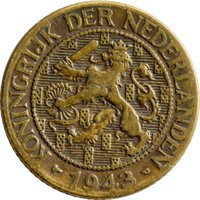
Description:
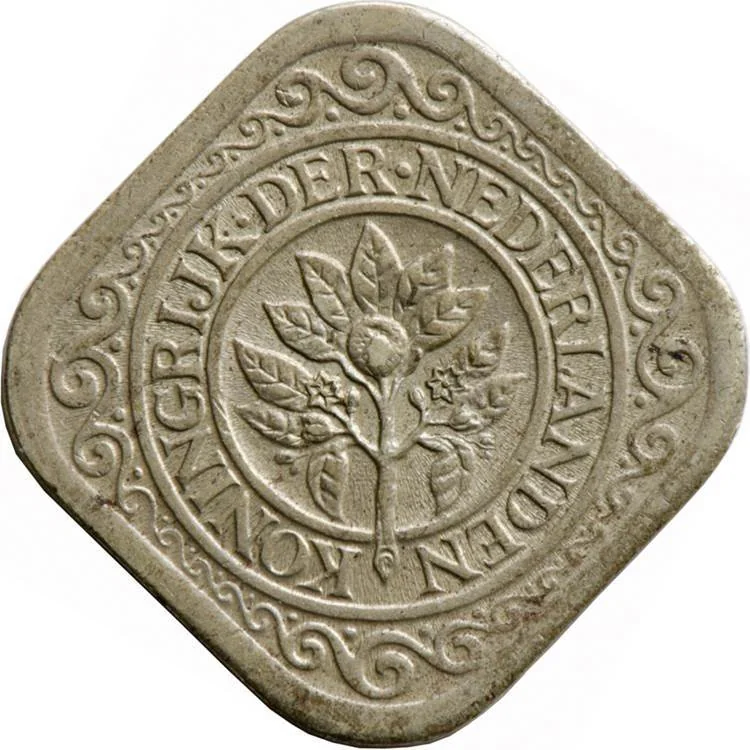
Orange branch with fruit inside a circle, Dutch text between circles, all within an outer decorative ring.
Inscription:
KONINGRIJK·DER·NEDERLANDEN
Translation:
KINGDOM OF THE NETHERLANDS
Script: Latin
Language: Dutch
Designer: Johannes Cornelis Wienecke
Reverse
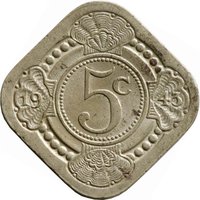
Description:
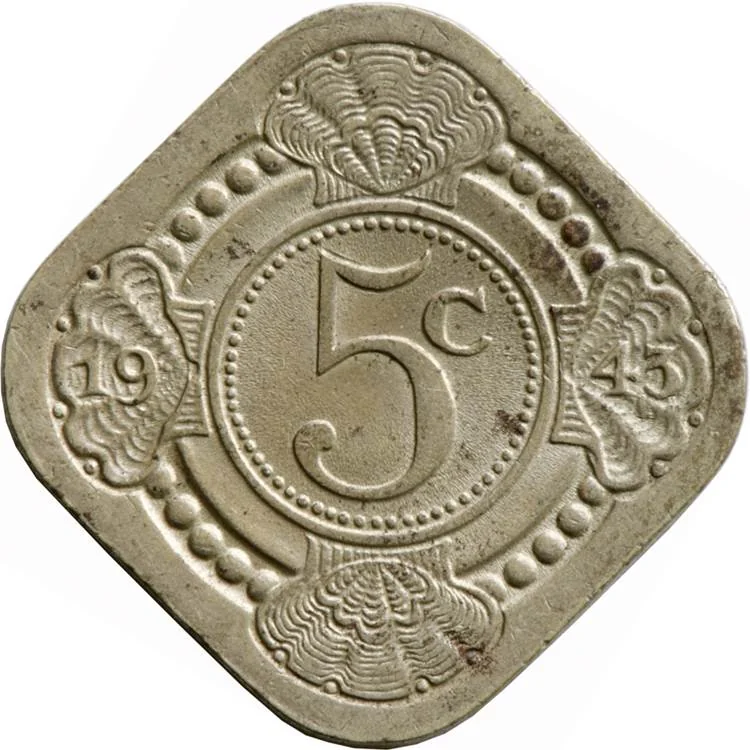
Denomination circles the date, shells mark the corners.
Inscription:
5c
1943
1943
Script: Latin
Designer: Johannes Cornelis Wienecke
Edge
Plain
Mints
| Name | Mark |
|---|---|
| United States Mint of Philadelphia | — |
Mintings
| Year | Mint Mark | Mintage | Quality | Collection |
|---|---|---|---|---|
| 1943 | — | 6,595,000 |
Historical background
In 1943, Suriname, then a Dutch colony, operated under a unique and complex currency situation shaped by World War II. The Netherlands had been occupied by Nazi Germany in 1940, severing direct economic ties between the colony and its mother country. In response, the Dutch government-in-exile in London, in close coordination with its Allies, took control of Suriname's financial system to secure its vital bauxite reserves for the Allied war effort and prevent funds from falling under enemy influence.
The official currency remained the Surinamese guilder, which was pegged at par to the Netherlands Antillean guilder. However, the most significant development was the effective dollarization of key sectors of the economy. A large U.S. military presence, established to protect the bauxite mines, introduced substantial amounts of U.S. dollars into circulation. The U.S. dollar became the de facto currency for transactions related to the American forces and the booming bauxite industry, creating a dual-currency environment in the colony's major economic hubs.
This period was marked by strict exchange controls and monetary governance exercised by the authorized banks, primarily the Surinaamsche Bank, under the authority of the exiled Dutch government. The primary objectives were to stabilize the local currency, manage the influx of U.S. dollars, and ensure that Suriname's financial resources contributed to the Allied cause. Thus, the 1943 currency landscape was one of colonial administration sustained by Allied partnership, defined by pragmatic dollar usage alongside official guilders, all under the umbrella of wartime economic control.
The official currency remained the Surinamese guilder, which was pegged at par to the Netherlands Antillean guilder. However, the most significant development was the effective dollarization of key sectors of the economy. A large U.S. military presence, established to protect the bauxite mines, introduced substantial amounts of U.S. dollars into circulation. The U.S. dollar became the de facto currency for transactions related to the American forces and the booming bauxite industry, creating a dual-currency environment in the colony's major economic hubs.
This period was marked by strict exchange controls and monetary governance exercised by the authorized banks, primarily the Surinaamsche Bank, under the authority of the exiled Dutch government. The primary objectives were to stabilize the local currency, manage the influx of U.S. dollars, and ensure that Suriname's financial resources contributed to the Allied cause. Thus, the 1943 currency landscape was one of colonial administration sustained by Allied partnership, defined by pragmatic dollar usage alongside official guilders, all under the umbrella of wartime economic control.
🌱 Common