

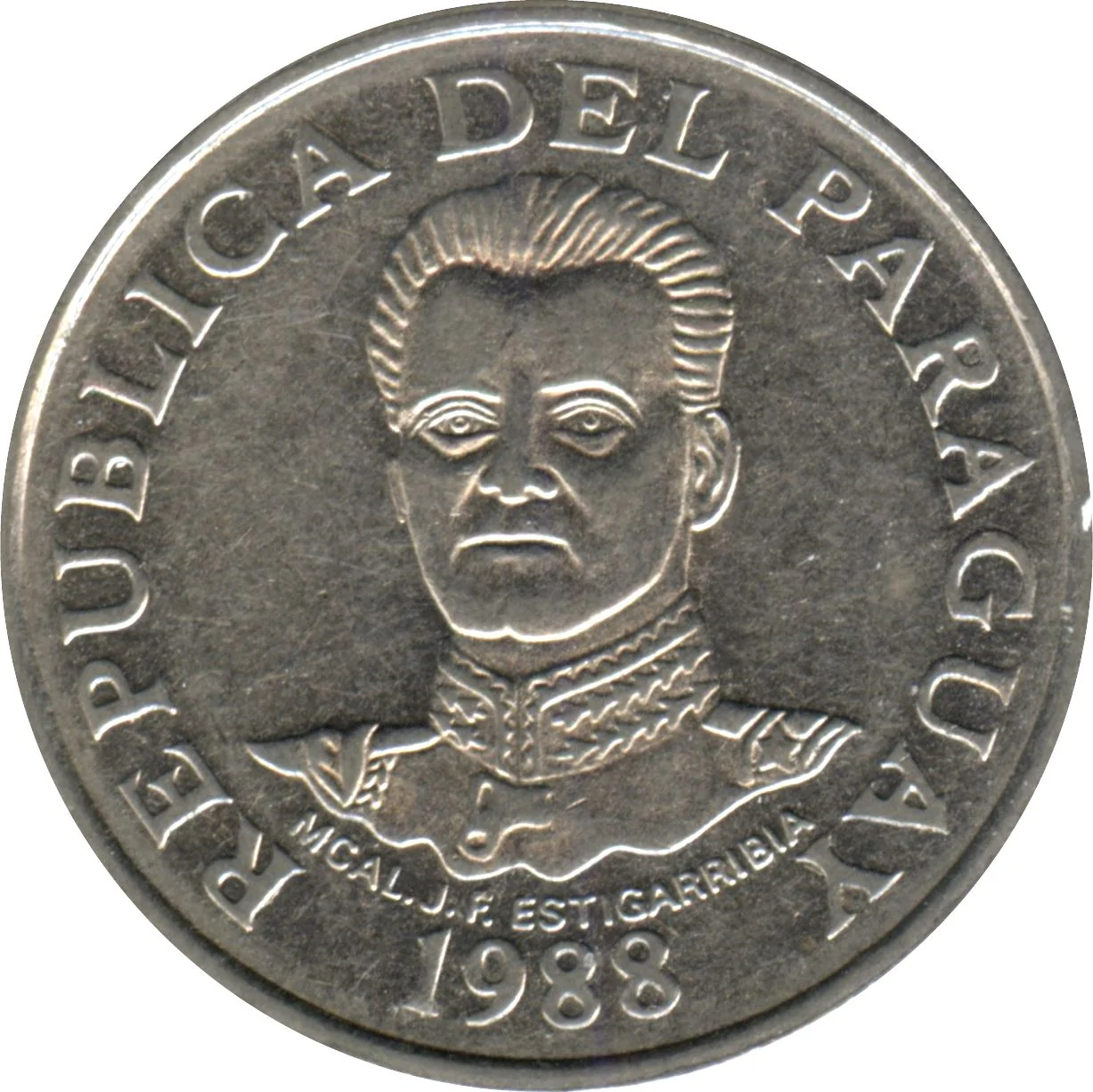
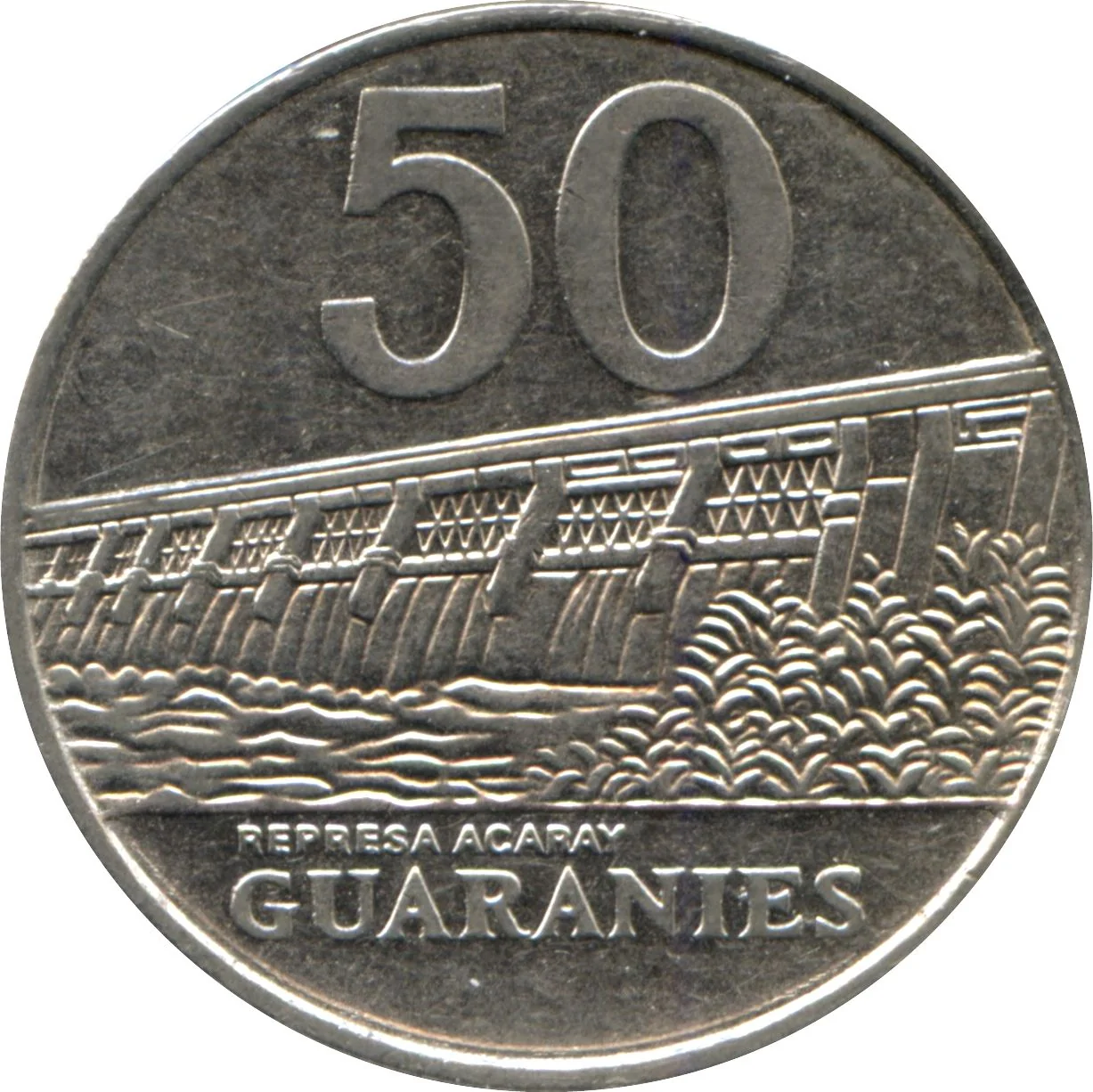
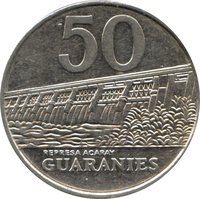
50 Guaraníes – Paraguay
Paraguay
Context
Years: 1980–1988
Issuer: Paraguay 
Issuing organization: Central Bank of Paraguay
Period:
(since 1811)
Currency:
(since 1944)
Demonetization: 17 January 2014
Total mintage: 50,701,000
Material
Diameter: 26 mm
Weight: 5.6 g
Thickness: 1.65 mm
Shape: Round
Composition: Stainless steel
Technique: Milled
Alignment: Coin alignment
flip
References
KM: #Click to copy to clipboard169
Numista: #4977
Value
Exchange value: 50 PYG
Obverse
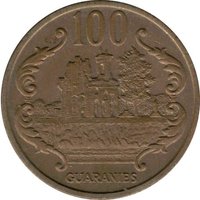
Reverse
Edge
Plain
Categories
| Person> Military leader |
| Person> Politician |
Mintings
| Year | Mint Mark | Mintage | Quality | Collection |
|---|---|---|---|---|
| 1980 | — | 10,700,000 | ||
| 1980 | — | 1,000 | Proof | |
| 1986 | — | 15,000,000 | ||
| 1988 | — | 25,000,000 |
Historical background
In 1980, Paraguay operated under the authoritarian regime of General Alfredo Stroessner, who had been in power since 1954. The country's currency, the guaraní, was characterized by a system of multiple exchange rates and strict government control. The Central Bank of Paraguay (BCP) maintained an official, overvalued exchange rate for priority imports and debt servicing, while a parallel, less favorable "financial" or black-market rate existed for most other transactions. This dual system was a hallmark of the period, creating distortions, fostering corruption, and benefiting regime allies with access to cheap dollars.
Economically, the early 1980s marked the end of a prolonged boom fueled by massive hydroelectric projects (like Itaipú), agricultural exports, and regional trade. However, the year 1980 itself saw the onset of significant external pressures. Global recession, rising international interest rates, and a decline in commodity prices began to strain Paraguay's balance of payments. While the full crisis would erupt later in the decade, the foundations were weakening as public external debt grew and the overvalued official guaraní increasingly misrepresented the currency's true market value.
The currency regime was ultimately a tool of the Stroessner government's political economy. It provided a mechanism to subsidize loyal business sectors and the state itself, while insulating the regime in the short term from inflationary pressures that plagued neighboring countries. However, this control came at the cost of economic efficiency and transparency. The growing disparity between the official and parallel rates in the early 1980s signaled underlying vulnerabilities, presaging the severe financial and currency crises that would challenge the regime later in the decade as the Itaipú-related windfalls diminished.
Economically, the early 1980s marked the end of a prolonged boom fueled by massive hydroelectric projects (like Itaipú), agricultural exports, and regional trade. However, the year 1980 itself saw the onset of significant external pressures. Global recession, rising international interest rates, and a decline in commodity prices began to strain Paraguay's balance of payments. While the full crisis would erupt later in the decade, the foundations were weakening as public external debt grew and the overvalued official guaraní increasingly misrepresented the currency's true market value.
The currency regime was ultimately a tool of the Stroessner government's political economy. It provided a mechanism to subsidize loyal business sectors and the state itself, while insulating the regime in the short term from inflationary pressures that plagued neighboring countries. However, this control came at the cost of economic efficiency and transparency. The growing disparity between the official and parallel rates in the early 1980s signaled underlying vulnerabilities, presaging the severe financial and currency crises that would challenge the regime later in the decade as the Itaipú-related windfalls diminished.
🌱 Very Common