

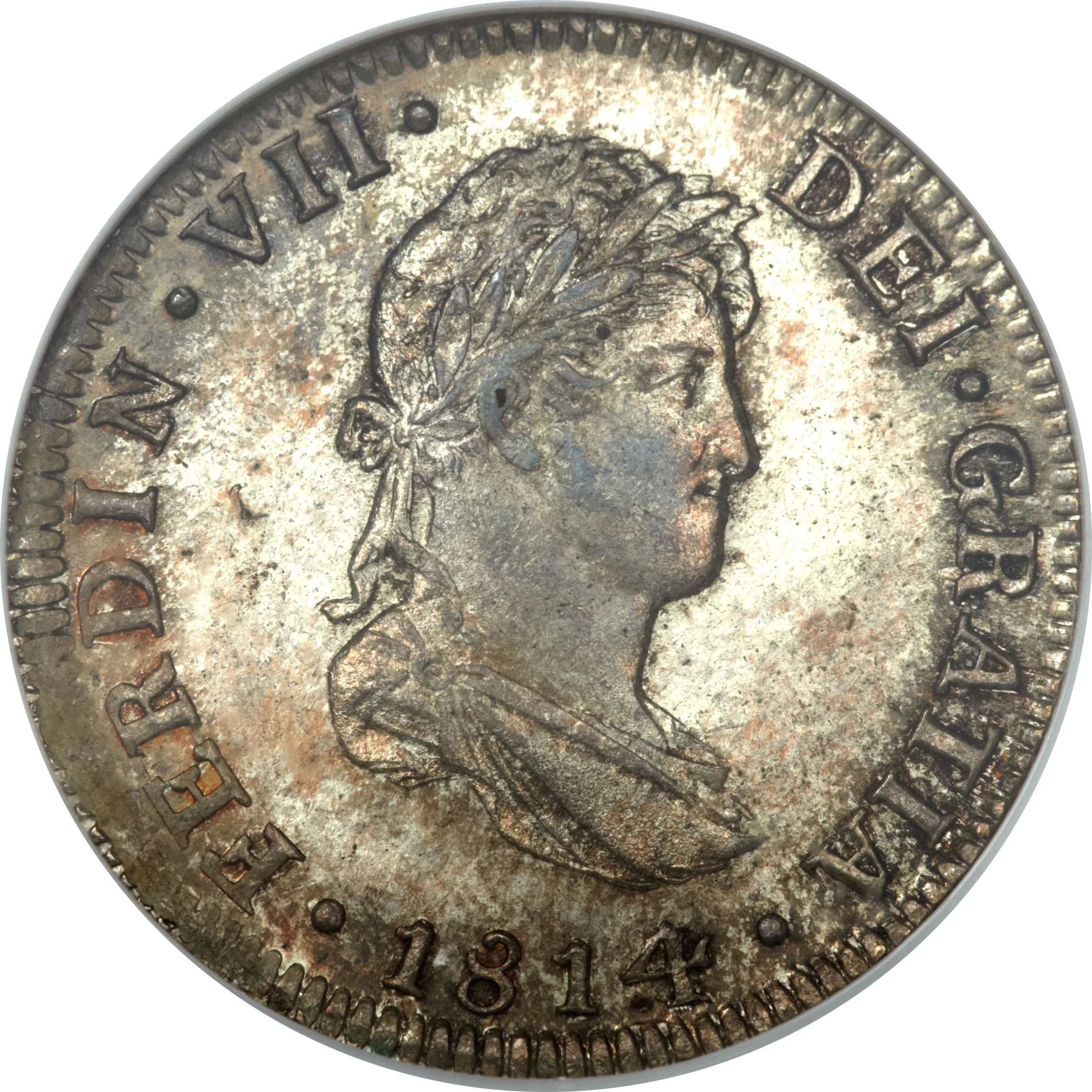
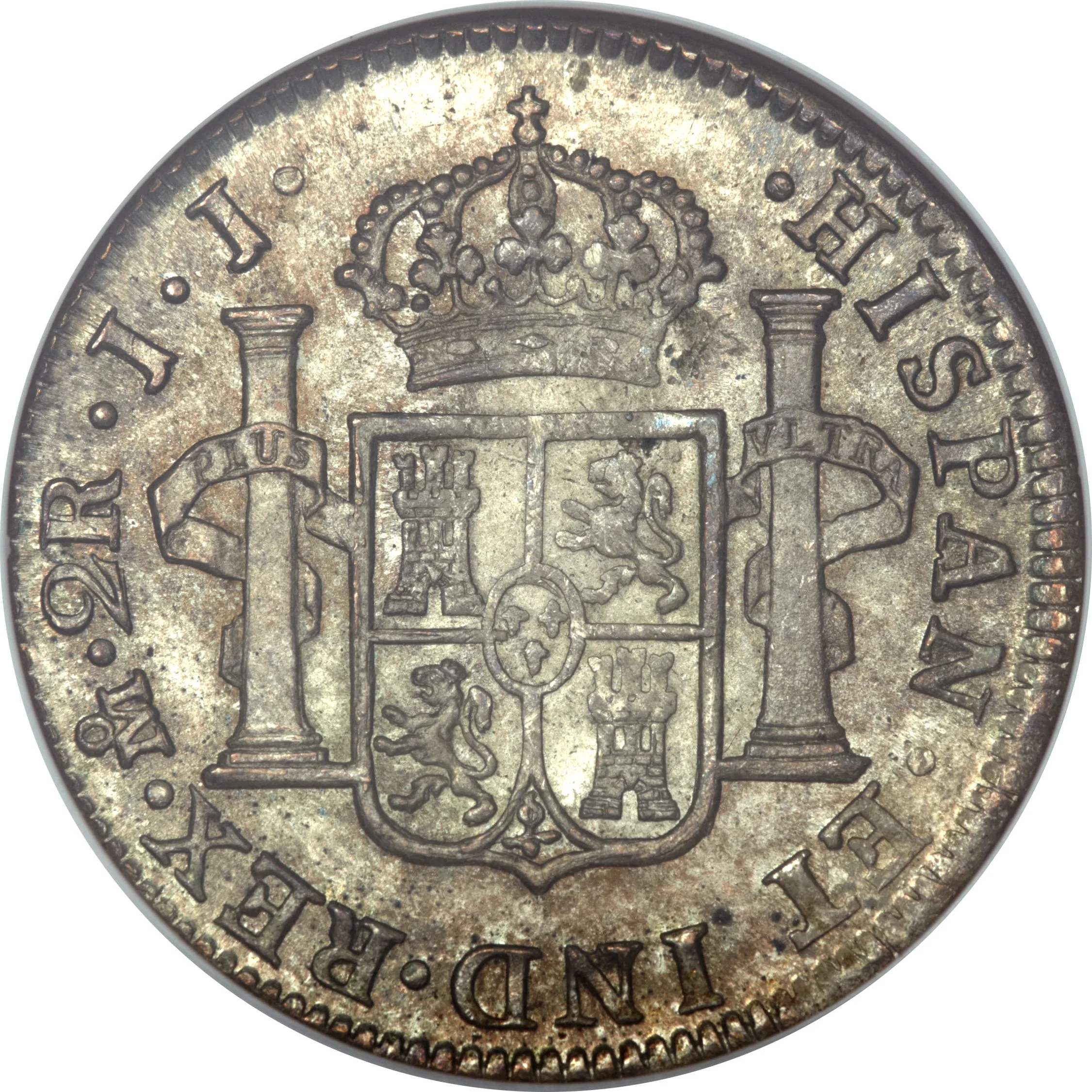
2 reales – New Spain
Add to wishlist
Mexico
Context
Years: 1812–1822
Country: Mexico
Issuer: New Spain
Ruler: Ferdinand VII
Currency:
(1535—1897)
Demonetized: Yes
Material
References
KM: #
Numista: #15102
Value
Bullion value: $15.00
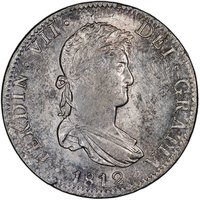
Obverse
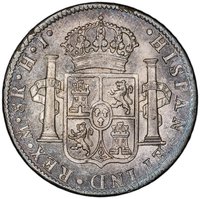
Reverse
Edge
Mintings
| Year | Mint Mark | Mintage | Quality | Collection |
|---|---|---|---|---|
| 1812 | Mo | — | ||
| 1813 | Mo | — | ||
| 1814 | Mo | — | ||
| 1815 | Mo | — | ||
| 1816 | Mo | — | ||
| 1817 | Mo | — | ||
| 1818 | Mo | — | ||
| 1819 | Mo | — | ||
| 1820 | Mo | — | ||
| 1821 | Mo | — | ||
| 1821 | Zs | — | ||
| 1822 | Go | — |
Historical background
In 1812, the currency situation in New Spain was one of profound crisis and fragmentation, a direct reflection of the ongoing War of Independence that had begun in 1810. The royalist government, controlling Mexico City and major urban centers, struggled to maintain the integrity of the colonial monetary system. To finance the war against the insurgency, the authorities resorted to excessive issuance of paper money, known as vales reales, and debased copper coinage (moneda de cobre). This led to rampant inflation, a severe loss of public confidence in currency, and widespread hoarding of silver pesos, the traditional pillar of value.
Simultaneously, the insurgent forces, operating from their own territories and strongholds, established an alternative financial system to fund their cause. Leaders like Miguel Hidalgo and, by 1812, José María Morelos, issued their own copper and silver coins, often stamped with symbols of the rebellion such as bows and arrows or the word "SUD" (for Suprema Junta Nacional Americana). This created a stark duality: two competing currencies circulated in a divided land, with the insurgent money holding value primarily in areas under their control and serving as a potent tool for political legitimacy and economic warfare against royalist authority.
Consequently, the year 1812 saw a deeply fractured and unstable monetary landscape. Trade was severely disrupted as the value of money fluctuated based on military fortunes and geographic control. The widespread distrust in all forms of coinage, driven by inflation and counterfeiting, pushed many transactions back toward barter. This financial chaos was both a symptom and a cause of the collapsing colonial order, undermining the economy and daily life, and illustrating how the struggle for political sovereignty was inextricably linked to a battle over economic sovereignty and the very medium of exchange.
Simultaneously, the insurgent forces, operating from their own territories and strongholds, established an alternative financial system to fund their cause. Leaders like Miguel Hidalgo and, by 1812, José María Morelos, issued their own copper and silver coins, often stamped with symbols of the rebellion such as bows and arrows or the word "SUD" (for Suprema Junta Nacional Americana). This created a stark duality: two competing currencies circulated in a divided land, with the insurgent money holding value primarily in areas under their control and serving as a potent tool for political legitimacy and economic warfare against royalist authority.
Consequently, the year 1812 saw a deeply fractured and unstable monetary landscape. Trade was severely disrupted as the value of money fluctuated based on military fortunes and geographic control. The widespread distrust in all forms of coinage, driven by inflation and counterfeiting, pushed many transactions back toward barter. This financial chaos was both a symptom and a cause of the collapsing colonial order, undermining the economy and daily life, and illustrating how the struggle for political sovereignty was inextricably linked to a battle over economic sovereignty and the very medium of exchange.

⭐ Somewhat Rare