

1⁄25 crown – Isle of Man
Add to wishlist
Context
Year: 2009
Country: British Crown dependencies
Issuer: Isle of Man
Ruler: Elizabeth II
Currency:
(since 1970)
Material
References
KM: #
Numista: #493225
Value
Bullion value: $190.86
Obverse
Description:
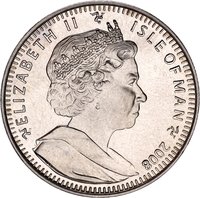
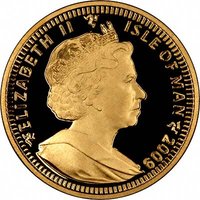
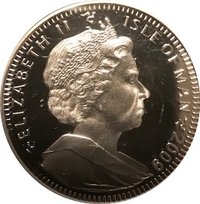
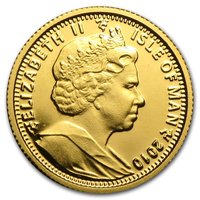
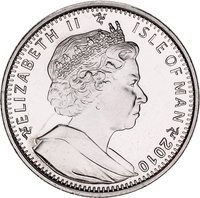
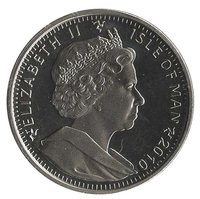
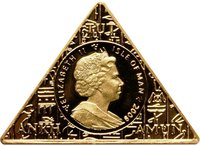
Queen Elizabeth II right-facing portrait in the "Girls of Great Britain and Ireland" Tiara, surrounded by legend and date.
Inscription:
ELIZABETH II ISLE OF MAN 2009
IRB
IRB
Translation:
ELIZABETH II ISLE OF MAN 2009
IRB
IRB
Script: Latin
Designer: Ian Rank-Broadley
Reverse
Description:
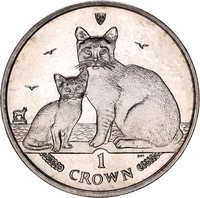
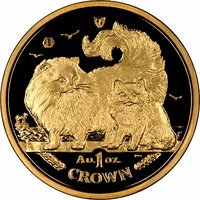
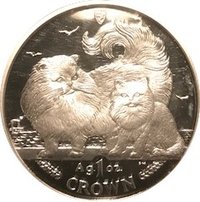
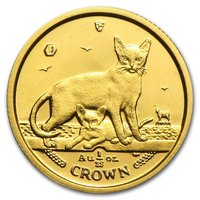
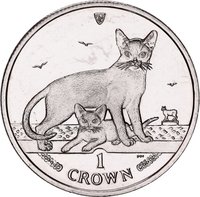
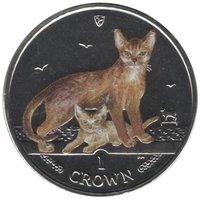
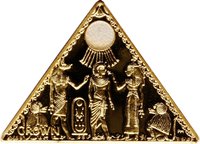
Chinchilla cat and kitten. Shield with triskeles above, flying birds behind, Manx cat on platform at lower right.
Inscription:
Au.1/25oz.
PM
CROWN
PM
CROWN
Script: Latin
Edge
Reeded
Categories
| Animal> Feline |
| Symbol> Triskelion |
Mints
| Name | Mark |
|---|---|
| Pobjoy Mint | (PM) |
Mintings
| Year | Mint Mark | Mintage | Quality | Collection |
|---|---|---|---|---|
| 2009 | PM | — | Proof | |
| 2009 | PM | — |
Historical background
In 2009, the Isle of Man's currency situation was defined by its unique constitutional position and the global financial crisis. As a self-governing British Crown Dependency, the island issued its own sterling-denominated currency, the Manx pound, which was not legal tender in the United Kingdom but maintained a fixed 1:1 parity with Pound Sterling (GBP). This arrangement provided monetary stability but meant the island's economy and banking sector were deeply integrated with and vulnerable to shocks from the UK, which acted as its lender of last resort.
The global financial crisis of 2007-2008 profoundly impacted the island, primarily through its significant offshore banking sector. While the Manx government emphasised its robust regulation and the fact that no depositors lost funds, the crisis led to a contraction in banking activity and increased scrutiny on offshore financial centres. A key event was the 2008 collapse of the UK bank Kaupthing Singer & Friedlander, which had a Manx subsidiary. The Isle of Man government took the unprecedented step of using public funds to ensure full repayment of depositors, a move that protected its reputation but came at a substantial fiscal cost, impacting public finances.
Consequently, 2009 was a year of fiscal consolidation and reputational defence for the Isle of Man. The government faced budget pressures from the bank rescue and reduced tax revenues, prompting reviews of public spending. Simultaneously, it worked to reinforce its image as a well-regulated jurisdiction, distinct from more opaque tax havens, to reassure international investors and depositors. Thus, the currency itself remained stable due to its Sterling peg, but the economic and fiscal environment surrounding it was challenged, testing the resilience of the island's financial model.
The global financial crisis of 2007-2008 profoundly impacted the island, primarily through its significant offshore banking sector. While the Manx government emphasised its robust regulation and the fact that no depositors lost funds, the crisis led to a contraction in banking activity and increased scrutiny on offshore financial centres. A key event was the 2008 collapse of the UK bank Kaupthing Singer & Friedlander, which had a Manx subsidiary. The Isle of Man government took the unprecedented step of using public funds to ensure full repayment of depositors, a move that protected its reputation but came at a substantial fiscal cost, impacting public finances.
Consequently, 2009 was a year of fiscal consolidation and reputational defence for the Isle of Man. The government faced budget pressures from the bank rescue and reduced tax revenues, prompting reviews of public spending. Simultaneously, it worked to reinforce its image as a well-regulated jurisdiction, distinct from more opaque tax havens, to reassure international investors and depositors. Thus, the currency itself remained stable due to its Sterling peg, but the economic and fiscal environment surrounding it was challenged, testing the resilience of the island's financial model.
Series: Cats

✨ Legendary