

20000 tolarjev (Slovenia and the Tolar) – Slovenia
Add to wishlist
Non-circulating coins
Commemoration: 10th Anniversary of Slovenia and the Tolar
Slovenia
Context
Material
References
KM: #
Numista: #49312
Value
Exchange value: 20000 SIT
Bullion value: $971.79
Inflation-adjusted value: 42264.20 SIT
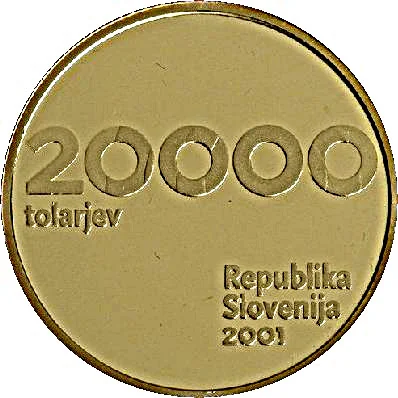
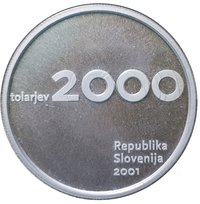
Obverse
Description:
Valuable
Inscription:
20000
tolarjev
Republika
Slovenija
2001
tolarjev
Republika
Slovenija
2001
Translation:
twenty thousand
tolars
Republic
of Slovenia
2001
tolars
Republic
of Slovenia
2001
Script: Latin
Language: Slovenian
Engraver: Jan Černaj
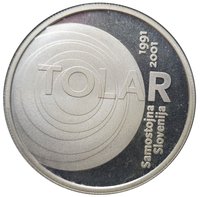
Reverse
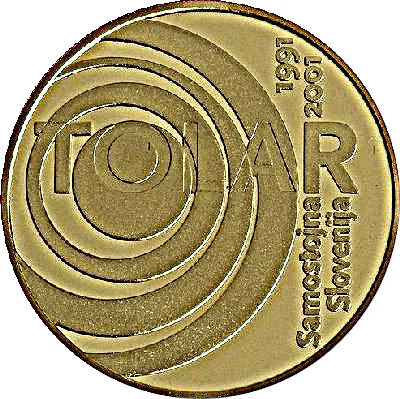
Description:
Three rings, inscribed.
Inscription:
TOLAR
1991
2001
Samostojna
Slovenija
1991
2001
Samostojna
Slovenija
Script: Latin
Engraver: Jan Černaj
Edge
200 reeds.
Mints
| Name | Mark |
|---|---|
| Kremnica | — |
Mintings
| Year | Mint Mark | Mintage | Quality | Collection |
|---|---|---|---|---|
| 2001 | — | 1,000 | Proof |
Historical background
In 2001, Slovenia's currency situation was defined by its strategic transition from the Yugoslav era towards European integration. Following independence in 1991, the country introduced the Slovenian tolar (SIT) in October 1991 as a critical symbol of monetary sovereignty, replacing the Yugoslav dinar. Throughout the 1990s, the Bank of Slovenia successfully maintained a stable and credible managed float exchange rate regime, taming the initial high inflation and establishing the tolar as a cornerstone of the nation's economic stability and growth.
The year 2001 was particularly significant as it marked Slovenia's active and advanced preparation for European Union membership, which included mandatory participation in the Exchange Rate Mechanism (ERM II), the eurozone's "waiting room." While formal ERM II entry would not occur until June 2004, the groundwork was being laid. Monetary policy was tightly managed to keep the tolar stable, primarily pegged to the German Mark (and later implicitly to the euro), ensuring low inflation and meeting the Maastricht criteria for future euro adoption.
Therefore, the currency landscape in 2001 was one of deliberate stability and strategic alignment. The tolar was not an end in itself but a vehicle for achieving broader macroeconomic convergence with the EU. The focus of authorities was squarely on maintaining the exchange rate stability and economic conditions necessary to eventually replace the national currency with the euro, a goal that was successfully realized in 2007 when Slovenia became the first post-communist country to adopt the single European currency.
The year 2001 was particularly significant as it marked Slovenia's active and advanced preparation for European Union membership, which included mandatory participation in the Exchange Rate Mechanism (ERM II), the eurozone's "waiting room." While formal ERM II entry would not occur until June 2004, the groundwork was being laid. Monetary policy was tightly managed to keep the tolar stable, primarily pegged to the German Mark (and later implicitly to the euro), ensuring low inflation and meeting the Maastricht criteria for future euro adoption.
Therefore, the currency landscape in 2001 was one of deliberate stability and strategic alignment. The tolar was not an end in itself but a vehicle for achieving broader macroeconomic convergence with the EU. The focus of authorities was squarely on maintaining the exchange rate stability and economic conditions necessary to eventually replace the national currency with the euro, a goal that was successfully realized in 2007 when Slovenia became the first post-communist country to adopt the single European currency.
✨ Legendary