

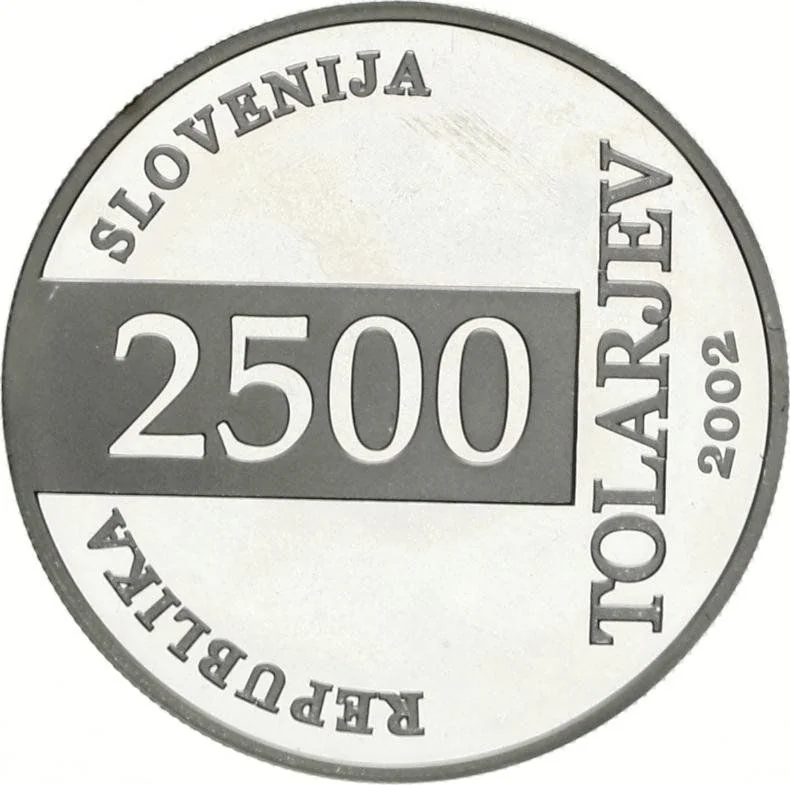
2500 tolarjev – Slovenia
Add to wishlist
Non-circulating coins
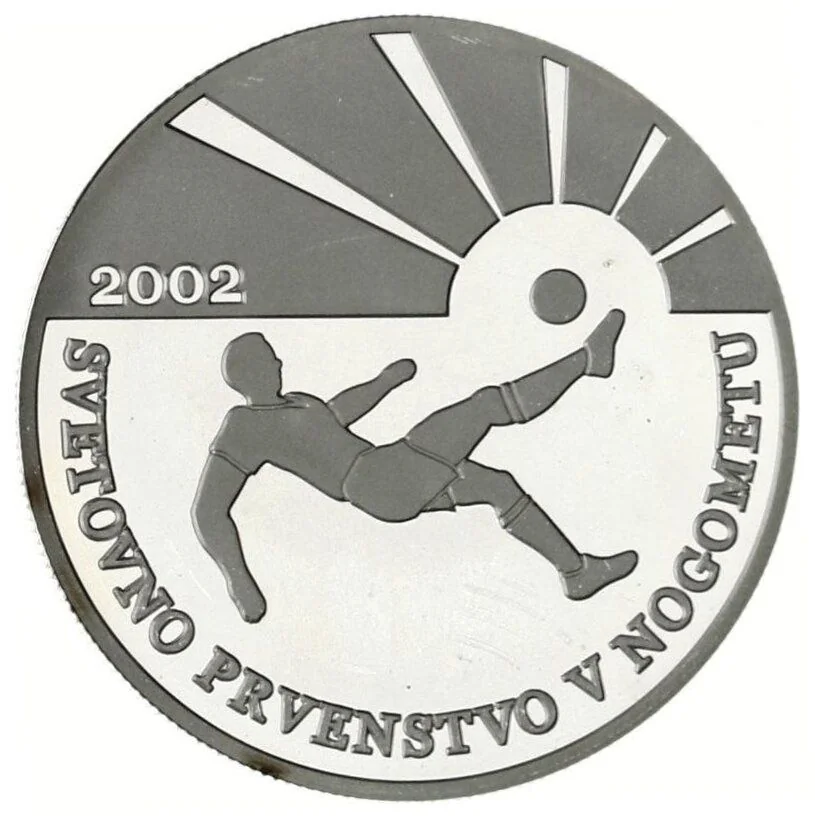
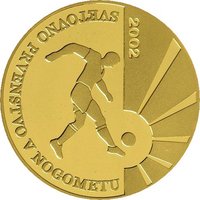
Commemoration: Soccer World Championship
Slovenia
Context
Material
References
KM: #
Numista: #24835
Value
Exchange value: 2500 SIT
Bullion value: $35.18
Inflation-adjusted value: 4874.55 SIT
Obverse
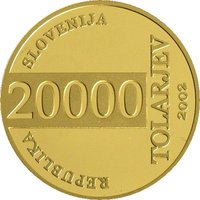
Reverse
Edge
200 reeds.
Categories
| Sport> Football> FIFA World Cup |
Mints
| Name | Mark |
|---|---|
| Kremnica | — |
Mintings
| Year | Mint Mark | Mintage | Quality | Collection |
|---|---|---|---|---|
| 2002 | — | 2,500 | Proof |
Historical background
In 2002, Slovenia was in the final and crucial stage of its transition from the national currency, the tolar, to the euro. Having successfully met the Maastricht convergence criteria for inflation, interest rates, budget deficits, and public debt, the country was formally invited in December 2002 to join the European Union on 1 May 2004. This invitation was the green light for its parallel and primary monetary objective: adopting the euro. The year was therefore characterized by intense technical and legislative preparations under a fixed exchange rate, as the tolar had already been operating within the ERM II mechanism since June 2004, with its central rate irrevocably set at 239.64 tolars to the euro.
Domestically, the Bank of Slovenia and the government focused on the massive logistical and public awareness campaign known as "The Big Change." This involved minting and distributing euro coins (which featured Slovenian motifs) and banknotes, adapting all financial software and accounting systems, and launching a nationwide information effort to familiarize citizens with the new currency. A critical aspect was the dual display of prices, which became mandatory from March 2003 onward, to build public trust and ease the transition.
Thus, the currency situation in 2002 was one of confident anticipation and meticulous groundwork. There was no monetary instability; instead, the tolar operated as a stable proxy for the euro, with its fate sealed by the EU accession decision. The year solidified Slovenia's path toward becoming the first transition economy to adopt the euro, which it successfully did on 1 January 2007, marking the culmination of the strategic process set in motion during this pivotal period.
Domestically, the Bank of Slovenia and the government focused on the massive logistical and public awareness campaign known as "The Big Change." This involved minting and distributing euro coins (which featured Slovenian motifs) and banknotes, adapting all financial software and accounting systems, and launching a nationwide information effort to familiarize citizens with the new currency. A critical aspect was the dual display of prices, which became mandatory from March 2003 onward, to build public trust and ease the transition.
Thus, the currency situation in 2002 was one of confident anticipation and meticulous groundwork. There was no monetary instability; instead, the tolar operated as a stable proxy for the euro, with its fate sealed by the EU accession decision. The year solidified Slovenia's path toward becoming the first transition economy to adopt the euro, which it successfully did on 1 January 2007, marking the culmination of the strategic process set in motion during this pivotal period.
💎 Extremely Rare