

15 Dollars – Australia
Australia
Context

Material
Diameter: 16.1 mm
Weight: 3.14 g
Gold weight: 3.14 g
Thickness: 1.5 mm
Shape: Round
Composition: 99.99% Gold
Standard: Gold tenth ounce
Magnetic: No
Technique: Milled
References
KM: #Click to copy to clipboard902
Numista: #493061
Value
Exchange value: 15 AUD = $10.68
Bullion value: $522.00
Inflation-adjusted value: 27.13 AUD
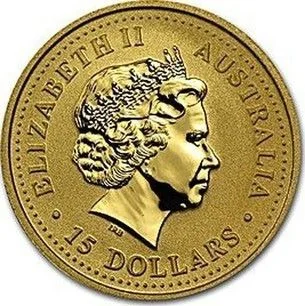
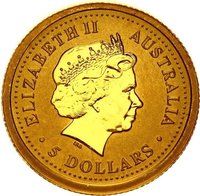
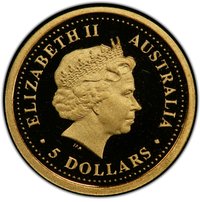
Obverse
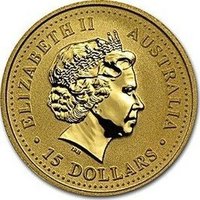
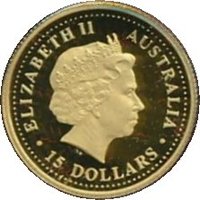
Description:
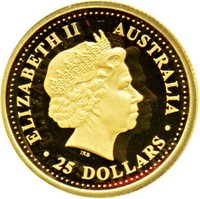
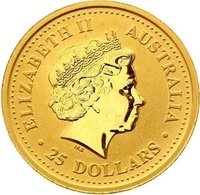
Queen Elizabeth IV, facing right, wearing the Girls of Great Britain and Ireland Tiara.
Inscription:
ELIZABETH II
AUSTRALIA
15 DOLLARS
IRB
AUSTRALIA
15 DOLLARS
IRB
Script: Latin
Designer: Ian Rank-Broadley
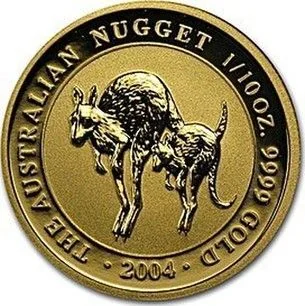
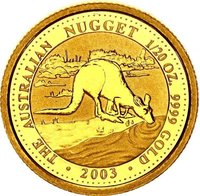
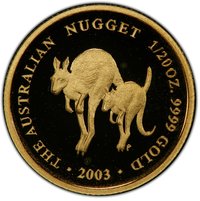
Reverse
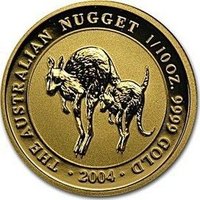
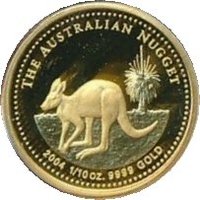
Description:
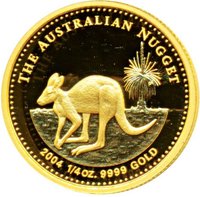
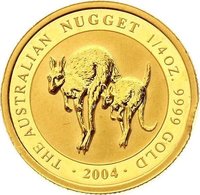
Bounding kangaroos.
Inscription:
THE AUSTRALIAN NUGGET
2004 1/10oz 9999 GOLD
P
LP
2004 1/10oz 9999 GOLD
P
LP
Script: Latin
Designer: Louise Pinder
Edge
Reeded
Mints
| Name | Mark |
|---|---|
| Perth Mint | P |
Mintings
| Year | Mint Mark | Mintage | Quality | Collection |
|---|---|---|---|---|
| 2003 | — | 500 | Proof | |
| 2004 | — | — | BU |
Historical background
In 2003, Australia's currency situation was characterised by a period of remarkable strength and global prominence, driven primarily by a sustained commodity boom. The Australian dollar (AUD), which had traded as low as 47.75 US cents in April 2001, began a powerful ascent, entering 2003 around 56 US cents and climbing to approximately 73 US cents by year's end. This dramatic appreciation was fuelled by soaring global demand, particularly from China, for Australia's key mineral and energy exports like iron ore, coal, and natural gas. Concurrently, the Reserve Bank of Australia (RBA) maintained a relatively high official cash rate compared to other developed nations, at 4.75% for most of the year, which attracted foreign capital and further supported the currency.
This "strong dollar" environment presented a dual-edged sword for the Australian economy. On one hand, it helped contain inflation by making imports cheaper, which provided the RBA with stability in its monetary policy settings. On the other hand, it exerted significant pressure on the country's export-oriented sectors beyond resources, such as manufacturing, tourism, and education services, as Australian goods and services became more expensive for foreign buyers. The high dollar also contributed to a growing current account deficit, which widened as the cost of imports fell and export incomes in local currency terms were somewhat tempered.
Underpinning this dynamic was a confident and transparent policy framework. Australia operated with a free-floating exchange rate, which had been in place since 1983, allowing the AUD to act as a shock absorber for the economy. The RBA, under Governor Ian Macfarlane, maintained an inflation-targeting regime and only intervened in foreign exchange markets on rare, disorderly occasions. Consequently, the currency's rise in 2003 was largely seen as a market-driven reflection of Australia's robust economic fundamentals and its pivotal role as a supplier in the accelerating global commodity "super-cycle," setting the stage for even greater gains in the following decade.
This "strong dollar" environment presented a dual-edged sword for the Australian economy. On one hand, it helped contain inflation by making imports cheaper, which provided the RBA with stability in its monetary policy settings. On the other hand, it exerted significant pressure on the country's export-oriented sectors beyond resources, such as manufacturing, tourism, and education services, as Australian goods and services became more expensive for foreign buyers. The high dollar also contributed to a growing current account deficit, which widened as the cost of imports fell and export incomes in local currency terms were somewhat tempered.
Underpinning this dynamic was a confident and transparent policy framework. Australia operated with a free-floating exchange rate, which had been in place since 1983, allowing the AUD to act as a shock absorber for the economy. The RBA, under Governor Ian Macfarlane, maintained an inflation-targeting regime and only intervened in foreign exchange markets on rare, disorderly occasions. Consequently, the currency's rise in 2003 was largely seen as a market-driven reflection of Australia's robust economic fundamentals and its pivotal role as a supplier in the accelerating global commodity "super-cycle," setting the stage for even greater gains in the following decade.
Series: The Australian Nugget
✨ Legendary