

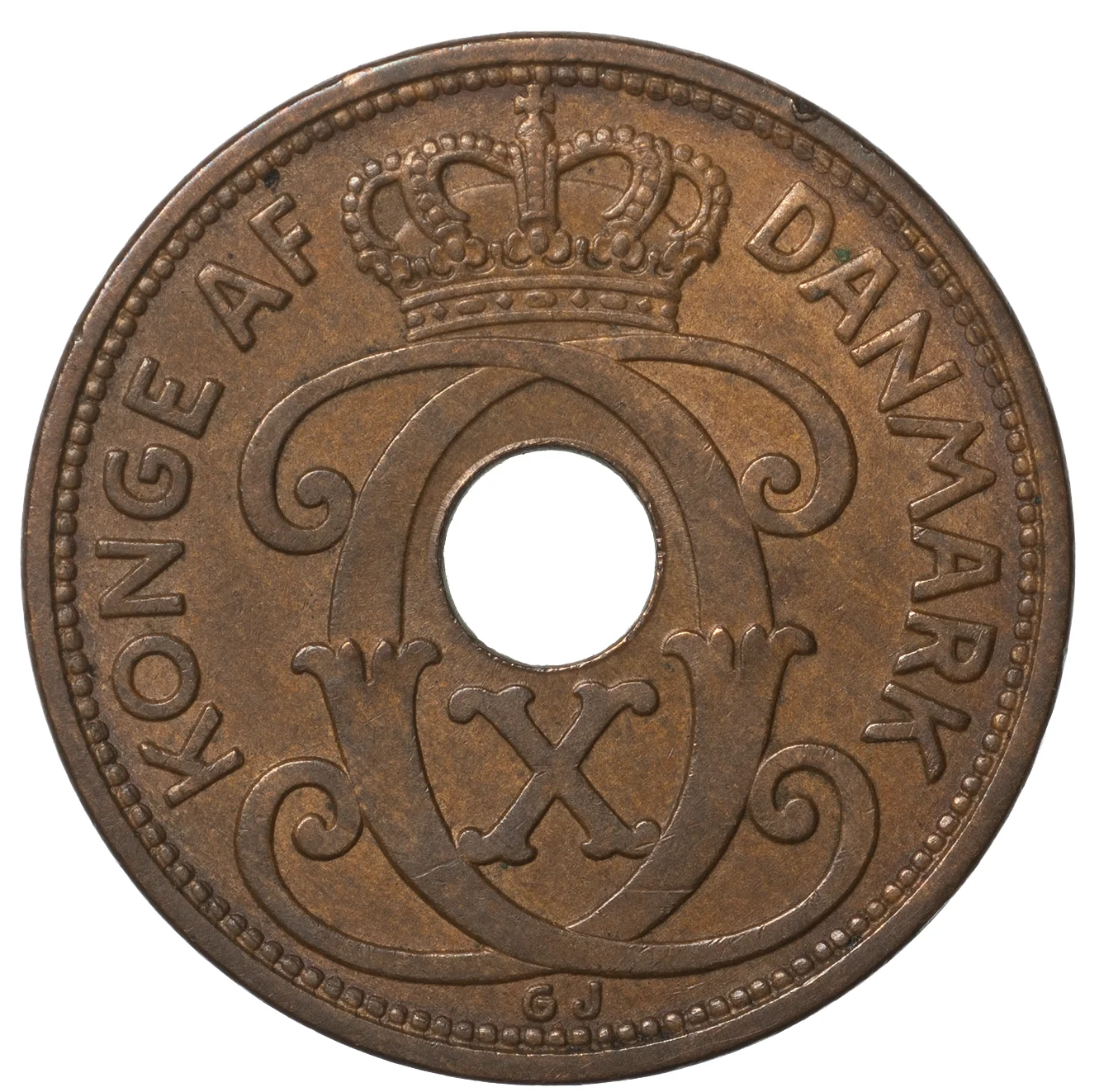
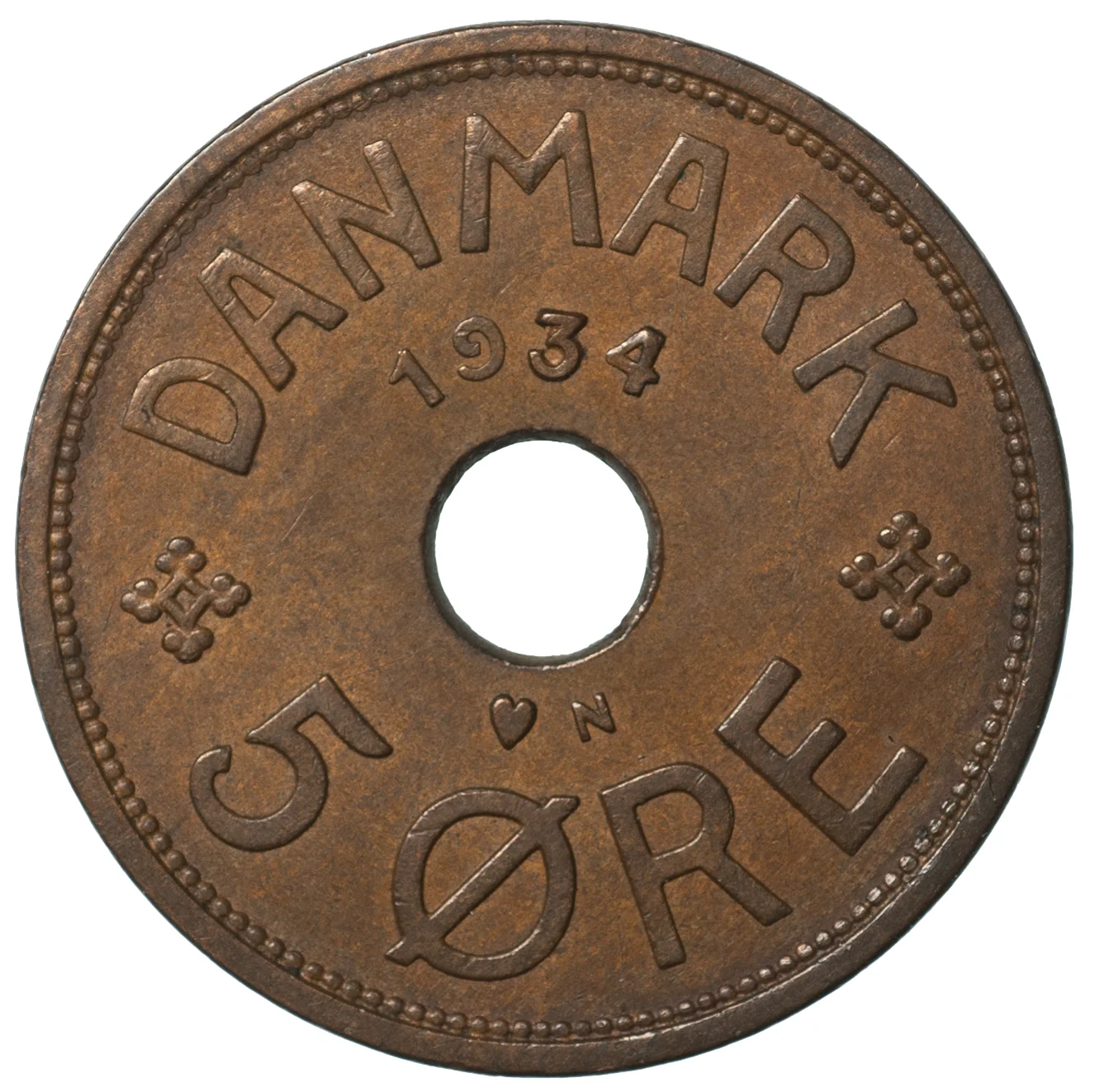
5 øre – Denmark
Add to wishlist
Denmark
Context
Years: 1927–1940
Issuer: Denmark
Ruler: Christian X
Currency:
(since 1873)
Demonetization: 30 June 1989
Total mintage: 24,728,999
Material
References
KM: #
Numista: #4925
Value
Exchange value: 0.05 DKK
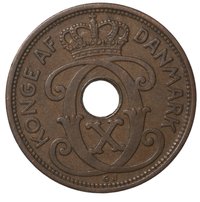
Obverse
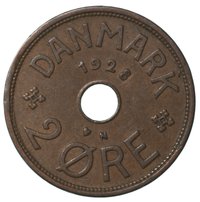
Reverse
Edge
Plain
Mints
| Name | Mark |
|---|---|
| Royal Danish Mint | — |
Mintings
| Year | Mint Mark | Mintage | Quality | Collection |
|---|---|---|---|---|
| 1927 | ♥HCN;GJ | 7,129,000 | ||
| 1927 | ♥N;GJ | — | ||
| 1928 | ♥N;GJ | 4,685,000 | ||
| 1929 | ♥N;GJ | 1,387,000 | ||
| 1930 | ♥N;GJ | 1,339,000 | ||
| 1932 | ♥N;GJ | 1,010,999 | ||
| 1934 | ♥N;GJ | 524,000 | ||
| 1935 | ♥N;GJ | 1,124,000 | ||
| 1936 | ♥N;GJ | 1,091,000 | ||
| 1937 | ♥N;GJ | 1,209,000 | ||
| 1938 | ♥N;GJ | 1,093,000 | ||
| 1939 | ♥N;GJ | 1,402,000 | ||
| 1940 | ♥N;GJ | 2,735,000 |
Historical background
In 1927, Denmark's currency situation was defined by its recent and successful return to the gold standard. Following the economic turmoil of World War I and the postwar period, which saw the suspension of gold convertibility and significant inflation, Denmark formally rejoined the gold standard in January 1927. This move was not made in isolation but was part of a broader European trend, heavily influenced by Britain's return to gold in 1925. The Danish krone was pegged at its pre-war parity of 1 krone = 0.403226 grams of fine gold, a rate that linked it directly to sterling and other gold-backed currencies, aiming to restore international confidence, stabilize prices, and facilitate trade.
The decision to return at the pre-war parity was politically and economically significant, as it required a period of tight monetary policy and deflation in the preceding years to bring the krone's value back up to that level. By 1927, this deflationary pressure had largely achieved its goal, and the currency was considered stable. The Danish National Bank held sufficient gold reserves to back the krone, and the system operated smoothly, with notes being freely convertible into gold for international settlements. This stability was seen as a cornerstone for the country's economic modernization and growing agricultural exports.
However, this stability existed within a fragile international framework. While the Danish economy benefited from predictable exchange rates, the gold standard also imposed strict limitations, removing exchange rate flexibility as a tool for adjusting to economic shocks. The Danish krone's fate was now inextricably tied to the stability of the broader international gold standard system. Unbeknownst to policymakers in 1927, the system carried inherent vulnerabilities that would be catastrophically exposed just a few years later with the onset of the Great Depression, ultimately forcing Denmark, like most of the world, to abandon gold convertibility in 1931.
The decision to return at the pre-war parity was politically and economically significant, as it required a period of tight monetary policy and deflation in the preceding years to bring the krone's value back up to that level. By 1927, this deflationary pressure had largely achieved its goal, and the currency was considered stable. The Danish National Bank held sufficient gold reserves to back the krone, and the system operated smoothly, with notes being freely convertible into gold for international settlements. This stability was seen as a cornerstone for the country's economic modernization and growing agricultural exports.
However, this stability existed within a fragile international framework. While the Danish economy benefited from predictable exchange rates, the gold standard also imposed strict limitations, removing exchange rate flexibility as a tool for adjusting to economic shocks. The Danish krone's fate was now inextricably tied to the stability of the broader international gold standard system. Unbeknownst to policymakers in 1927, the system carried inherent vulnerabilities that would be catastrophically exposed just a few years later with the onset of the Great Depression, ultimately forcing Denmark, like most of the world, to abandon gold convertibility in 1931.
🌱 Very Common