

50 öre – Sweden
Add to wishlist
Sweden
Context
Years: 1992–2009
Issuer: Sweden
Ruler: Carl XVI Gustaf
Currency:
(since 1873)
Demonetization: 30 September 2010
Total mintage: 213,718,359
Material
References
KM: #
Numista: #1507
Value
Exchange value: 0.50 SEK
Inflation-adjusted value: 0.93 SEK
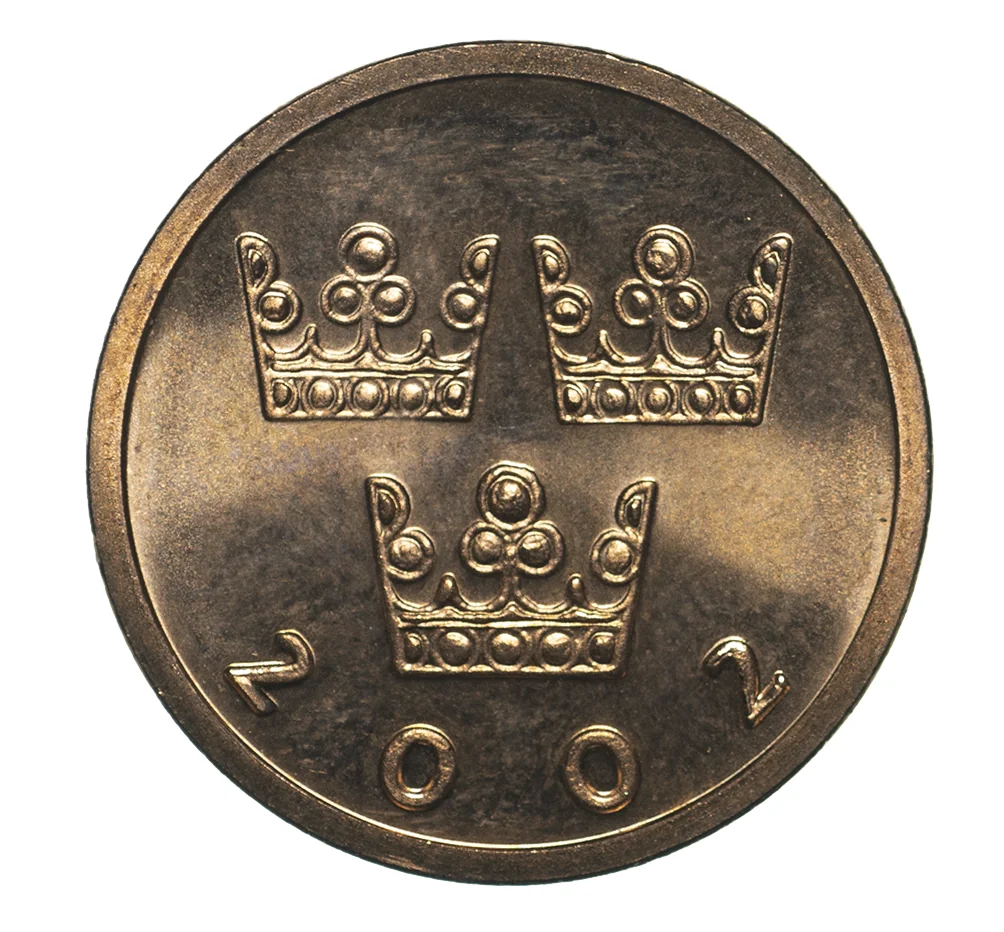
Obverse
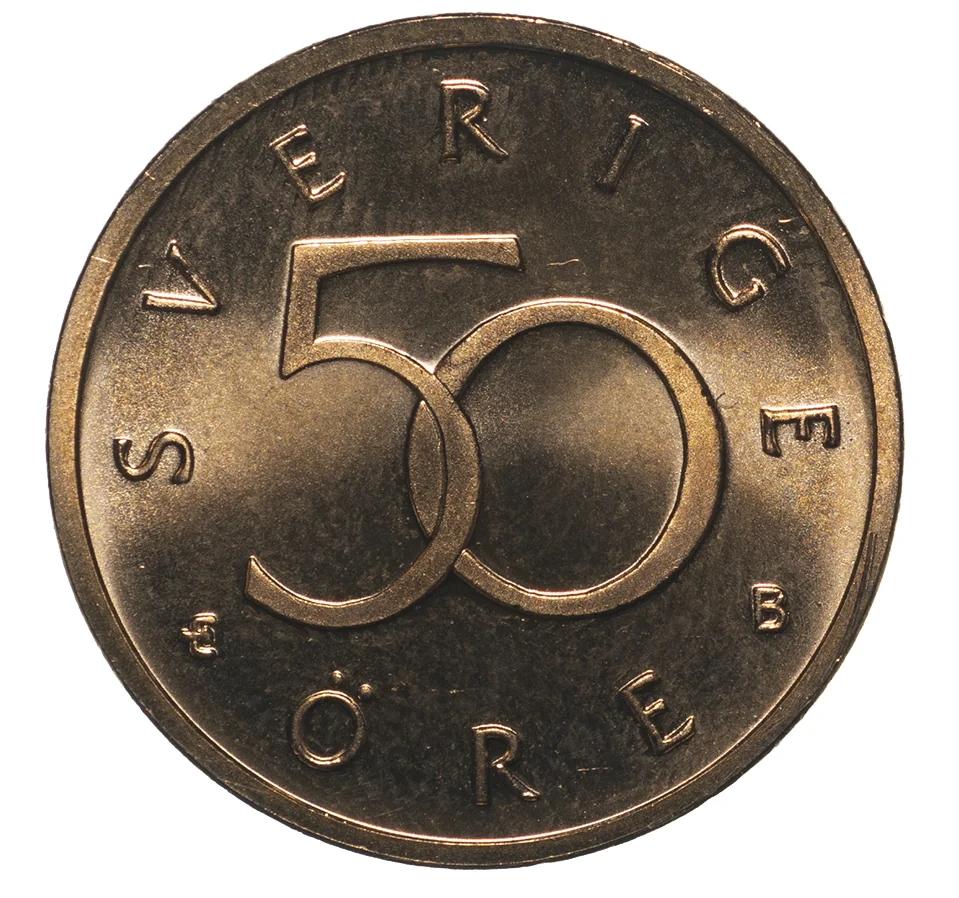
Reverse
Edge
Plain
Categories
| Symbols> Coat of Arms |
Mints
| Name | Mark |
|---|---|
| Myntverket | — |
| Mint of Finland | S |
Mintings
| Year | Mint Mark | Mintage | Quality | Collection |
|---|---|---|---|---|
| 1992 | — | 39,530,810 | ||
| 1993 | — | — | ||
| 1994 | — | 453,384 | ||
| 1995 | — | 415,352 | ||
| 1996 | — | 194,310 | ||
| 1997 | — | 20,471 | ||
| 1998 | — | 5,017,969 | ||
| 1999 | — | 22,030,269 | ||
| 2000 | — | 33,002,831 | ||
| 2001 | — | 30,077,413 | ||
| 2002 | — | 31,976,358 | ||
| 2003 | — | — | ||
| 2004 | — | 25,925,239 | ||
| 2004 | — | 1,200 | Proof | |
| 2005 | — | 24,998,203 | ||
| 2005 | — | 550 | Proof | |
| 2006 | — | 20,000 | ||
| 2007 | — | 20,000 | ||
| 2008 | S | 20,000 | ||
| 2009 | S | 14,000 |
Historical background
In the early 1990s, Sweden found itself in a severe economic crisis, marked by a banking collapse, soaring unemployment, and a deep recession. To combat high inflation and stabilize the economy, the Swedish central bank, the Riksbank, had pegged the Swedish krona to the European Currency Unit (ECU) in 1991. This fixed exchange rate regime was intended to import credibility and low inflation from the European economic sphere, but it came at a high cost: to defend the peg, the Riksbank was forced to raise its key interest rate to extraordinary levels, with the marginal rate briefly hitting 500% in September 1992.
The pressure on the krona intensified during the European Exchange Rate Mechanism (ERM) crisis of 1992, as international currency speculators, most famously George Soros, targeted perceived weak currencies. Despite Sweden's strong fiscal position and lack of foreign debt, the krona was attacked due to the high cost of maintaining the peg during a recession and the market's belief that the central bank would ultimately be forced to devalue. The Riksbank spent vast foreign currency reserves and borrowed extensively to buy kronor, but the speculative pressure proved overwhelming.
On November 19, 1992, after exhausting its defensive measures and facing unsustainable interest rates, the Swedish government and Riksbank made the decisive choice to abandon the fixed exchange rate. They allowed the krona to float freely. The immediate result was a significant devaluation, which ultimately proved beneficial for the Swedish economy. The floating krona freed monetary policy, allowing for lower interest rates, and the cheaper currency boosted exports, helping to pull Sweden out of its recession and setting the stage for a strong recovery in the following years.
The pressure on the krona intensified during the European Exchange Rate Mechanism (ERM) crisis of 1992, as international currency speculators, most famously George Soros, targeted perceived weak currencies. Despite Sweden's strong fiscal position and lack of foreign debt, the krona was attacked due to the high cost of maintaining the peg during a recession and the market's belief that the central bank would ultimately be forced to devalue. The Riksbank spent vast foreign currency reserves and borrowed extensively to buy kronor, but the speculative pressure proved overwhelming.
On November 19, 1992, after exhausting its defensive measures and facing unsustainable interest rates, the Swedish government and Riksbank made the decisive choice to abandon the fixed exchange rate. They allowed the krona to float freely. The immediate result was a significant devaluation, which ultimately proved beneficial for the Swedish economy. The floating krona freed monetary policy, allowing for lower interest rates, and the cheaper currency boosted exports, helping to pull Sweden out of its recession and setting the stage for a strong recovery in the following years.
🌱 Very Common