

10 kronor – Sweden
Add to wishlist
Sweden
Context
Years: 1991–2000
Issuer: Sweden
Ruler: Carl XVI Gustaf
Currency:
(since 1873)
Total mintage: 72,750,045
Material
References
KM: #
Numista: #2750
Value
Exchange value: 10 SEK
Inflation-adjusted value: 20.27 SEK
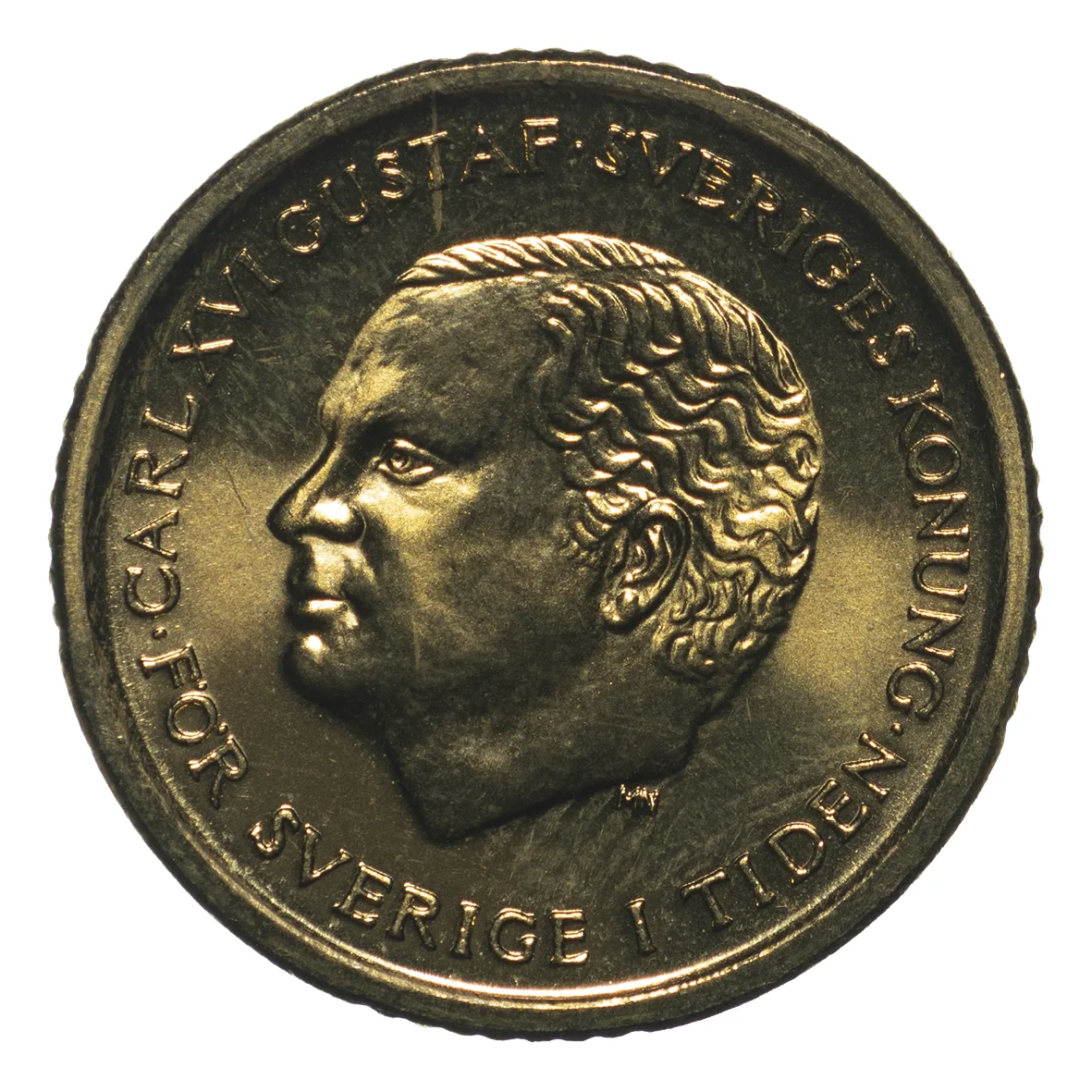
Obverse
Description:
Carl XVI Gustaf facing left, encircled by text. Engraver's initials below.
Inscription:
CARL XVI GUSTAF·SVERIGES KONUNG
MN
·FÖR SVERIGE I TIDEN·
MN
·FÖR SVERIGE I TIDEN·
Translation:
CARL XVI GUSTAF·SWEDEN'S KING
MN
·FOR SWEDEN IN TIME·
MN
·FOR SWEDEN IN TIME·
Script: Latin
Language: Swedish
Engraver: Marita Norin
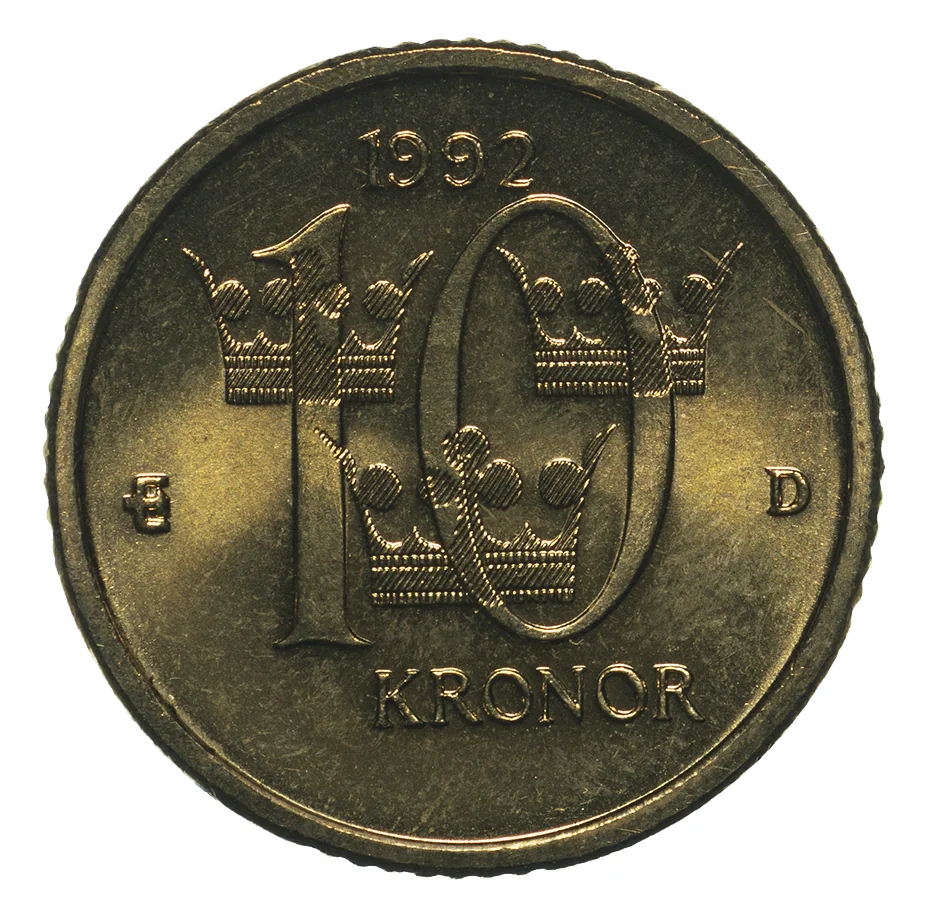
Reverse
Description:
Date above Swedish crowns over value, flanked by mint mark and Riksbank Governor's initial.
Inscription:
2000
E 10 B
KRONOR
E 10 B
KRONOR
Script: Latin
Engraver: Lars Englund
Edge
Alternating smooth and reeded: 4 reeded segments of 8 grooves each.
Mints
| Name | Mark |
|---|---|
| Myntverket | — |
Mintings
| Year | Mint Mark | Mintage | Quality | Collection |
|---|---|---|---|---|
| 1991 | — | — | ||
| 1992 | — | 42,440,009 | ||
| 1993 | — | 20,039,670 | ||
| 1994 | — | 509,052 | ||
| 1995 | — | 452,499 | ||
| 1996 | — | 241,743 | ||
| 1997 | — | 282,926 | ||
| 1998 | — | 285,013 | ||
| 1999 | — | 35,571 | ||
| 2000 | — | 8,463,562 |
Historical background
In the early 1990s, Sweden faced a severe economic crisis, and its currency, the krona, was at the center of the storm. The background to the 1991 situation was a combination of financial deregulation in the 1980s, which led to a massive credit boom and a bubble in real estate and asset prices. This was followed by a sharp international downturn, soaring interest rates, and collapsing asset values, which pushed the banking system toward insolvency and plunged the economy into a deep recession. Against this backdrop, the fixed exchange rate policy of the Swedish krona became a critical point of vulnerability.
Since 1982, Sweden had maintained a fixed exchange rate regime, pegging the krona to a trade-weighted basket of currencies (later to the ECU). This policy, known as the "devaluation cycle," was intended to provide stability and anchor inflation expectations after previous devaluations. However, by 1991, the peg was under immense speculative pressure. To defend the krona's fixed value, the Riksbank was forced to raise interest rates to extraordinarily high levels, with the marginal rate briefly reaching 500% in 1992. These drastic measures aimed to attract capital and deter speculators but also severely worsened the domestic recession by crippling business and consumer borrowing.
Thus, in 1991, the currency situation was one of acute tension and contradiction. The government and central bank were politically committed to the fixed exchange rate as a symbol of stability, yet the economic cost of defending it was becoming unsustainable. The high-interest-rate defense strained public finances and deepened the banking crisis, setting the stage for the dramatic events of 1992 when the peg was ultimately abandoned after a massive speculative attack, allowing the krona to float.
Since 1982, Sweden had maintained a fixed exchange rate regime, pegging the krona to a trade-weighted basket of currencies (later to the ECU). This policy, known as the "devaluation cycle," was intended to provide stability and anchor inflation expectations after previous devaluations. However, by 1991, the peg was under immense speculative pressure. To defend the krona's fixed value, the Riksbank was forced to raise interest rates to extraordinarily high levels, with the marginal rate briefly reaching 500% in 1992. These drastic measures aimed to attract capital and deter speculators but also severely worsened the domestic recession by crippling business and consumer borrowing.
Thus, in 1991, the currency situation was one of acute tension and contradiction. The government and central bank were politically committed to the fixed exchange rate as a symbol of stability, yet the economic cost of defending it was becoming unsustainable. The high-interest-rate defense strained public finances and deepened the banking crisis, setting the stage for the dramatic events of 1992 when the peg was ultimately abandoned after a massive speculative attack, allowing the krona to float.
🌱 Very Common