

1 metical – Mozambique
Add to wishlist
Mozambique
Context
Material
References
KM: #
Numista: #10321
Value
Exchange value: 1 MZM
Obverse
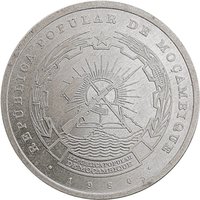
Description:
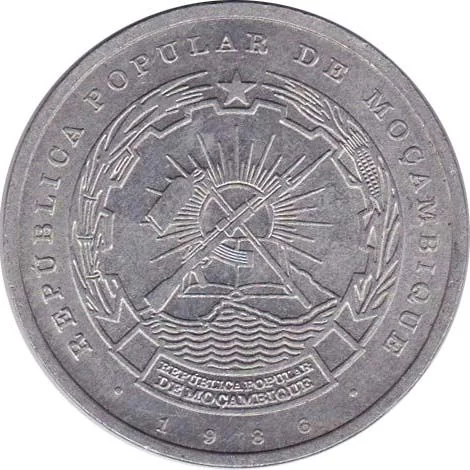
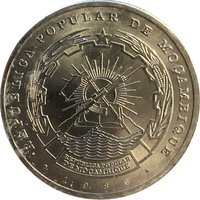
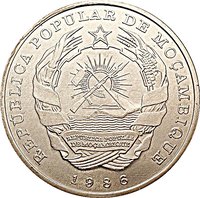
Coat of arms with encircling legend and date below.
Inscription:
REPUBLICA POPULAR DE MOCAMBIQUE
REPUBLICA POPULAR
DE MOCAMBIQUE
1986
REPUBLICA POPULAR
DE MOCAMBIQUE
1986
Translation:
PEOPLE'S REPUBLIC OF MOZAMBIQUE
PEOPLE'S REPUBLIC
OF MOZAMBIQUE
1986
PEOPLE'S REPUBLIC
OF MOZAMBIQUE
1986
Script: Latin
Language: Portuguese
Reverse
Edge
Plain
Mintings
| Year | Mint Mark | Mintage | Quality | Collection |
|---|---|---|---|---|
| 1986 | — | — |
Historical background
In 1986, Mozambique was in the midst of a profound economic and humanitarian crisis, with its currency, the metical (MZM), at the center of the storm. The nation was crippled by a devastating civil war, severe drought, and the legacy of a centrally planned socialist economy. These factors collapsed productive capacity, leading to catastrophic shortages of goods. With little to buy and the government financing itself by printing money, hyperinflation took hold, rendering the currency increasingly worthless and undermining all formal economic activity.
The government's response, under pressure from the International Monetary Fund (IMF) and World Bank, was a sharp structural adjustment program announced in 1987 (the Economic Rehabilitation Program, or PRE). However, the 1986 prelude set the stage: authorities attempted a drastic, one-off devaluation of the metical by approximately 80% against the US dollar in an effort to align the official exchange rate with the rampant black-market rate. This failed to stabilize the situation, as the fundamental problems of war, deficit spending, and lack of confidence remained unaddressed.
Consequently, the currency situation was characterized by a vast and growing disparity between the official and parallel market exchange rates, with most real transactions occurring on the black market. The metical was in a state of effective collapse, serving as a symbol of the country's broader disintegration. This dire monetary environment paved the way for the more comprehensive, albeit painful, liberalization and reform measures that would follow under the PRE, beginning the long and difficult process of stabilizing the Mozambican economy.
The government's response, under pressure from the International Monetary Fund (IMF) and World Bank, was a sharp structural adjustment program announced in 1987 (the Economic Rehabilitation Program, or PRE). However, the 1986 prelude set the stage: authorities attempted a drastic, one-off devaluation of the metical by approximately 80% against the US dollar in an effort to align the official exchange rate with the rampant black-market rate. This failed to stabilize the situation, as the fundamental problems of war, deficit spending, and lack of confidence remained unaddressed.
Consequently, the currency situation was characterized by a vast and growing disparity between the official and parallel market exchange rates, with most real transactions occurring on the black market. The metical was in a state of effective collapse, serving as a symbol of the country's broader disintegration. This dire monetary environment paved the way for the more comprehensive, albeit painful, liberalization and reform measures that would follow under the PRE, beginning the long and difficult process of stabilizing the Mozambican economy.
🌱 Common