


Obverse
Description:
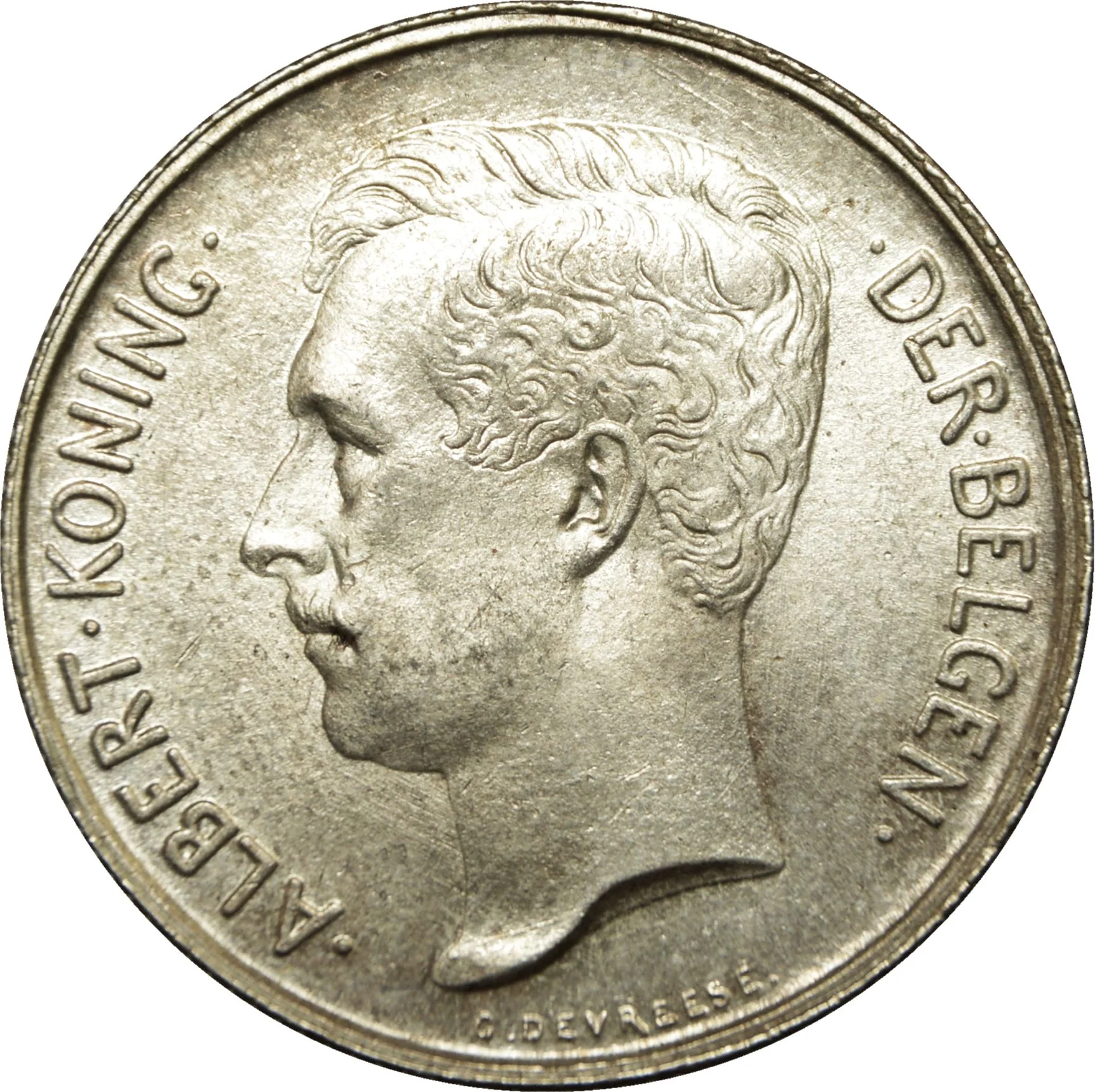
King Albert I in left profile, encircled by Dutch legend. Designer below.
Inscription:
·ALBERT·KONING· ·DER·BELGEN·
G.DEVREESE.
G.DEVREESE.
Translation:
ALBERT KING OF THE BELGIANS
G. DEVREESE
G. DEVREESE
Script: Latin
Language: Dutch
Engraver: Godefroid Devreese
Reverse
Description:
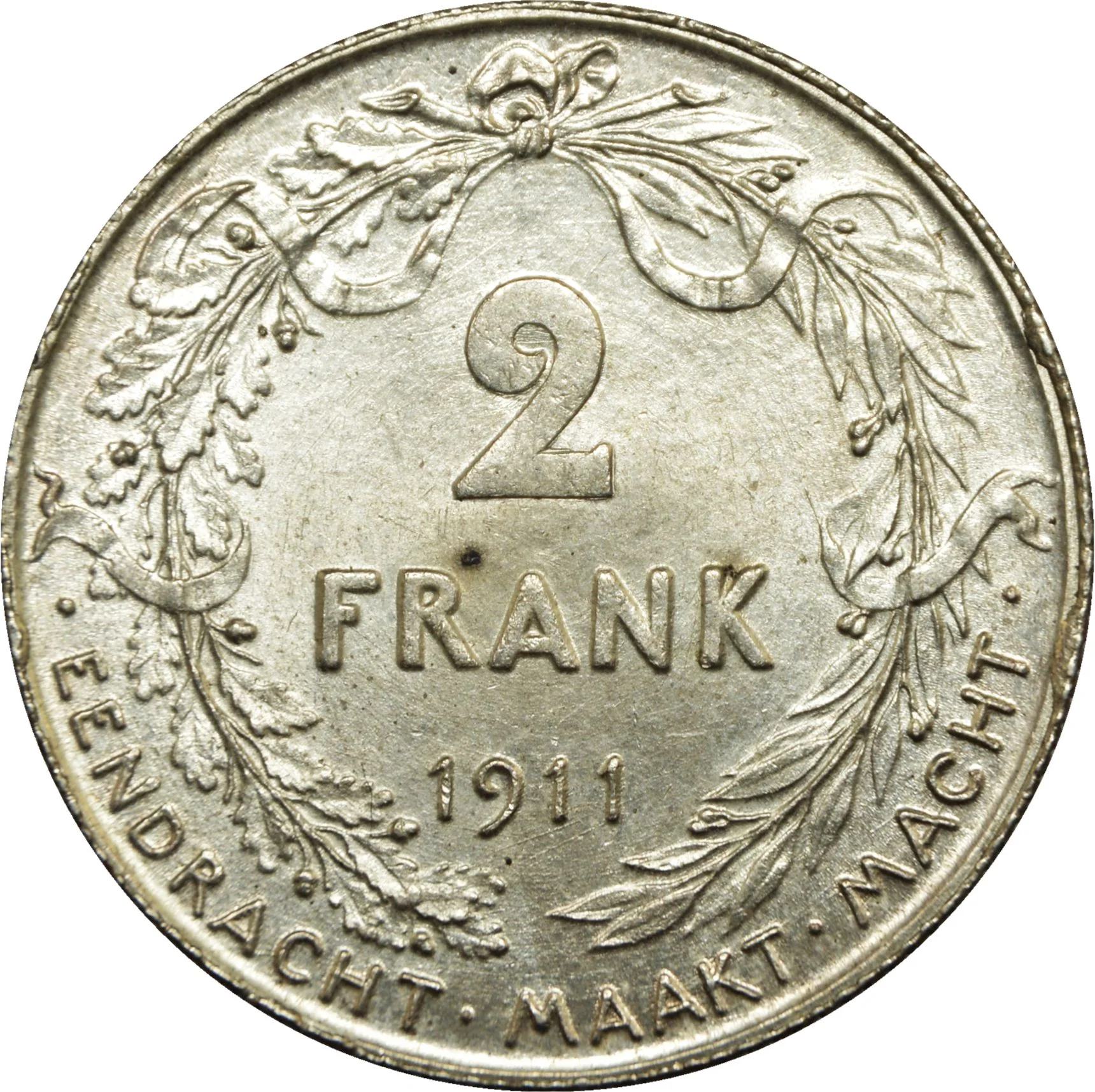
The face value and date are encircled by olive and oak branches with the Dutch motto.
Inscription:
2
FRANK
1911
·EENDRACHT·MAAKT·MACHT·
FRANK
1911
·EENDRACHT·MAAKT·MACHT·
Translation:
UNITY MAKES STRENGTH
Script: Latin
Language: Dutch
Engraver: Godefroid Devreese
Edge
Reeded
Mints
| Name | Mark |
|---|---|
| Royal Mint of Belgium | — |
Mintings
| Year | Mint Mark | Mintage | Quality | Collection |
|---|---|---|---|---|
| 1911 | — | — | ||
| 1912 | — | 375,000 |
Historical background
In 1911, Belgium's currency was firmly embedded within the Latin Monetary Union (LMU), a continental system it had co-founded in 1865. This agreement standardized the gold and silver content of member nations' coins (the Belgian franc, French franc, Swiss franc, etc.), making them legal tender and effectively interchangeable across borders. Belgium's currency was thus not operating in isolation but as part of a wider European bimetallic bloc, which facilitated trade and stability. Domestically, the Belgian franc was a stable and trusted unit, backed by a gold standard that had been formally adopted in the 1870s, aligning the country with the prevailing global financial orthodoxy.
However, the system was under significant strain by 1911. The LMU was grappling with structural flaws, primarily the overproduction of silver coins by some members, which led to an imbalance and caused gold coins to be hoarded. Belgium itself had experienced a major banking crisis in 1870 linked to silver speculation, leaving a legacy of caution. While the franc was stable, the international monetary landscape was becoming increasingly tense, with major powers building large gold reserves. Belgium, as a small, trade-dependent industrial nation, was highly sensitive to these shifts and reliant on the stability of its larger partners, particularly France, within the fragile LMU framework.
Politically and economically, the period was one of quiet anticipation rather than crisis. There were no major currency reforms or devaluations underway in 1911; the focus was on maintaining the status quo that supported Belgium's booming industrial exports. Yet, beneath the surface, the pressures on the bimetallic system and the gathering geopolitical tensions in Europe posed latent threats to the monetary order. Within three years, the outbreak of World War I would force Belgium to suspend gold convertibility, end its adherence to the LMU, and usher in a new era of managed currency, making 1911 the final chapter of a long period of pre-war monetary stability.
However, the system was under significant strain by 1911. The LMU was grappling with structural flaws, primarily the overproduction of silver coins by some members, which led to an imbalance and caused gold coins to be hoarded. Belgium itself had experienced a major banking crisis in 1870 linked to silver speculation, leaving a legacy of caution. While the franc was stable, the international monetary landscape was becoming increasingly tense, with major powers building large gold reserves. Belgium, as a small, trade-dependent industrial nation, was highly sensitive to these shifts and reliant on the stability of its larger partners, particularly France, within the fragile LMU framework.
Politically and economically, the period was one of quiet anticipation rather than crisis. There were no major currency reforms or devaluations underway in 1911; the focus was on maintaining the status quo that supported Belgium's booming industrial exports. Yet, beneath the surface, the pressures on the bimetallic system and the gathering geopolitical tensions in Europe posed latent threats to the monetary order. Within three years, the outbreak of World War I would force Belgium to suspend gold convertibility, end its adherence to the LMU, and usher in a new era of managed currency, making 1911 the final chapter of a long period of pre-war monetary stability.
Series: 1911 Belgium circulation coins
🌱 Common