

1 Kreuzer – Austrian Empire
Austria
Context
Year: 1851
Country: Austria 
Issuer: Austrian Empire
Ruler: Francis Joseph I
Currency:
(1754—1857)
Demonetization: 30 September 1863
Total mintage: 106,458,201
Material
References
KM: #Click to copy to clipboard2185
Numista: #4847
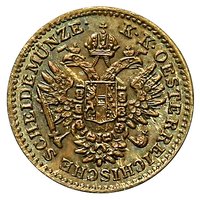
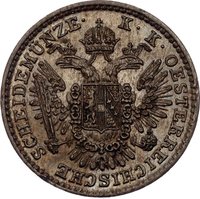
Obverse
Description:
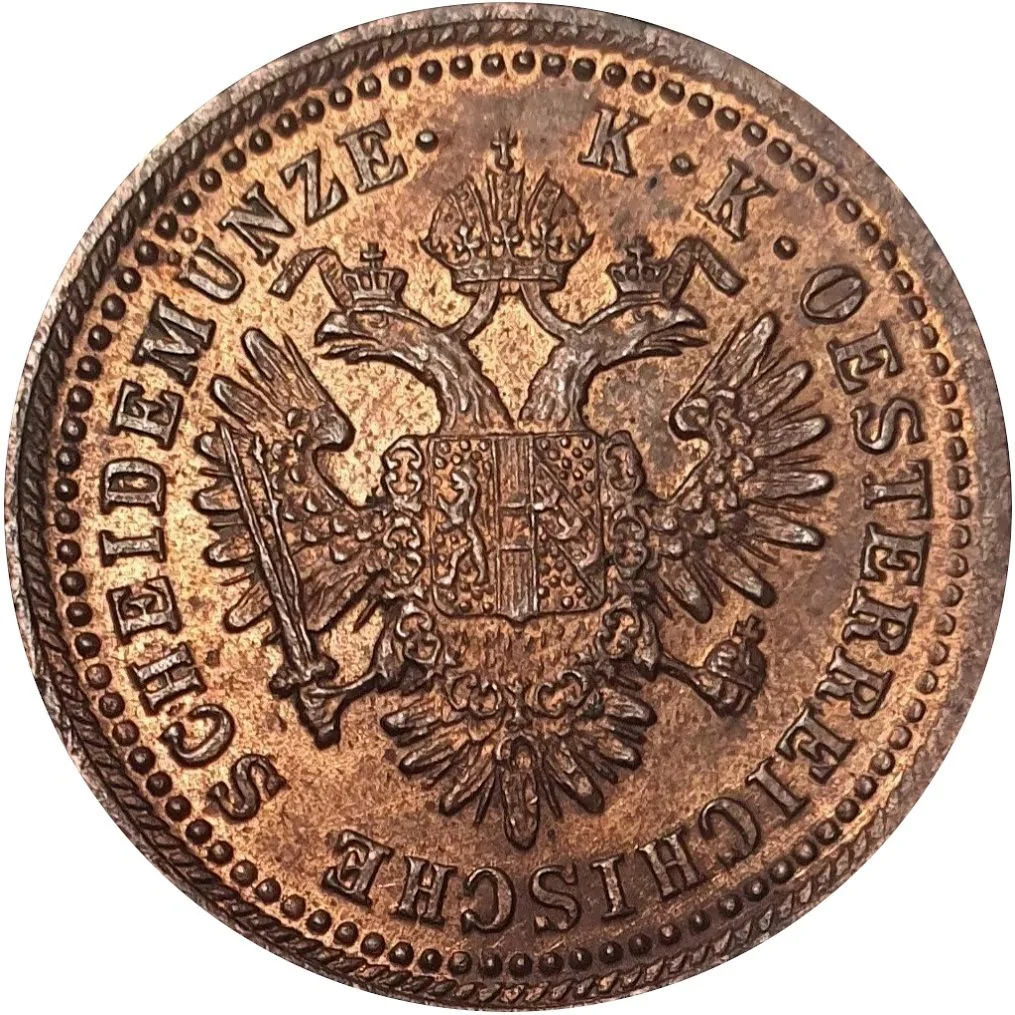
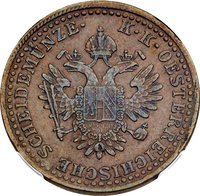
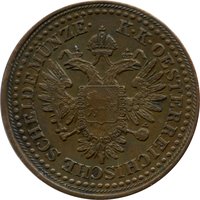
Double-headed eagle within beaded border and outer lettering.
Inscription:
K·K·OESTERREICHISCHE SCHEIDEMÜNZE·
Translation:
K.K. Austrian small change.
Script: Latin
Language: German
Engraver: Johann Gross
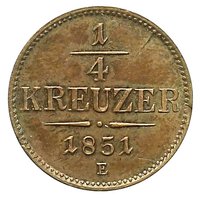
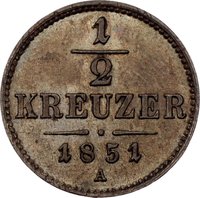
Reverse
Description:
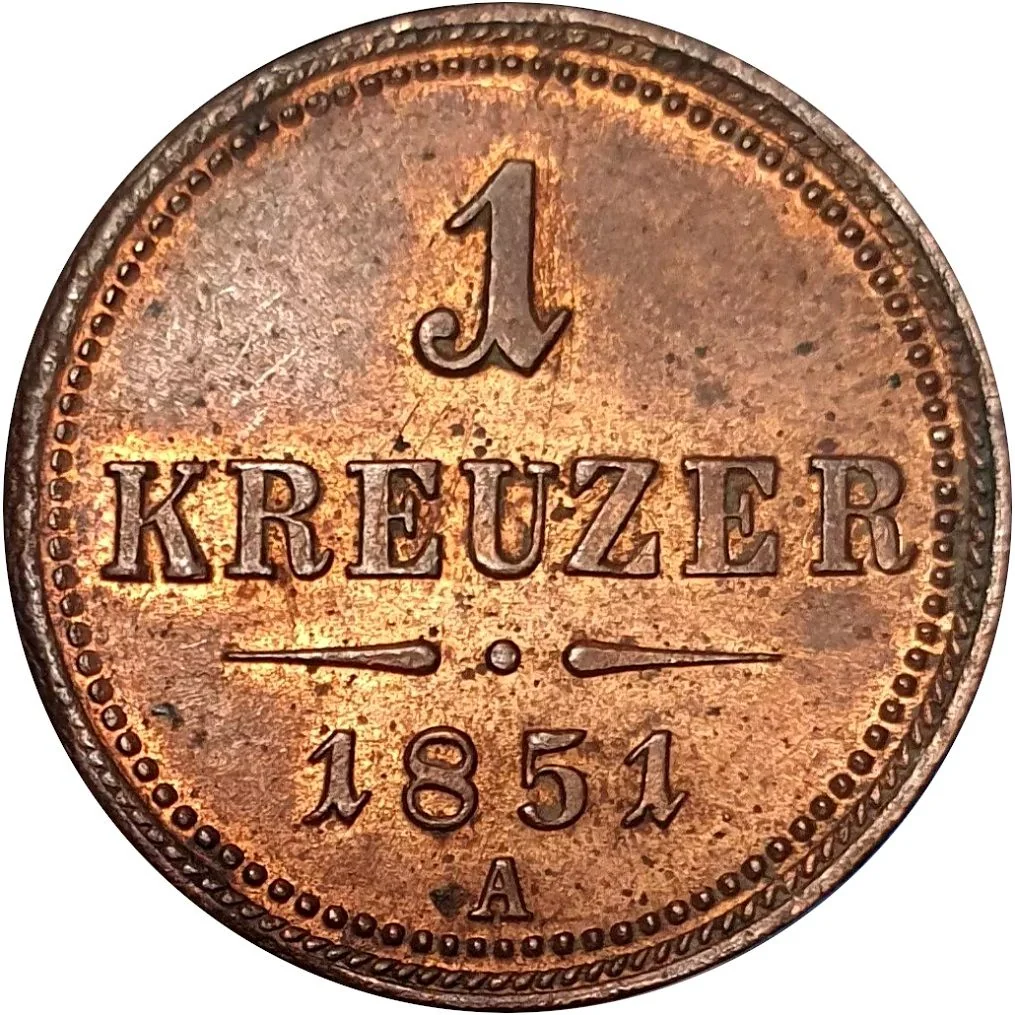
Value above, date and mintmark below.
Inscription:
1
KREUZER
1851
A
KREUZER
1851
A
Script: Latin
Engraver: Johann Gross
Edge
Plain
Mintings
| Year | Mint Mark | Mintage | Quality | Collection |
|---|---|---|---|---|
| 1851 | A | — | ||
| 1851 | B | 106,458,101 | ||
| 1851 | C | 100 | ||
| 1851 | E | — | ||
| 1851 | G | — |
Historical background
In 1851, the Austrian Empire was grappling with the severe aftermath of the 1848-49 revolutions and a legacy of chronic fiscal instability. The state treasury was effectively bankrupt, burdened by massive debt from wartime expenditures and years of deficit financing. The primary circulating currency was the paper Gulden (Conventionsmünze), issued by the Wiener Stadtbank, but these notes were not convertible to silver and had lost significant value, trading at a steep discount to their nominal worth. This created a chaotic system of "agio," where daily exchange rates between paper and metallic coin caused economic uncertainty and hampered trade.
Emperor Franz Joseph's government, under Minister of Finance Karl Ludwig von Bruck, recognized that monetary reform was essential for economic recovery and state credibility. The pivotal Coinage Patent of 1851 was a decisive step toward establishing a new, unified silver standard. It legally defined the Vereinsthaler as a large silver coin and reintroduced the Conventionsthaler (also known as the Konventionsthaler or Speziesthaler), pegging the paper currency to a silver value. The aim was to restore public confidence by promising eventual convertibility, though this promise remained theoretical in the immediate term due to a lack of sufficient silver reserves.
Thus, the currency situation in 1851 was one of transition from discredited paper toward a promised metallic standard. While the legal framework for stability was created, the practical reality was a fragile and strained dual system. The success of the reform hinged on future fiscal discipline and the accumulation of specie, a challenge that would only be partially met with the full introduction of the Austrian Florin (Gulden) on a silver standard in 1858. The period therefore represents a critical, yet still precarious, juncture in the Empire's long struggle for monetary order.
Emperor Franz Joseph's government, under Minister of Finance Karl Ludwig von Bruck, recognized that monetary reform was essential for economic recovery and state credibility. The pivotal Coinage Patent of 1851 was a decisive step toward establishing a new, unified silver standard. It legally defined the Vereinsthaler as a large silver coin and reintroduced the Conventionsthaler (also known as the Konventionsthaler or Speziesthaler), pegging the paper currency to a silver value. The aim was to restore public confidence by promising eventual convertibility, though this promise remained theoretical in the immediate term due to a lack of sufficient silver reserves.
Thus, the currency situation in 1851 was one of transition from discredited paper toward a promised metallic standard. While the legal framework for stability was created, the practical reality was a fragile and strained dual system. The success of the reform hinged on future fiscal discipline and the accumulation of specie, a challenge that would only be partially met with the full introduction of the Austrian Florin (Gulden) on a silver standard in 1858. The period therefore represents a critical, yet still precarious, juncture in the Empire's long struggle for monetary order.
🌱 Very Common