

1 Florin – United Kingdom
United Kingdom
Context
Years: 1851–1887
Issuer: United Kingdom 
Ruler: Victoria
Currency:
(1158—1970)
Demonetization: 30 June 1993
Total mintage: 61,559,265
Material
References
KM: #Click to copy to clipboard746
Numista: #4840
Value
Bullion value: $29.85
Obverse
Description:
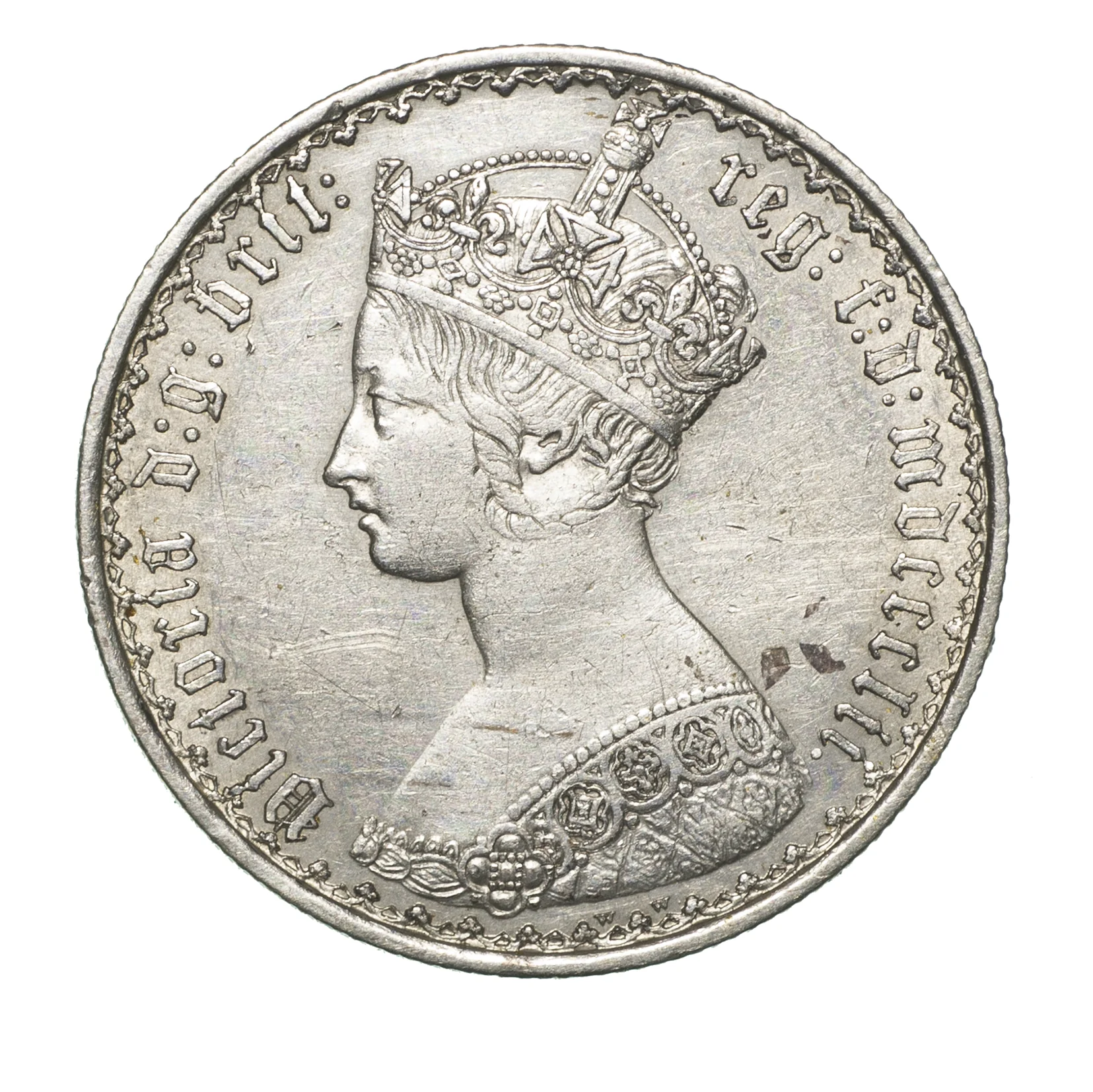
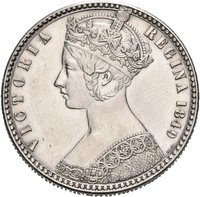
Queen Victoria crowned bust left, legend and date around.
Inscription:
Victoria d:g:britt: reg:f:d:mdccclxxvii
Translation:
Victoria by the Grace of God, Queen of Britain, Defender of the Faith, 1877
Script: Latin (Fraktur blackletter)
Language: Latin
Engraver: William Wyon
Reverse
Description:
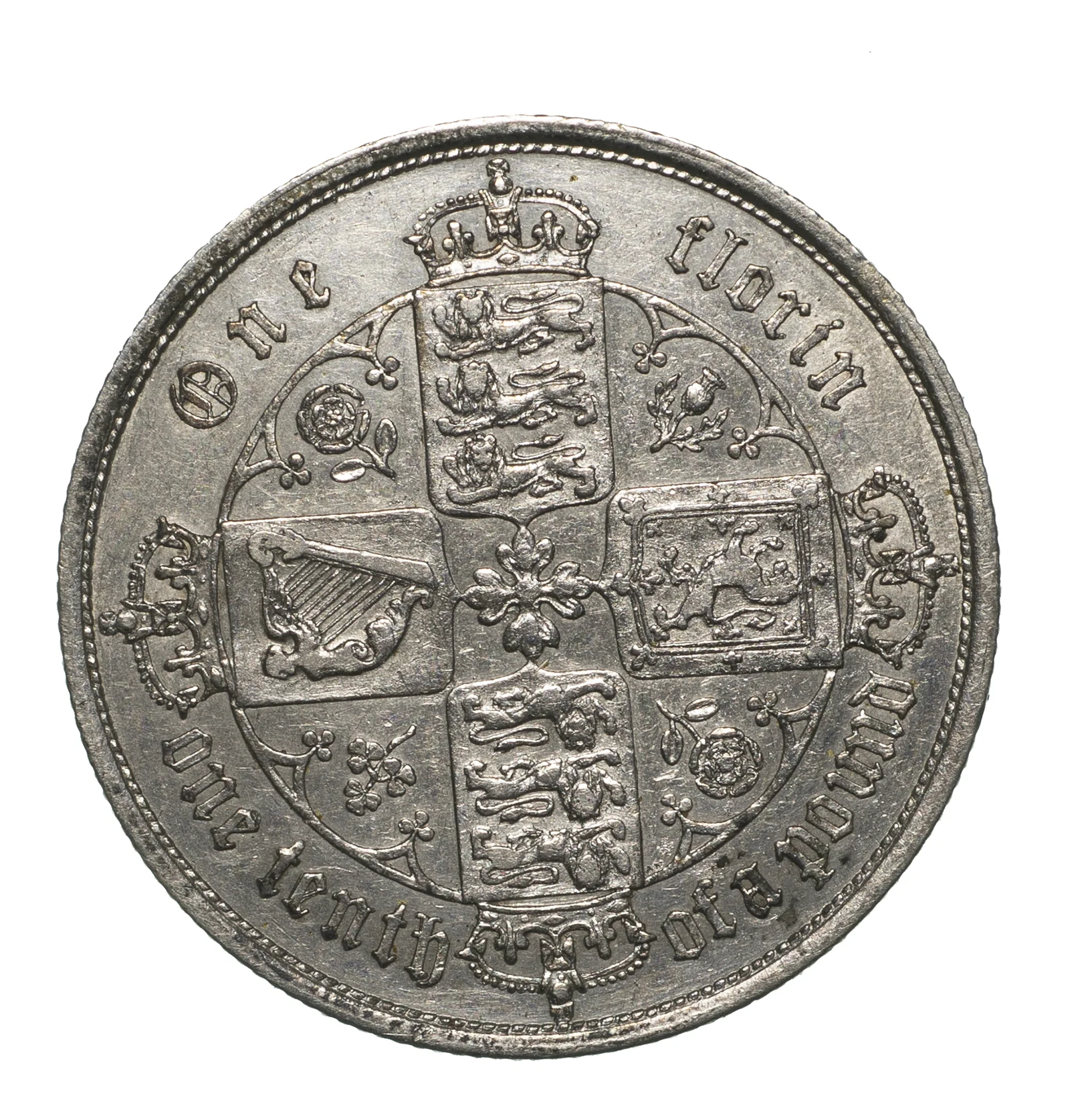
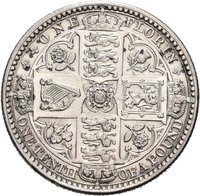
Crowned shields of England, Scotland, and Ireland with national flowers in the corners, surrounded by a legend.
Inscription:
One florin
one tenth of a pound
one tenth of a pound
Script: Latin (Fraktur blackletter)
Engraver: William Dyce
Edge
Reeded
Mints
| Name | Mark |
|---|---|
| Royal Mint (Tower Hill) | — |
Mintings
| Year | Mint Mark | Mintage | Quality | Collection |
|---|---|---|---|---|
| 1851 | — | 1,540 | Proof | |
| 1852 | — | 1,014,500 | ||
| 1852 | — | — | Proof | |
| 1853 | — | — | Proof | |
| 1853 | — | 3,919,900 | ||
| 1854 | — | 550,400 | ||
| 1855 | — | 831,000 | ||
| 1856 | — | 2,201,700 | ||
| 1857 | — | 1,671,100 | ||
| 1857 | — | — | Proof | |
| 1858 | — | 2,239,300 | ||
| 1858 | — | — | Proof | |
| 1859 | — | 2,568,000 | ||
| 1860 | — | 635,500 | ||
| 1861 | — | 839,500 | ||
| 1862 | — | 594,000 | ||
| 1862 | — | — | Proof | |
| 1863 | — | 938,500 | ||
| 1863 | — | — | Proof | |
| 1864 | — | 1,861,000 | ||
| 1864 | — | — | Proof | |
| 1865 | — | 1,580,000 | ||
| 1866 | — | 914,700 | ||
| 1867 | — | 423,700 | ||
| 1867 | — | — | Proof | |
| 1868 | — | 896,900 | ||
| 1869 | — | 297,000 | ||
| 1869 | — | — | Proof | |
| 1870 | — | 1,080,600 | ||
| 1871 | — | 3,425,600 | ||
| 1871 | — | — | Proof | |
| 1872 | — | 7,199,600 | ||
| 1873 | — | 5,921,800 | ||
| 1873 | — | — | Proof | |
| 1874 | — | 1,642,600 | ||
| 1875 | — | 1,117,000 | ||
| 1876 | — | 580,000 | ||
| 1877 | — | 682,200 | ||
| 1878 | — | 1,786,600 | ||
| 1878 | — | — | Proof | |
| 1879 | — | 1,512,200 | ||
| 1879 | — | — | Proof | |
| 1880 | — | 2,167,100 | ||
| 1880 | — | — | Proof | |
| 1881 | — | 2,570,000 | ||
| 1881 | — | — | Proof | |
| 1883 | — | 3,555,000 | ||
| 1884 | — | 1,447,300 | ||
| 1885 | — | 1,758,200 | ||
| 1885 | — | — | Proof | |
| 1886 | — | 591,700 | ||
| 1886 | — | — | Proof | |
| 1887 | — | 543,525 | ||
| 1887 | — | — | Proof |
Historical background
In 1851, the United Kingdom operated under a de facto gold standard, formalised by the 1844 Bank Charter Act. This legislation, championed by Sir Robert Peel, sought to ensure monetary stability by strictly tying the issuance of new Bank of England notes to its gold reserves. The Act split the Bank into two departments: the Issue Department, which could only issue new notes against additional gold (with a small fiduciary issue against government debt), and the Banking Department, which handled commercial operations. This system aimed to prevent the inflationary boom-and-bust cycles of the past by eliminating the over-issuance of paper money, thereby firmly anchoring the value of the pound sterling to gold.
The currency in circulation was a mixture of gold coins, Bank of England notes (predominant in England and Wales), and a plethora of private and joint-stock bank notes in Scotland and Ireland, which were not directly regulated by the 1844 Act but were required to be backed by holdings of Bank of England notes. The sovereign, a gold coin containing 123.274 grains of standard gold, was the principal unit, and confidence in its value was high. The system facilitated Britain's dominant role in global trade and finance, as the fixed gold value of the pound provided a predictable medium for international settlement, crucial for the world's foremost industrial and imperial power.
However, the rigidity of the 1844 framework was already a subject of debate. Critics argued that by limiting the money supply strictly to gold reserves, the system was vulnerable to financial panics, as it could not easily expand liquidity in a crisis. The decade following 1844 saw several financial strains, and the year 1851 itself, while one of confidence showcased by the Great Exhibition, sat between the crises of 1847 and what would come in 1857. These events would test the Act's provisions and lead to the repeated suspension of its rules by the government to allow emergency lending, revealing a fundamental tension between the ideal of automatic monetary control and the practical need for discretionary central banking in times of distress.
The currency in circulation was a mixture of gold coins, Bank of England notes (predominant in England and Wales), and a plethora of private and joint-stock bank notes in Scotland and Ireland, which were not directly regulated by the 1844 Act but were required to be backed by holdings of Bank of England notes. The sovereign, a gold coin containing 123.274 grains of standard gold, was the principal unit, and confidence in its value was high. The system facilitated Britain's dominant role in global trade and finance, as the fixed gold value of the pound provided a predictable medium for international settlement, crucial for the world's foremost industrial and imperial power.
However, the rigidity of the 1844 framework was already a subject of debate. Critics argued that by limiting the money supply strictly to gold reserves, the system was vulnerable to financial panics, as it could not easily expand liquidity in a crisis. The decade following 1844 saw several financial strains, and the year 1851 itself, while one of confidence showcased by the Great Exhibition, sat between the crises of 1847 and what would come in 1857. These events would test the Act's provisions and lead to the repeated suspension of its rules by the government to allow emergency lending, revealing a fundamental tension between the ideal of automatic monetary control and the practical need for discretionary central banking in times of distress.
🌱 Very Common